O’Neil Play Goes Back Down Memory Lane

When reading the manuscript of a play, the reader can discover a world that does not necessarily appear on stage.  Dialogue and most importantly stage directions reveal more about the playwright’s true purpose for writing the play other than applause and a stint on Broadway.  Similar to a poem cleverly hidden within a poem, stage directions add texture and inject supplementary life to the work.

No playwright was as detailed with their stage direction as Eugene O’Neil.  The legendary dramatist made his first mark on Broadway with Beyond the Horizon, but before O’Neil became a Nobel and Pulitzer Prize winning playwright, he was an experimental writer in the downtown theatre district. 

Christopher Loar describes O’Neil as “a failed poet who became a Nobel Prize winning playwright.”  Loar is an ensemble member for New York Neo-Futurists  Known for Too Much Light Makes the Baby Go Blind, a production billed as “an ever-changing attempt to perform 30 Plays in 60 Minutes,” New York Neo-Futurists interject vivacious physicality into live theatre – they are not a theatre group, they are a revolution.  As the director of The Complete and Condensed Stage Directions of Eugene O’Neil: Vol. 1, Early/Lost Plays, Christopher Loar accepted the mission of adapting O’Neil’s punctilious stage directions into a production that could stand on its own, separate from the dialogue, scenery and transformation of the actors into the characters.  The result is an uproarious free-for-all.

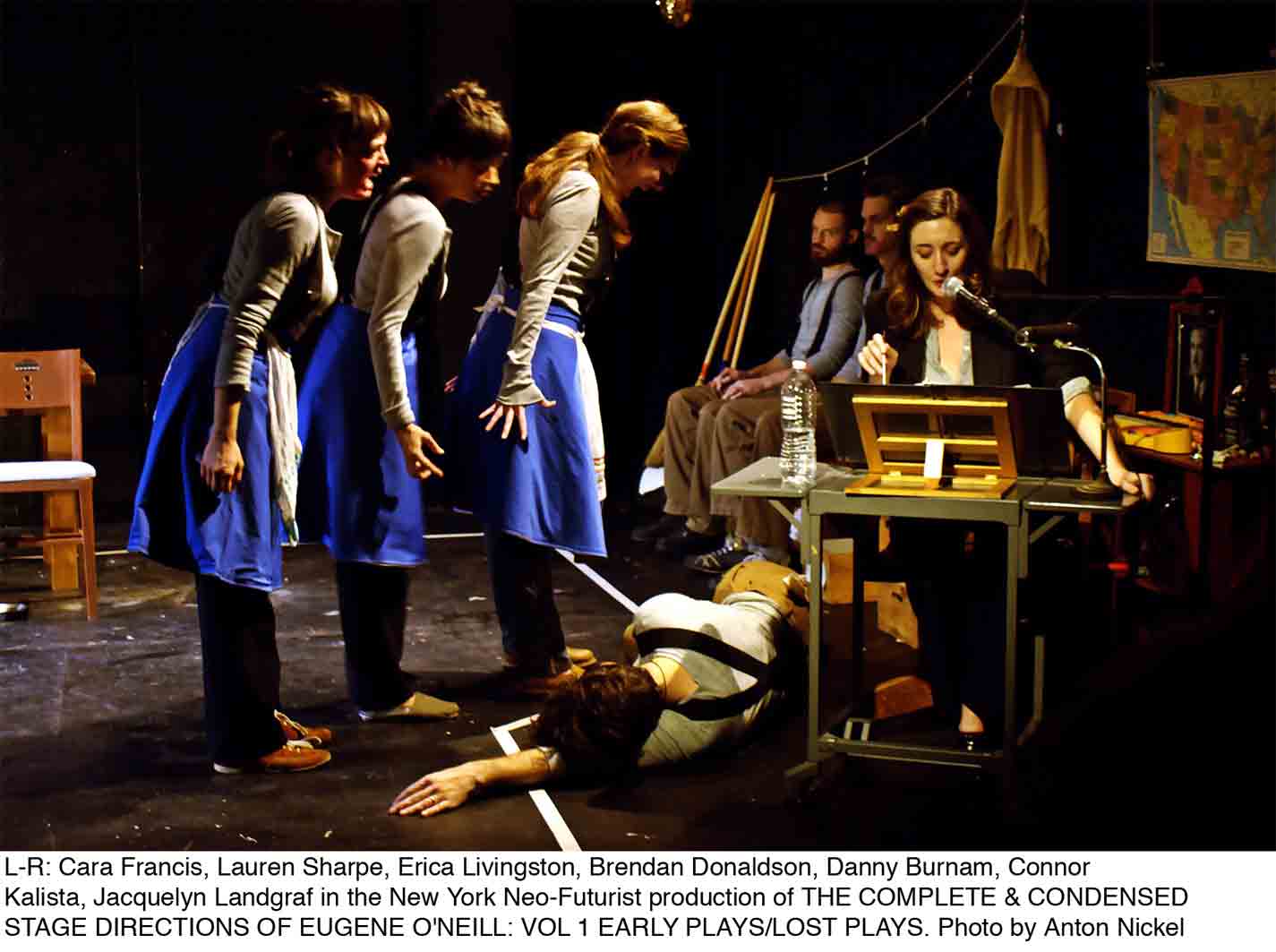
Loar and the ensemble of New Neo-York Futurists deconstruct the instructions of an obsessive control freak and create comedic art.  Following the model of Too Much Light, the troupe stages a physical reenactment of seven of O’Neil’s lesser known works.   As a narrator, played by Jacquelyn Landgraf describes the action, the ensembles mimic O’Neil’s stage directions with gestures that are over-dramatized and abundant with laughs.  There is no way anyone can watch this production and not walk away without having one moment in which they are doubled over in their seats from laughter.  Each of these plays deals with intense emotion and somber subject matter, however after New York Neo-Futurists get done with it, it became a vaudeville skit for the new millennium.  A red pail doubles for a fire in the Arizona desert; actors with shark fins on their heads imitate circling predators, an ensemble member places a puppet dinosaur over her hand and pretends to coo and cry like a baby, actors smear rouge on their face to display changes in emotion, a pig nose masquerades for an oddly shaped feature– all of it absurd and every bit of it comedic gold.

Overall, The Complete and Condensed Stage Directions of Eugene O’Neil is a 60-minute bacchanalia.  It is a brilliant, unique theatre going experience that elevates O’Neil’s work into a new realm all while bringing  America’s greatest playwright back to his beginnings.  If Benny Hill and Monty Python adopted a group of kids, New York Neo-Futurists would be their rainbow tribe.  Hats off to this kooky troupe for developing a new take on a theatre legend.

Photos:  Anton Nickel

A Testimony for RENT

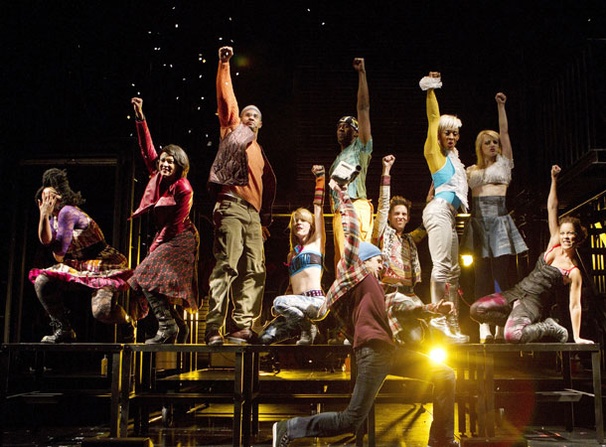
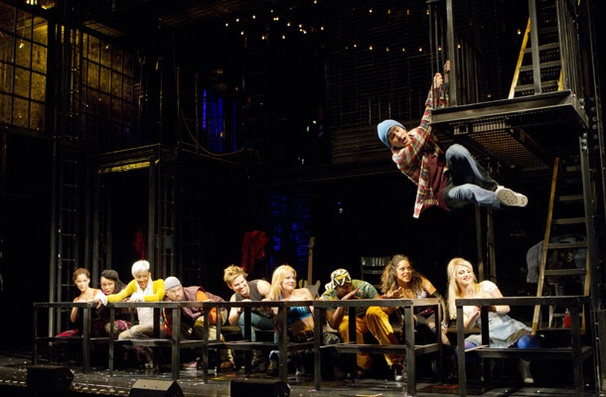
Every Sunday those who are filled with the spirit, regardless of their denomination, attend church.  In the Baptist faith, there is a part of the service called devotion.  During this time, parishioners and visitors stand before the congregation and give their testimony, which generally consists of a narration that details the trials and tribulations that they have gone through and how they have overcome them (usually with  the assistance of god).  I spent season after season of my childhood in church listening to people’s testimonial; none of them were as dynamic as the affirmation I received after watching RENT.

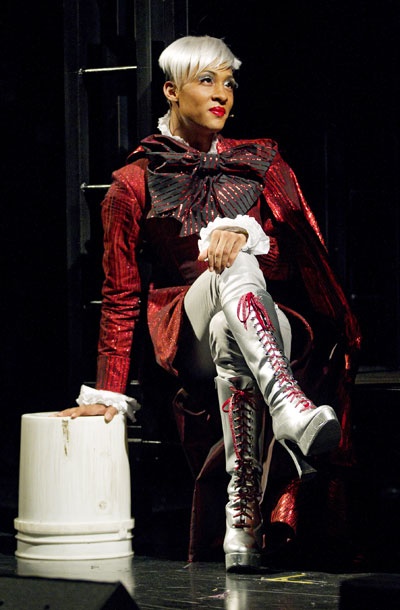
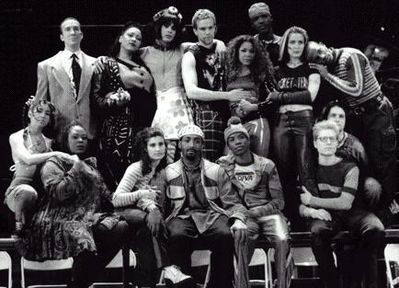
There is no doubt in my mind that Jonathan Larson’s most seminal piece of work was and still is the ultimate testimony of a life lived.  The story behind RENT is beyond legendary.  The fact that Larson died at 35 of an aortic aneurysm the night before its off-Broadway premiere in 1996 is a detail that epitomized the phrase “life imitating art.”  Like the character Angel, who looked after his friends after his death, it seemed as if his spirit departed this earthly plane so that he could be a guide, lifting this production on his shoulders, as he did in life, and ensuring that his labor of love lived on.  A labor, and a testimony in itself, Larson wrote RENT as a tribute to the friends he lost from AIDS.  And how his tribute has grown, becoming an entity of its own, when the rock opera completed its final Broadway performance on September 7, 2008, it had become the ninth longest-running Broadway.  Subsequently, it developed legions of zealous RENTheads, created several incarnations with American and European tours.  It even spawned a school edition (which toned down the language and other elements of the show) and a 2005 movie which featured the majority of the original Broadway cast. 

Now RENT has returned back to its Off-Broadway roots – full circle for a production that had been touted as the musical that spoke to Generation X the way Hair spoke to those who grew up in the 60s.  I have always believed there is a time and season for everything.   When RENT made its Broadway debut on April 29, 1996 at Nederlander Theatre, I had no desire to see it, despite the ravings of my colleagues.   I never listened to the soundtrack, nor had I watched one scene from its film adaptation.  Perhaps it was because I was too much of a rebel back in the 90s to believe anyone had my generation pegged.  Perhaps it was because I lost one brother to AIDS in 1988 and another in 1997 and had no desire to return to feelings of despair, hysteria, anger and grief of the AIDS epidemic of the late 80s and early 90s.  Perhaps it just was not my time to see it.  Suffice to say when I took my seat at New World Stages, I was a true RENT-virgin and what a cherry popping!  I sat behind a row of RENTheads who were already singing the songs before the performance started.  But once it did, they were right on queue, from the first “Voicemail” to the last.  Putting the production within the context of when it originally premiered, I understood how RENT was ahead of its time and definitely ushered in a new age of American musicals, laying out a blueprint that productions like American Idiot and Fela used.  What I was not prepared for was the flooding of tears that erupted from my eyes as I stood to give the cast the standing ovation it most definitely deserved.
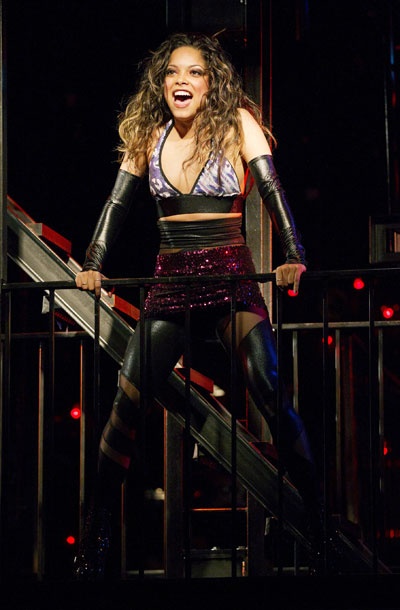
There is no doubt that RENT is a masterpiece in any incarnation.  After I pulled myself together, I went home and immediately scoured the internet to view the movie and whatever videos I could find of the original cast.  Despite being overtaken with emotion by this powerful theatrical force of nature, the reviewer in me still needed to make comparisons.  Without question the shoes the current cast had to fill were larger than the Grand Canyon.  And they do so in an impressive scale, I did not feel as if I had been cheated by not seeing RENT on Broadway or in the movies.  The spirit of Jonathan Larson is still present and when they lifted there voices to sing every note, they did so with the sincerest passion to live up to the promise of the music and still make the character their own.  They delivered a dose of fabulosity that I will soon not forget.

To wax on about how wonderful RENT is would seem futile and unworthy of what I experienced.  Everyone knows it is phenomenal – a tour de force of the digital age.  Perhaps the best attempt to sum up RENT’s continual relevance on our culture is to give my testimony.  RENT hit me with a direct blow to the heart and as I cried I knew why I never saw this rock opera before.  I am a member of the bohemian class.  The group I belong to is the underground house community of New York City.  Some of us have belonged to this community for decades, others for a few months. Like the protagonists of Larson’s greatest musical production, our struggle has been to find the freedom to be ourselves without judgment from the outside world. Whether it has been The Paradise Garage, Sound Factory Bar, Body & Soul, Shelter or Soulgasm we have given our sweat, blood and spirit to the dance floor, finding our true selves in the bass and treble of the speakers, making connections with people who could only understand us because they were like us.  Now my beloved community seems to remain in an in a state of disrepair.  I have watched fellow members become ill and die.  I have viewed members dismantle precious relationships through petty actions.  I have witnessed New York City attack my culture, deeming it unworthy because we do not want to spend hundreds of dollars for bottle service or pose behind a velvet rope. As I watch cast sing “no day but today,” in the final scene, I realized RENT was created during the height of the New York clubbing experience.  I began to understand how the mistakes of our past are shaping the consequences of today and if Mimi got a second chance, maybe we would get a second chance too. 
RENT is to me what Marvin Gaye’s What’s Going On is to my mom and like that great musical work, will always be relevant.  Sure, some who go to see it may be in their twenties and can fully comprehend the idea of not selling out.  Others may be older and view it with through the reflection of hindsight, recognizing past mistakes and knowing they may have abandoned some principles to pay a mortgage or a child’s school tuition.  While the rest, will just hear the wonderful music and lyrics of Jonathan Larson and just be satisfied with that.  Because in the end, after you strip away all the back stories the greatest testimony of this rock opera is the music and because of it, RENT will never be evicted from the hearts and minds of anyone who sees it. 

Photos:  Joan Marcus
Don’t Ask, I’m Gonna Tell Anyway

When most people think about war, their imaginations tend to lead them to the traditional sense – old and middle-aged men and women in Brooks Brother’s suits sitting in the House chamber making proclamations of war, the president reciting a skillfully prepared address to the American people describing why we must plunge into a conflict, young men and women in fatigues flying off to foreign lands, carrying the fears, pride and sometimes anger of a nation square across their shoulders all while preparing to face death daily.  But what if the war is not being waged in humid jungles or blistering deserts, what if the battleground lies within? 

A soldier’s job is not to ask why, theirs but to do and die.  But what if you cannot relegate yourself to be a weapon of destruction killing on the government’s command?  What if the word “why “echoes in your head until the sound replaces a soldier’s instinct to act without question?

Opposing fractions gripping and ripping at one’s soul can be just as deleterious and exhausting as watching for landmines or dodging bullets.  Former Lance Corporal Jeff Key was already at war when he was flying off to Iraq to strike as our sword of vengeance for the attacks of 9/11 and liberate our country and indeed the world from terror-mongers like Saddam Hussein.  The Don’t Ask, Don’t Tell policy instituted under President Clinton forced a soldier to betray his existence.  The propaganda President Bush used to invade Iraq forced a soldier to betray his oath. What to do?  Keep a descriptive journal and transform it into a robust, introspective one-man stage production.

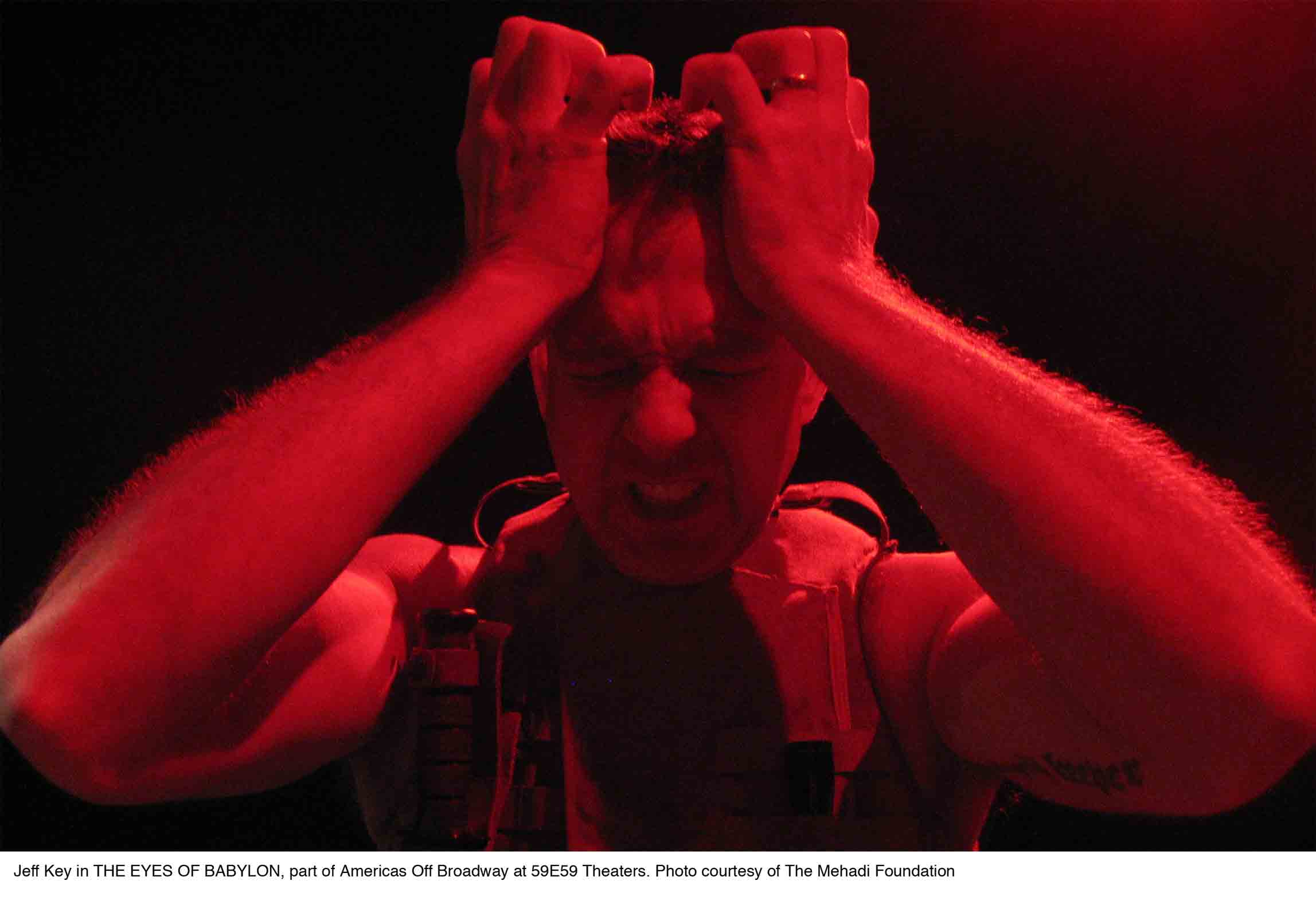
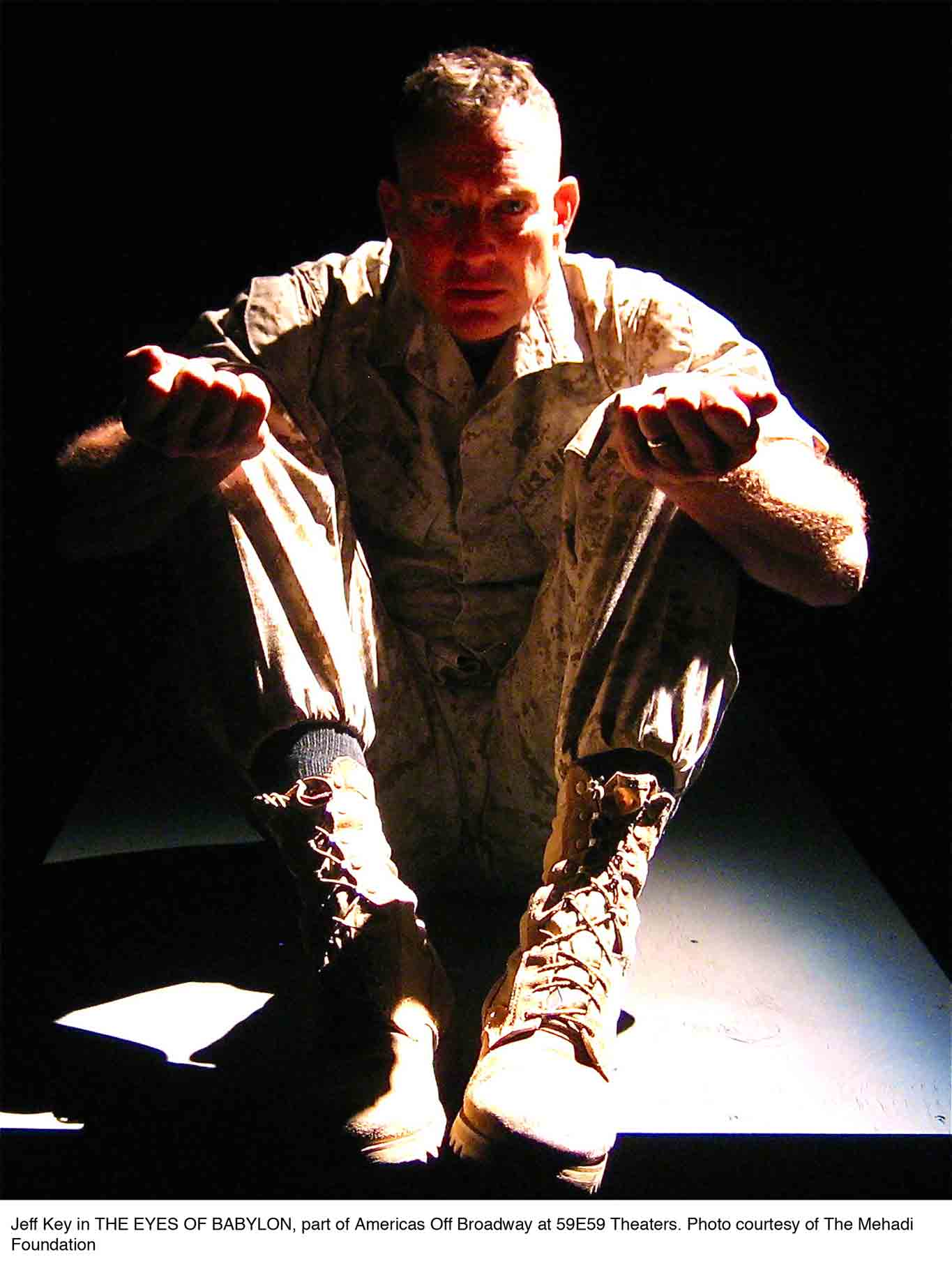
There is no doubt that the American public was inundated with images, video streams and commentary from the Iraq War.  It was like a soap opera “As the War Turns” or a Sony Playstation videogame, only this version had real casualties.  Using photos he took and the illumination of his rhythmical verse, Key’s narrative transports the audience into the Iraq War in a more intimate way than CNN and other network’s daily updates ever did.  The Eyes of Babylon is a spellbinding 90-minute monologue that is real soldier’s story instead of a manufactured segment of media.  Told with humor and conviction, Key relates a story with his Alabama/Forrest Gump accent that displays pure emotion.  He takes the audience on a journey that begins with 9/11 and ends with him coming out as a gay man on CNN.  Along this journey Key communicates the feeling of connecting with the universe’s most insignificant creatures, the eroticism of a subtle shared moment with a gay Iraqi man, the joy for simple pleasures such as the soundtrack from Rent that allowed him to mentally venture off from the state he was currently in, the realities of how soldiers shower and move their bowels in combat situations, the brutality of soldiers with a hard on to get their gun off and his growing abhorrence for the war he was sent to.

The words of this warrior poet are as powerful as a M16 with a full clip and no less haunting than a wolf howling at the full moon.  I was beyond transfixed; I hung on to every word that flowed from his lips like a recruit swinging on an immense set of monkey bars.  Key was my sergeant and it was up to me to follow his guidance and make the links until I had finished the task, feeling better for going through the exercise with him. Key is truthful and is the personification of the Marine term “Semper Fi”.  Always faithful, Key demonstrates what it means to be a true patriot all while changing conventional paradigms of the expression.  This production is a significant piece of theatre – it is Off-Broadway’s To Hell and Back. Exchanging a rifle and assault vehicle for a pen and stage Key is more formidable.  Using his weapon to the fullest, The Eyes of Babylon challenges the status quo, flips them the bird and gives them a salute at the same time.  Key is mercenary for those who have known little mercy, for those who are used by this government and forgotten about like cracked egg shells after the omelets has been cooked and you best believe he will go down with his boots on.

The Eyes of Babylon is not just a gay man’s account of his stint in the military during wartime.  It is a story every military person can relate to.  A person joins the military for different reasons.  When he spoke I felt the presence of my friend that gave the ultimate sacrifice in a gun battle in Iraq, a man that joined the military to provide a better life for his two sons, a man whose beautiful face I will never see again.  On a personal note, this production was closure for me.  I want thank Key for sharing his story.  I was so angry upon hearing of my friend’s death, knowing that he lost his life without any of his friends or family around as he made his transition plagued my heart.  But after viewing The Eyes of Babylon I realized that he was surrounded with love from his fellow brethren and if he passed serving with anyone like Key, he was never alone.  I salute you Jeff Key for a job well done.

Photos courtesy of The Mehadi Foundation

The Earp Women Revisit History

One of the most retold stories of the old west is the account of the events that occurred at the O.K. Corral.  It has been the subject of dozens of films, books and documentaries – some historically accurate, while others are unadulterated romantic fantasy.  Generally this story is told from the Earp brothers’ perspective, but a new musical gives audiences a glimpse of the harshness of the west from a feminine point of view. I Married Wyatt Earp is based on a book of the same name penned by Glenn G. Boyer and tells the story of Josie Earp (Wyatt’s third wife and widow), Allie Earp (Virgil’s widow), Bess Earp (James’ wife), Mattie Blaylock (Wyatt’s ill-fated second spouse) as well as the events that led up to the famous gunfight.

Life in the west was hard and love was even harder.  Josie Marcus is weary of her restrictive life in San Francisco.  Refusing to live the existence of an upper-class Jewish woman, the naive young girl finagles her way into becoming a member of a traveling troupe of actors in search of adventure.  The troupe travels to Tombstone, where Josie meets a whole horde of personalities and falls in love with Wyatt Earp.   Her affair with the married lawman comes off the heels of her break up with Sheriff John Behan and also adds fuel to a rivalry between Behan and Earp.  The feud also enlists Wyatt’s brothers and Doc Holiday on Wyatt’s side and the Clanton-McLaury gang on Behan’s.  The bad blood felt between these men would spill over in a 30-second gunfight on October 26, 1881.  Subsequently, Wyatt and Josie’s affair also rippled into the discentagration of Doc Holliday’s relationship with Kate, his traveling companion, and the ruination of Mattie and Wyatt’s relationship, which also led to Mattie’s descent into addiction and her death from an overdose of laudanum. The production deals with these themes as well as Josie’s guilt over her decisions as an older Josie and Allie recall the past and how that fateful day affected their lives.

I Married Wyatt Earp is being touted as a “creative nonfiction” musical.  To retell a story that has been told countless times is a definitely a daunting endeavor.  The narration of this famous legend from the wives and girlfriend’s viewpoint is definitely creative, but the creators of I Married Wyatt Earp relied too much on this concept to try to sell the production.  It appears the rest of the production had not been fleshed out, so its innovative concept became reduced to a ploy to pull in the audience.  While the musical does have some southern fried charm, it lacks the grit that is associated with the old west.  It is sort of like Gunfight at the O.K. Corral light, similar to a decaf cup of coffee it has flavor but is deficient of a kick.   The cast delivers with the material, but the material could have been more polished.  The choreography is mediocre; however the music and lyrics are memorable.  “Don’t Blame Me For That,” “Pins and Needles,” “Did Ya Hear” and “Stand Our Ground” are songs that will remain in your head long after the show closes at 59 East 59 Theatres on June 12.   

While I do believe this story may have to go back to the proverbial “drawing board” if it wants to take the O.K. Corral to Broadway, I also feel there is enough there to keep an audience with a proclivity for American folklore interested.


Photos: Gerry Goodstein

The Best of Cy Coleman on Display on Off-Broadway

The word legend is almost too small of a term to describe Cy Coleman and his epic talent.  By the time he turned six, the Bronx native, born Seymour Kaufman, was considered a prodigy and had graced the stages of Town Hall, Carnegie Hall and Steinway Hall.  The Cy Coleman Trio was an extremely popular club attraction and completed numerous recordings.  Cy could have become a maestro in either the classical or jazz scenes, but it was popular music and Broadway that reaped the benefits of his genius.  Never one to be put in box, Cy collaborated with some of the best lyricists in the history of American music to create classics that were featured in Hollywood, The Great White Way and the small screen and garnered Tony, Emmy and Grammy Awards.   Cy was a vital creative force in the theatre world and was not one to let grass grow under his feet.  When Cy passed away at age 75 in 2004 from cardiac arrest, he was preparing for an engagement at a Manhattan club.

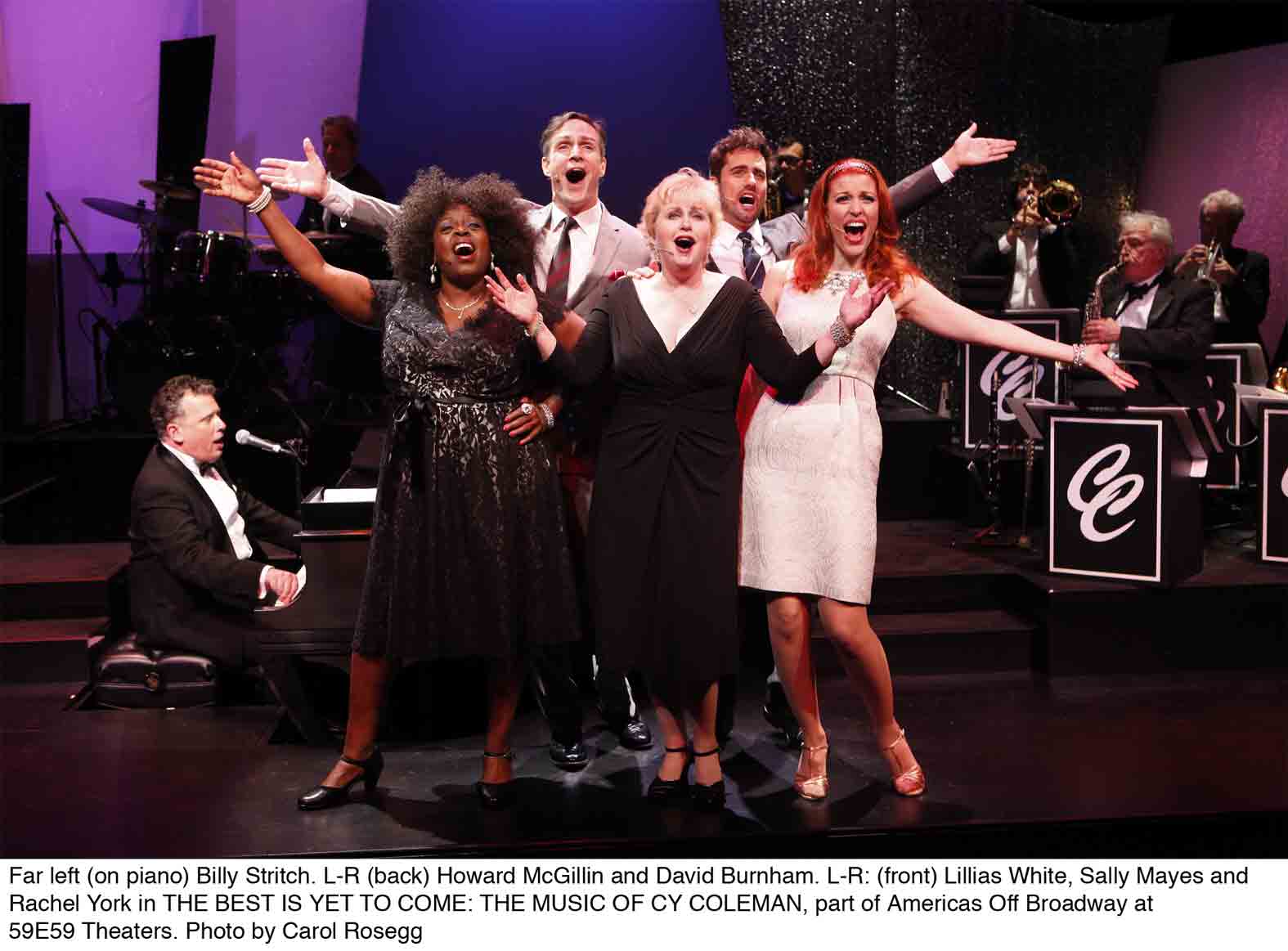
Six years after his death, the eastside welcomes a phenomenal piece of musical theatre that pays homage to a phenomenal man.  The Best Is Yet to Come: the Music of CY Coleman is currently playing at 59E59 Theatres and consists of standards, musical numbers and previously unreleased material from this extraordinary musician.  One the best elements of a musical is the music and lyrics; The Best Is Yet To Come showcases great music without the potential of boiler plate dialogue and trite choreography.  The show features well known songs like “Witchcraft,” “Big Spender” and “If My Friends Could See Me Now” as well as music that the audience may not have known was part of Cy’s catalog. 

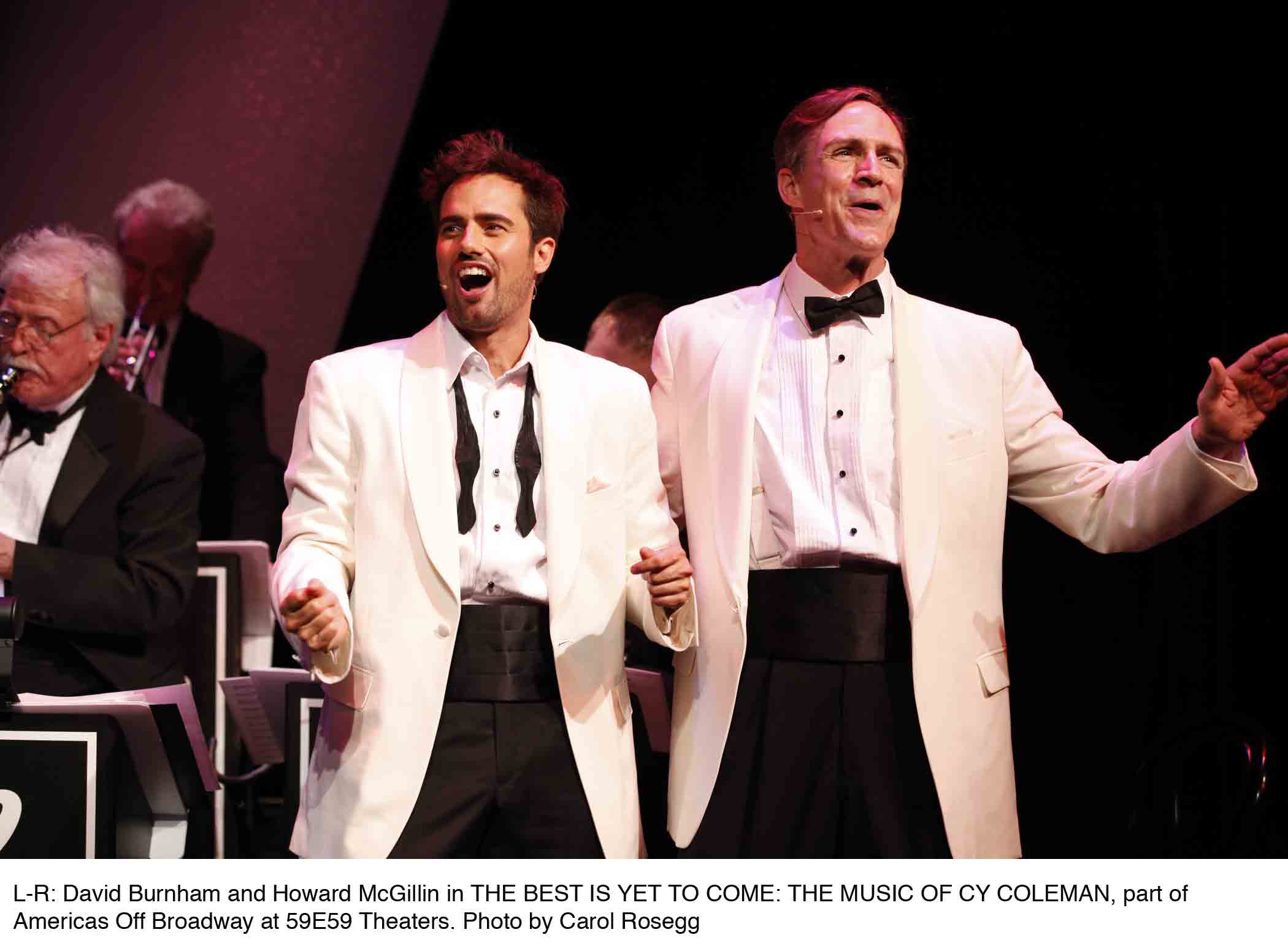
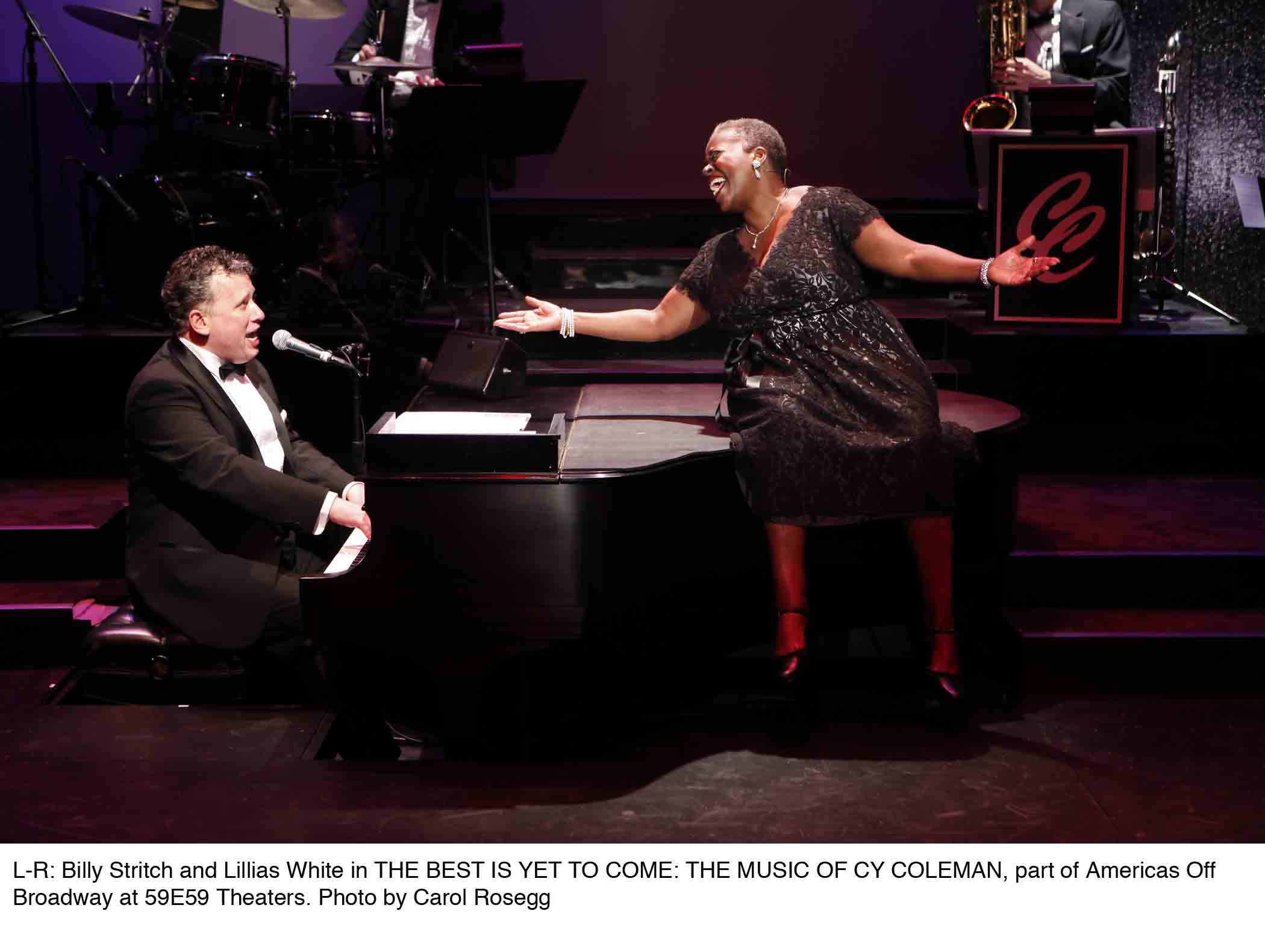
The cast is comprised of David Burnham, Sally Mayes, Howard McGillin, Billy Stritch (who is also the musical director and pianist), Lillias White and Rachel York, all of whom are Broadway veterans.  The band encompasses a brass, woodwind and percussion section along with a bass and piano.  The set is reminiscent of Saturday night at The Copa in its heyday – all that is missing are the huge clouds of cigarette smoke and drinks.  I have always loved a cabaret; this production superbly exceeded all of my expectations.  Although there was no dialogue or set changes, The Best Is Yet To Come followed the blueprint of a jukebox musical.  The numbers blend one into the other very well and tell the story of love, loss, desire and hope. The vocal arrangements are exquisite.  Together the performers form a jazz super group, sort of like Manhattan Transfer on steroids.  Separately the vocalists illuminate the stage.  Ladies will not just be swooning from David Burnham’s good looks, but from his golden voice.   “The Doodling Song” is one of my favorite Cy Coleman songs and York delivers it with oodles of pizzazz.  I could listen to her doodle anytime. Howard McGillin will always be the Phantom to me.  His voice is classic Broadway – rich, velvety with a wonderful timbre.  Sally Mayes is the perfect personification of a cabaret singer – sassy, sultry and full of energy.  Lillias White is a New York City treasure.  Every solo she sang became my new instant favorite.  White has a way of contorting chords until they become new notes on the musical scale.  Her voice is a true instrument.

When you are not singing along to the tunes you know, you will be toe-tapping and hip twisting to the rest.   For a man who was as versatile as he was gifted, I believe Coleman would be pleased with The Best Is Yet To Come.  Out of the tree of musical theatre it is a ripe, juicy plum.   The Best Is Yet To Come: The Music of Cy Coleman ends it limited engagement on July 3.  Before it closes get down to the eastside, buy a ticket and fasten your seatbelts; you are in for a swinging good time, man!

Photos:  Carol Rosegg

WTC View Rocks the Eastside

There is no New Yorker, indeed no American that has not been affected by the tragic events of September 11, 2001.  The images of that day have been indelibly seared into our minds and the emotions branded into our hearts.  But the days and weeks following that catastrophic day can sometimes be as blurry as a Monet and other times it is as vivid as a Matisse.  This year marks the 10th anniversary of that infamous day.  Playwright Brian Sloan explores the surreal time after the 9/11 attacks in WTC View.

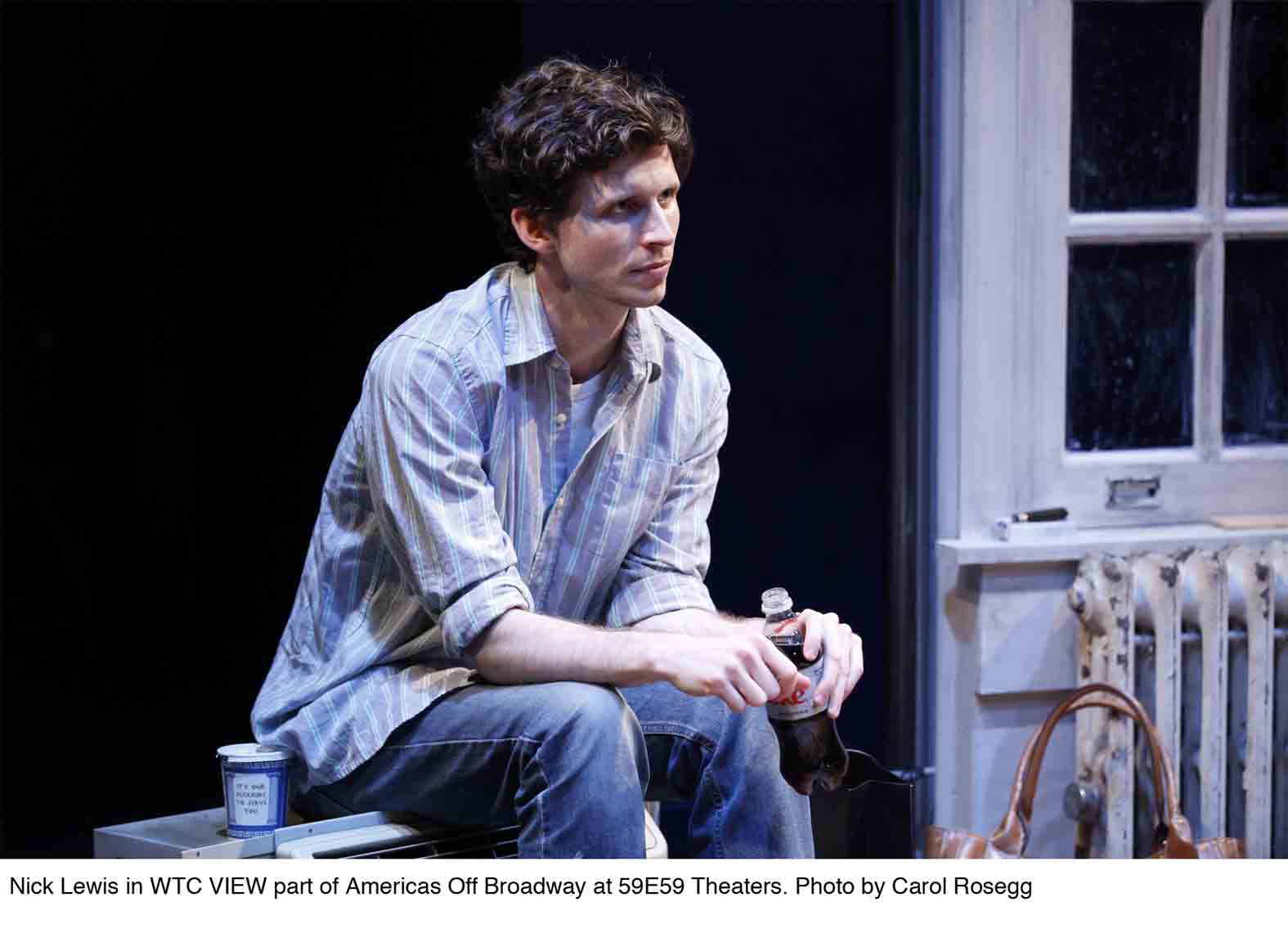
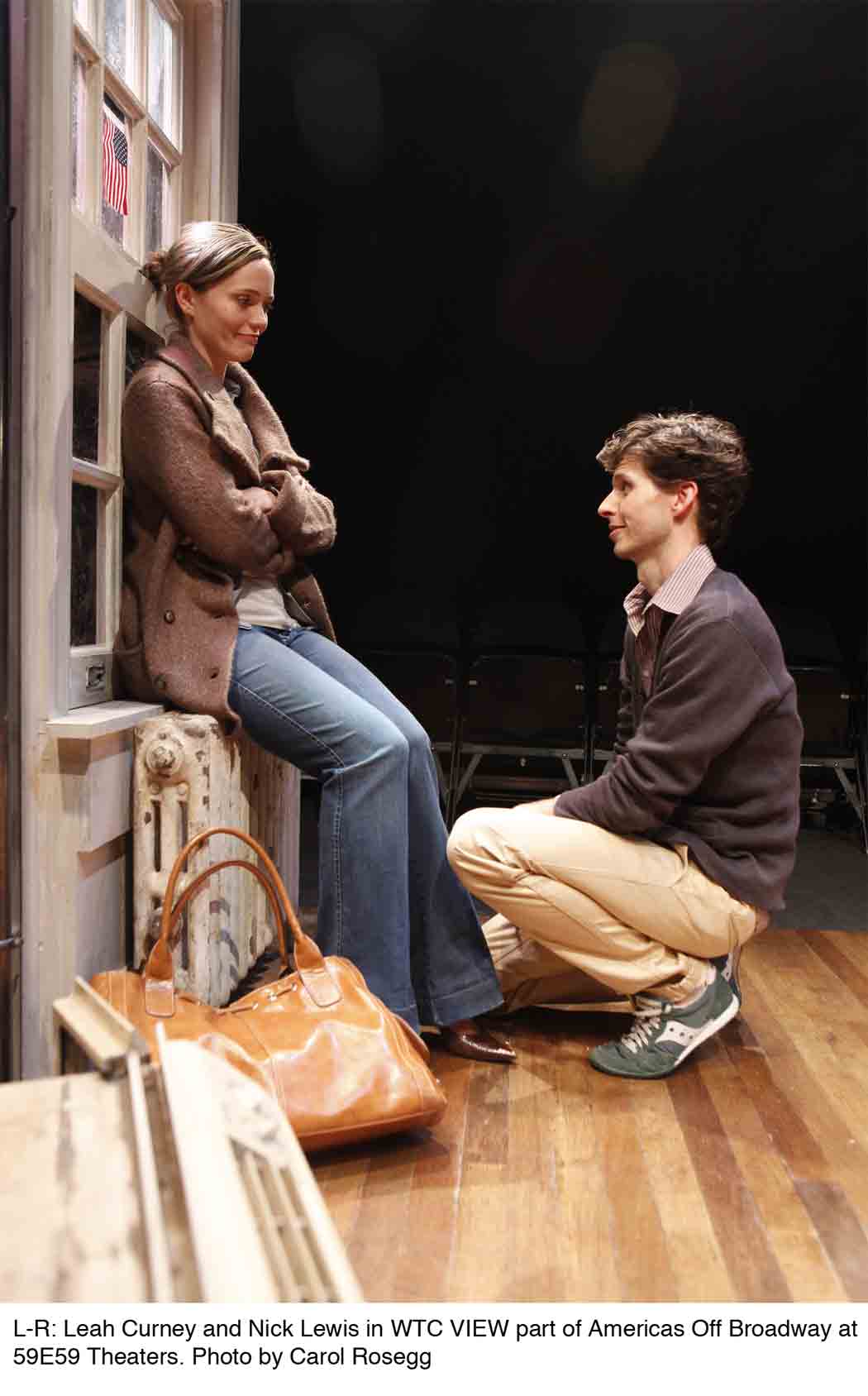
WTC View examines the psychological effects on a group of New Yorkers after the World Trade Center attacks.  It centers on a photographer named Eric and his quest to find a roommate to assist in paying the rent in his two bedroom SoHo apartment.  Eric, portrayed by Nick Lewis, was in his apartment when the attacks began, which has a bird’s eye view of the Twin Towers; he witnessed the cataclysmic episode unfold outside a bedroom window.  He meets an array of interested applicants, each with their own perspective on 9/11.  Jeremy, played by Bob Braswell, is the British St. Regis employee who loses his job because of the lack of tourists and returns home to England.  Kevin, played by Michael Carlsen, was unable to go back to his Battery Park apartment after the attacks and was stuck in New Jersey with a one night stand for three days.  Jeff, depicted by Torsten Hillhouse, is a democratic campaign worker who was born in NYC and decided to return because he felt New York City needed him.  Alex, played by Patrick Edward O’Brien, worked at the World Trade Center and was present during the time of the attacks.  His story is one of the carnage left in the wake such a vicious act of terrorism as well as one of hope.  Max, played by Martin Edward Cohen, is a young NYU student that mixes his feelings of guilt and activism into one huge twenty-something M80 that is just ready to burst.  All these young men, along with Eric’s friend Josie, played by Leah Curney, and Eric’s ex-boyfriend (who is only heard via Eric’s answering machine) assist Eric in coming to terms with the loss he felt as a result of 9/11 as well as the hysteria that subsequently followed in the days and weeks that followed.

With September marking the 10th anniversary of the 9/11 attacks, this review is the first time I have written anything about what happened on that Tuesday morning in September 2001.  Somehow I could not locate the words that I felt adequately expressed my pain.   Almost ten years later, and it was not until I witnessed WTC View that I realized why I never did.  All humans react differently during times of distress and earth-shattering events.  I was like Eric.  I wanted desperately to pretend that watching those towers fall did not affect me.  I wanted to believe that the weeks of watching funerals on television or passing by dozens of missing person bulletins had no impact on my psyche, but the glaring truth for me and the protagonist of the play is that it did.  Eric finally came to grips with his pain after several breakdowns.  I buried it as deep as I could and as a result it paralyzed my fingers and mind.  I thought I had covered the wounds inflicted on us as a society that day with the finest emotional band-aids, but as I watched each actor recount how 9/11 changed their life as they knew it and observed Eric slowly succumb to his grief and fear, I could feel the bandage being ripped from my heart.  What I found was that I had not healed at all, but thanks to the crafty storytelling of Brian Sloan, I recognized that I was ready to go back to the pain and try to heal.

Watching WTC View is similar to having the deepest deep tissue massage you will ever have.  The right hand grabs your heart, the left clutches your soul, sometimes you will wince in pain, but you will leave feeling more healed than when you came in.  WTC View is a must see for all New Yorkers, it is a riveting piece of theater, powerfully acted by an impressive cast.  Currently playing at 59E59 Theaters until June 5 as part of the America’s Off-Broadway series, WTC View is a production that embodies the true spirit of New York and its unrelenting resiliency.   

Photos:  Carol Rosegg

Off-Broadway Gets Lucky


Deep in the heart of the Theatre District sits a production that shines just as bright as the stars in the Texas sky,  is as funny as a Hee Haw episode, with music that would rank on the top 10 of any WSM AM radio show countdown.  Country is getting its turn at bat once again, and it is swinging for the fences with Lucky Guy, a production that is all about the most important rule in music – rule 4080 – people in record industry are shady. 

Nashville is the Mecca of country music and it breeds recording stars the way Kentucky breeds champions. This is why Billy Ray Jackson, played by Kyle Dean Massey, has come to Music City.  Billy Ray won a matchbook songwriting contest, sponsored by Wright Records, and has come to Nashville to record his song and become famous.  G.C. Wright, the owner of Wright Records, has also eagerly awaited the arrival of Billy Ray.  He believes “Lucky Guy” – Billy Ray’s winning song – will save his struggling record label.  This possibility does not sit very well with G. C.’s cousin, Big Al Wright.  He is the proprietor of the most famous used car dealer franchise in Nashville and wants the property Wright Records resides on to expand his car empire.  Big Al contrives to hustle Billy Ray and G. C. out of the song and enlists the help of Miss Jeannie Jeannine, the queen of country music, to assist him with his plan.  She has not had a hit since before Johnny Cash started wearing black and “Lucky Guy” is just the tune she needs to reclaim her spot at the top.  Jeannie begins to employ all her womanly wilds, which are plenty, and star power to try to seduce naive Billy Ray, but he only has eyes for Wanda, the secretary at Wright Records. 

The bamboozle is all set take place during Big Al’s Grand Ole Opry show.  But Jeannie has a change of heart after realizing that Billy Ray is an earnest country guy that is devoted to another woman.  Even after Big Al puts the pressure on, Jeannie transforms herself from conniving villainess to heroine, saving Wright Records by allowing Billy Ray to sing his song on stage.  G.C. and Big Al come to an agreement about the property.  G.C. finally makes an honest woman out of his girlfriend, the gossiping hairdresser/wanna be country singer Chicky Lay, and Billy Ray and Wanda are ready to make it a double wedding.  Jeannie maintains her status as the queen of country music and all is right in Nashville.

Lucky Guy is being advertised as, “A big new musical at The Little Shubert Theatre,”and they ain’t telling no lies.  Playwright and director Willard Beckham has got himself a winner.  The laughs that will come from your gut will be as enormous as the wigs glued to Miss Jeannie Jeannine’s head.  The score is a great representation of country music, the melodies are earthy and the lyrics are relatable and impressive.  Before you know what hit you your head will be swaying and your toes will be tapping in your shoe.  The eye-popping sets are colorful and homey and the choreography is electrifying.  The cast is the sugar in the sweet tea of this musical, and oh how sweet it is.  The Buckaroos, played by Callan Bergmann, Xavier Cano, Wes Hart and Joshua Woodie are the buffed minstrels and dancers that give the show a healthy dose of eye candy.  Not to be outdone is Kyle Dean Massey, FAMERS can you say sexy?  Massey is a dreamboat that can sing and act.  What else do you need? Savannah Wise as Wanda Clark is as sugary as a ripe Georgia peach and could give Taylor Swift a run for her money.  Jean Colella is hysterical as Chicky Lay and Jim Newman is equally as comical as G.C. Wright, but the best lines and stomach crunching cackling came courtesy of Varla Jean Merman and Leslie Jordan.  As a legendary drag queen, Merman is already entertainment royalty.  The role of Miss Jeannie Jeannine was tailor made for her talents.  She is vivacious; the audience could not get enough of the blue jean queen of country antics.  Leslie Jordan is J.R. Ewing in bespangled cowboy boots.  His omnipresent presence and sarcasm is so outrageous it is sublime. 

I view this production as the little musical that could – since its 2009 premiere in Connecticut, it has been picking up steam.  I firmly believe it will not stop until it has reached Broadway.  Lucky Guy is playing a 12-week limited engagement; promenade on down to The Little Shubert Theatre and get yourself a good ole heaping of some country-fried fun.

Photos:  Joan Marcus


Triangle Offers Homage to a Centennial NYC Tragedy

March 25, 2011 marked the 100th anniversary of the Triangle Shirtwaist Factory fire.  The inferno was the most deleterious industrial catastrophe in NYC history and ranked the fourth highest in casualties from an industrial accident in US history.  It was also the most mortiferous tragedy in Manhattan until 9/11.  The sweatshop blaze, located in the Asch Building on 23-29 Washington Place, resulted in the deaths of 146 workers, most of whom were Jewish and Italian immigrants.  Because of locked doors, people jumped to their deaths and created outrage with the community and politicians alike. But the fire’s lasting legacies were not just the deaths, it was the legislation passed to improve factory safety standards and the creation of the International Ladies’ Garment Workers’ Union. 

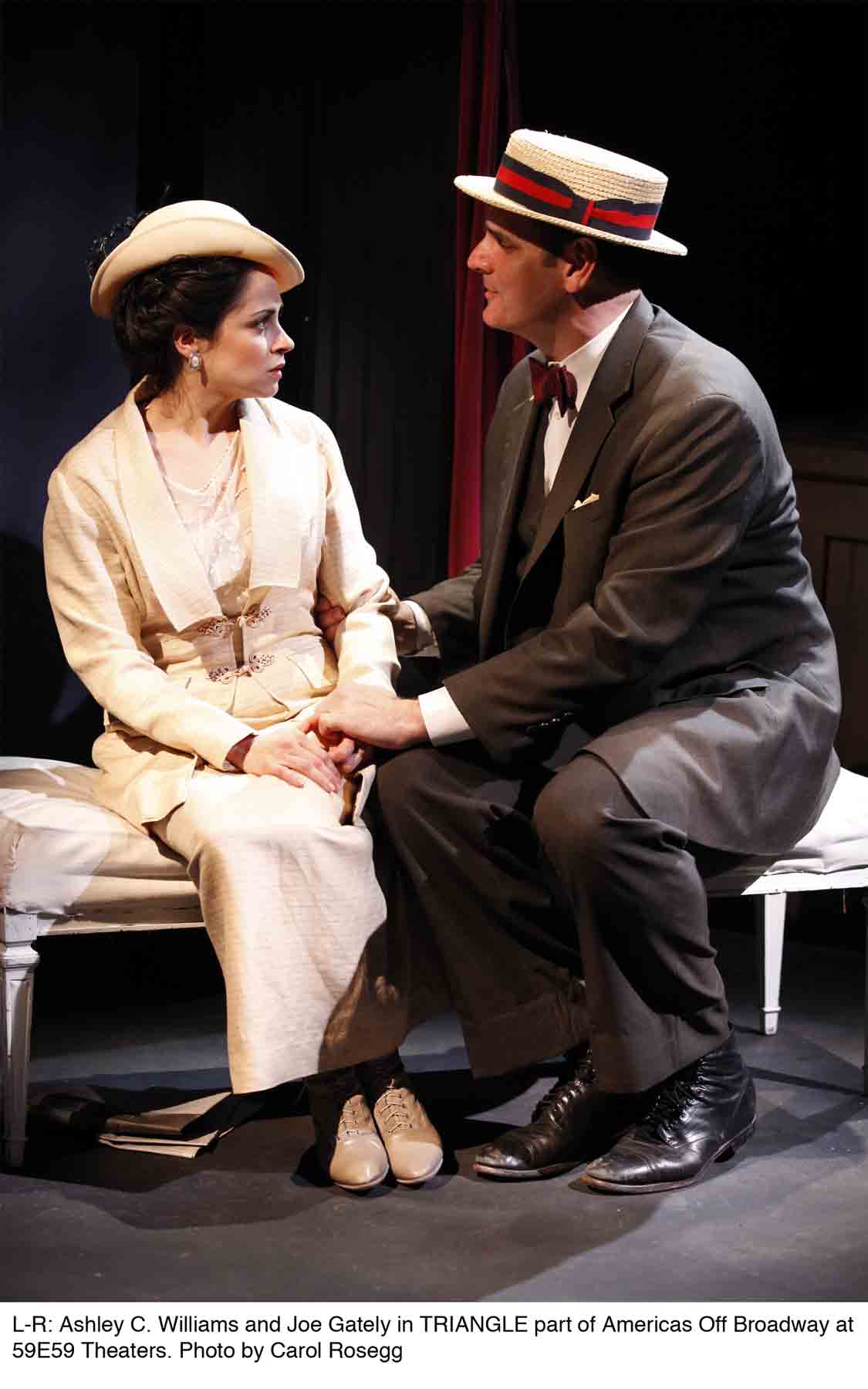
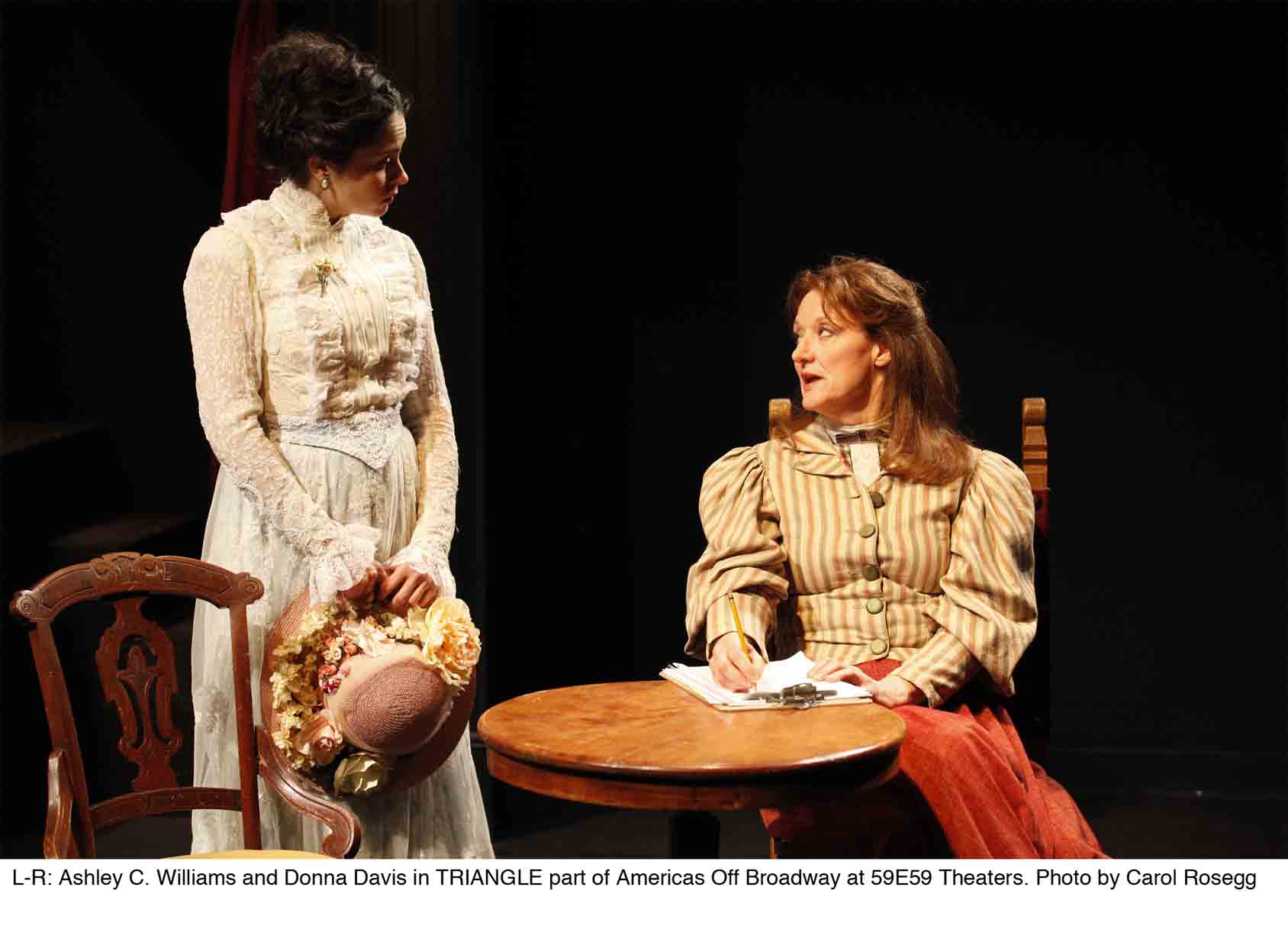
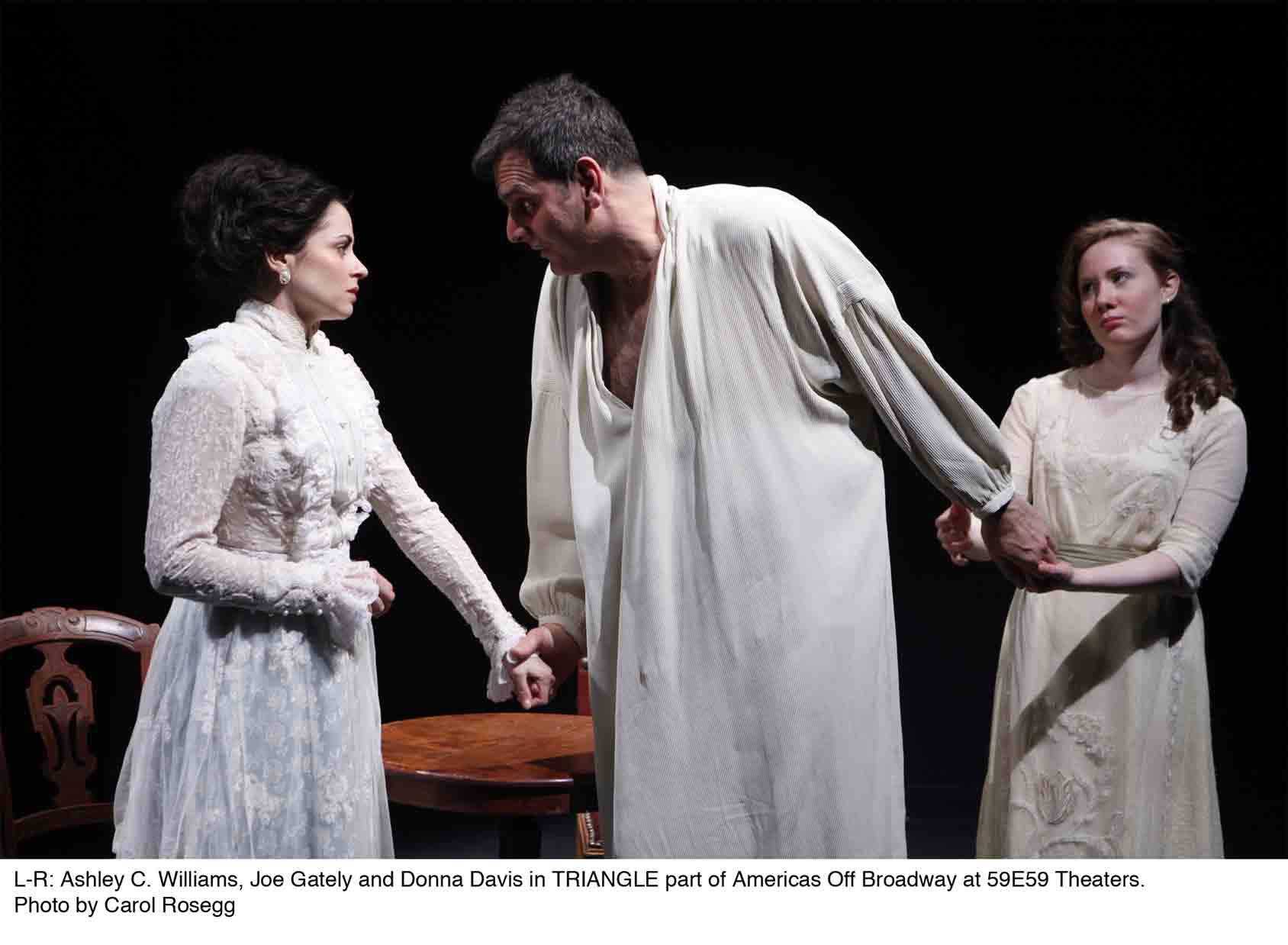
Currently, the Americas Off-Broadway series offers a production that exhumes the ghosts of that tragedy and the lives it affected with TriangleTriangle is a 120 minute drama that recounts the adulterous liaison between “Big” Tim Sullivan and actress Margaret Holland against the backdrop of the Triangle Shirtwaist Factory fire and the events that followed.   When young, beautiful Margaret goes to audition for Big Tim at his headquarters, he is already known as “The Boss of the Bowery.”  Along with being a one of the prominent politicos of Tammany Hall, he was also the kingfish of various criminal enterprises which included prostitution, gambling and extortion.  Margaret, a highbrow, progressive woman, becomes seduced by Tim’s immoral, yet captivating demeanor.  Tim immediately recognizes Margaret’s beauty and casts her in his productions out of state.  While Margaret continues to tour on the acting circuit, she and Tim fall in love and have an illegitimate daughter named Mary Catherine.  But the Triangle Factory fire forever changes Margaret, Tim and Mary Catherine.  Margaret tirelessly works as a reformist, causing a strain on her relationship with her growing daughter, and blames Tim for taking kickbacks.  Guilt spurs Tim into using his political muscle to aide the reformers and sponsors legislation limiting the maximum number of hours women were forced to work despite his failing health from syphilis. 

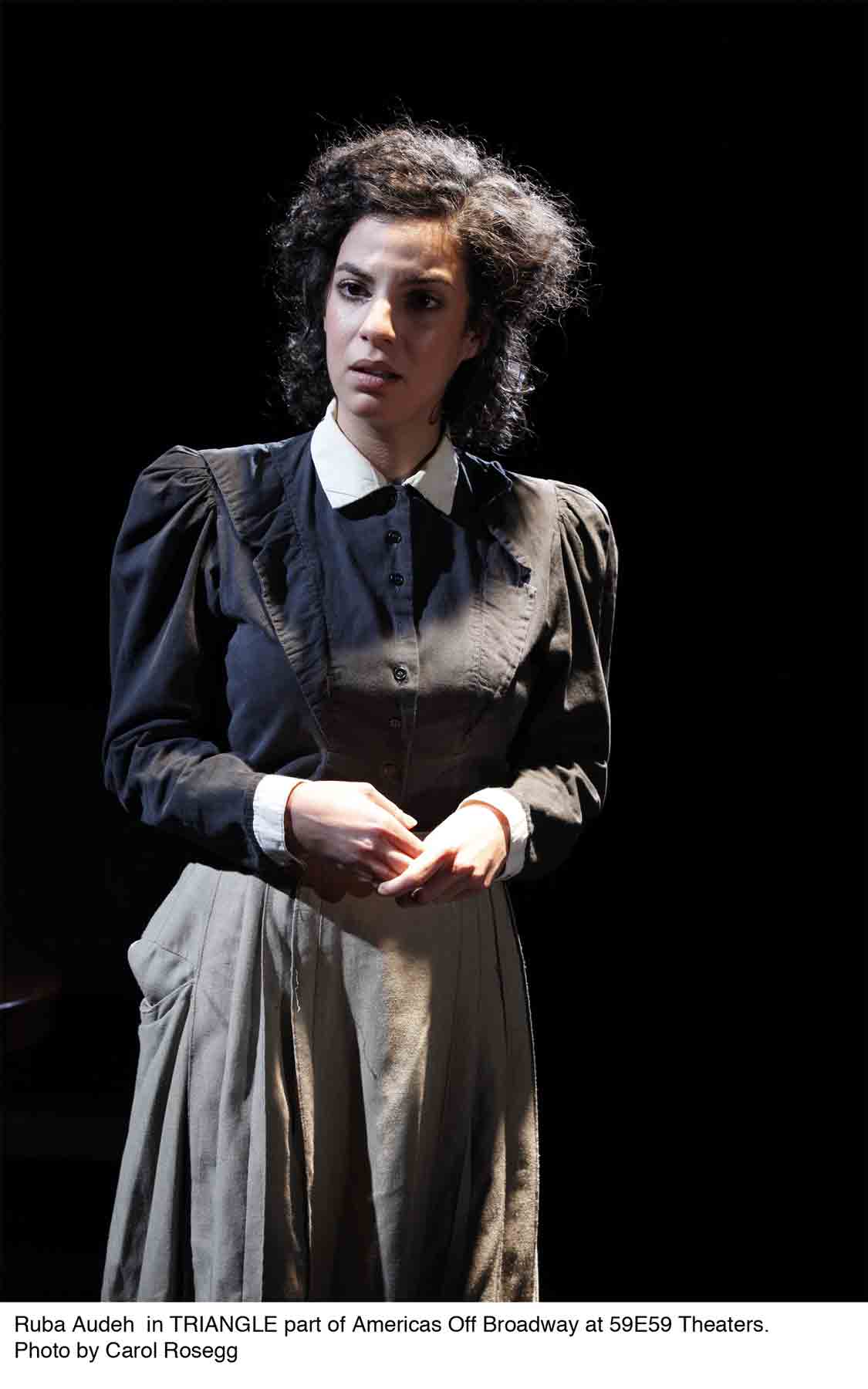
One aspect I find with Off-Broadway productions is that they are generally hit or miss.  This production teeters somewhere in the middle.  At best Triangle is a nondescript tribute to the legacies of the women and men who perished in Triangle Shirtwaist Factory fire, focusing more on the love affair between Tim and Margaret instead of the immigrant men and women who toiled and died in the fire.  It reminded me of Spike Lee’s Summer of Sam, a think piece that provided a glimpse into the lives of people placed in a stressful situation.  The acting in Triangle impressed me more than the story itself, and when the play did focus on the fire specifically, it showed flashes of brilliance.  Ruba Audeh is superb, playing dual roles as a young Jewish girl and a former Triangle Shirtwaist worker turned hooker – her scenes are some of the most telling, emotional moments of the play and will painfully stick with you like burnt clothing on skin.  Donna Davis and Dennis Wit are very engaging as Cathleen Murphy and Izzy Weissman, a common law couple on Big Tim’s payroll.  Their banter and narration throughout the production not only offered comic relief, but prevented the show from dragging.  They, along with Audeh, are without a doubt the most memorable characters and performances.  Joe Gately, Ashley C. Williams and Michaela McPherson round out the cast giving fine performances as Tim Sullivan, Margaret Holland and Mary Catherine. 

Triangle’s final performance at 59E59 Theatre is May 1.  It is my conclusion that parts of this show were greater than its sum.  Overall, Triangle is a satisfactory play that produced solid performances, but the jury is still out on whether this drama did or did not deliver on its commitment to honor the victims of the fire.

Photos:  Carol Rosegg

Intonations of Love

Love is an all-encompassing entity.  It can be displayed through all five senses.  You can hear the sounds of love coming from a bedroom or pining through a radio.  You can see it dancing in someone’s eyes or in their gestures.  There is a different aroma that follows a couple in love – even food taste different when the person preparing it is in love.  In contrast, a person lacking love in their life is as anemic as a person living with diabetes.  And this is where the audience finds Beane, the tragic, young protagonist of John Kolvenbach’s brilliant romantic comedy Love Song, when the play begins.

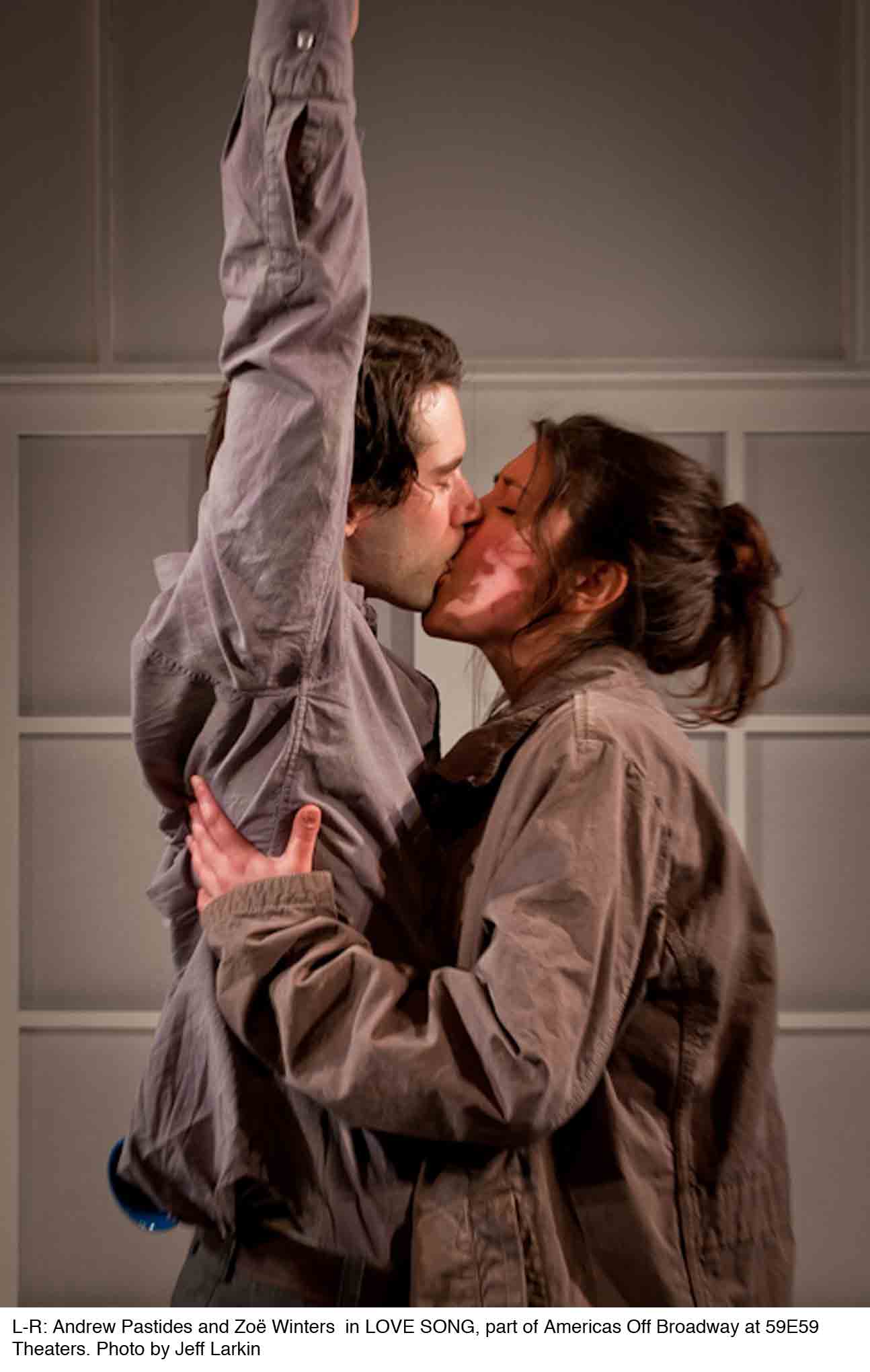
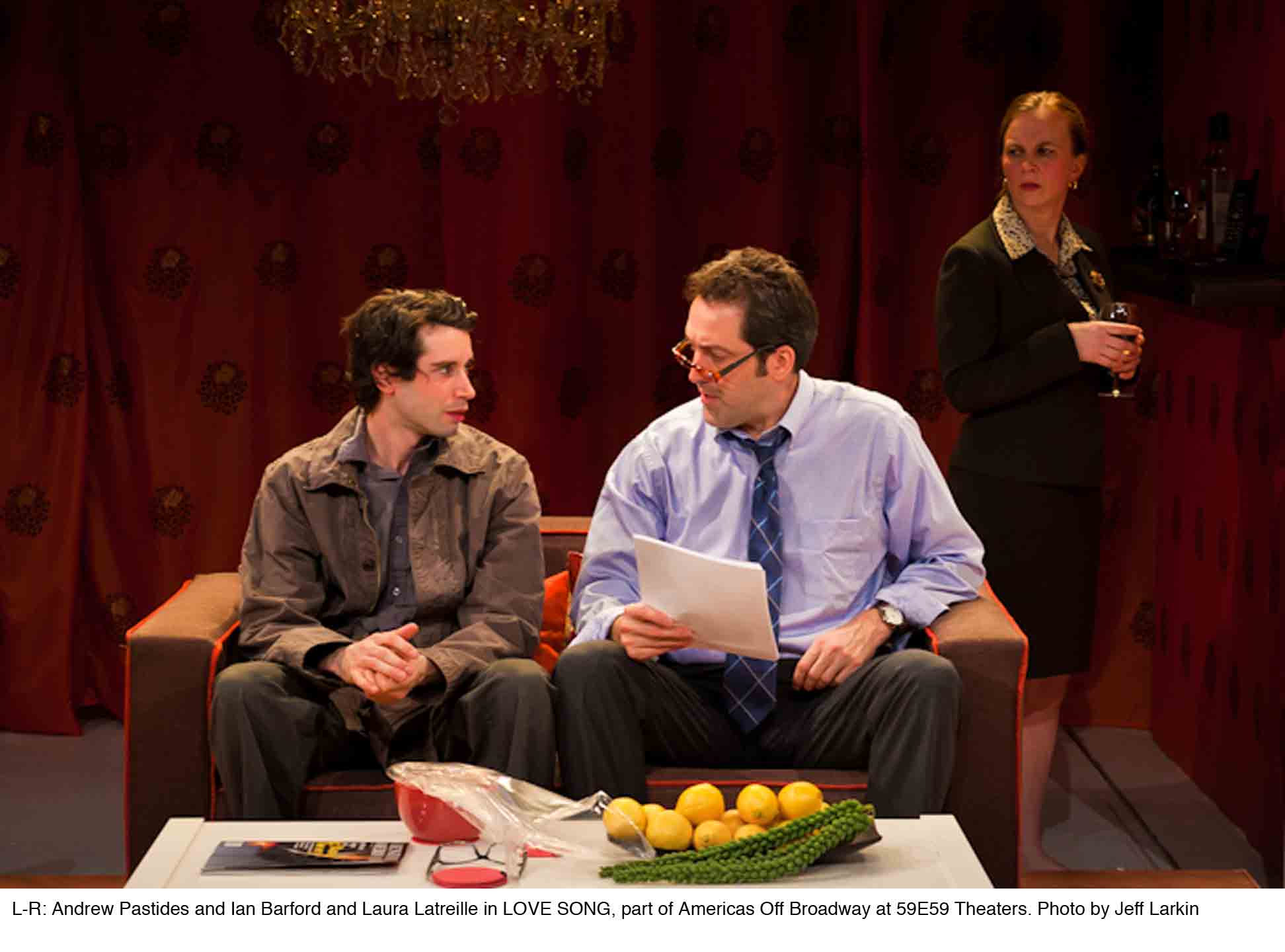
To say that Beane is an eccentric would be an understatement.  He lives alone in an apartment void of furniture; his worldly possessions include a cup, a spoon, a couple of pairs of socks, two button down shirts and two slacks.  Beane is a shadow and likes it that way.  Like the boy in the bubble, he encloses himself in an orb to survive, but for Beane his oxygen is filled with misery.  He desires no interactions with humans, if he desires at all.   Outside of work, the only people Beane sees are his sister Joan and her husband Harry, an upwardly mobile couple too busy with work for Beane or even themselves for that matter.  Then along comes Molly, a hellcat/burglar that robs Beane and incidentally develops a weird infatuation for him as does Beane for her.  Suddenly, the light in Beane’s dreary world has been turned on.  His whole outlook on life changes, which does not go unnoticed by Joan and Harry.  In fact, Beane’s new attitude is contagious and assists in reigniting the romance in Joan and Harry’s life. Molly is like the Sazón that adds essential flavor to a dish of arroz con pollo – there is only one problem with her – she is as real as the Easter Bunny.  Once Beane’s secret is out in the open, he must decide whether to move forward or shrink back into the existence he once had.

Love Song is one of the best character studies I have ever witnessed.  It is Punch Drunk Love on LSD – a wild, trippy ride into the dimensions of love, loneliness and lunacy – three paths that can sometimes run side by side or collide into each other like a messy intersection.  Playwright and director John Kolvenbach aims for the heart and hits his target dead on the mark.  I adore this comedy; it is great theatre plain and simple.  The cast radiates even brighter than the light Beane has been trying to avoid all his life.  Laura Latreille and Ian Barford are a scream as Joan and Harry.  Their chemistry was extremely organic.  Zoe Winters is the most convincing imaginary girlfriend I have seen and Andrew Pastides makes quite an impression as Beane.  Love Song is playing a limited engagement at 59E59 Theatres until May 8 as part of their America’s Off Broadway series.  There are many tales of love in the world, but this one that should not be missed.

Photos:  Jeff Larkin

What Happens In Jersey…

What is it about Jersey that gets such a bad rap?  Frank Sinatra, Bruce Springsteen, Jerry Lewis, Joe Pesci and Bon Jovi all came from the Garden State.  Before Sin City opened its first casino, Atlantic City was a gambler’s playground for years and with its beach and boardwalk, it played host to the Miss America Pageant for decades.  But despite these facts, New Jersey is constantly the butt of tri-state jokes and poorly depicted in the media, i.e. Jersey Shore.  Then came a fictional story set in an attic in Ridgewood, New Jersey, touted as a gothic fairytale, and my hopes that New Jersey would be seen in the public eye as more than a fist-pumping toxic dump was restored.    Unfortunately, Play Nice! did little to enhance New Jersey’s public image nor did it fully live up to its potential as a gothic fairytale.

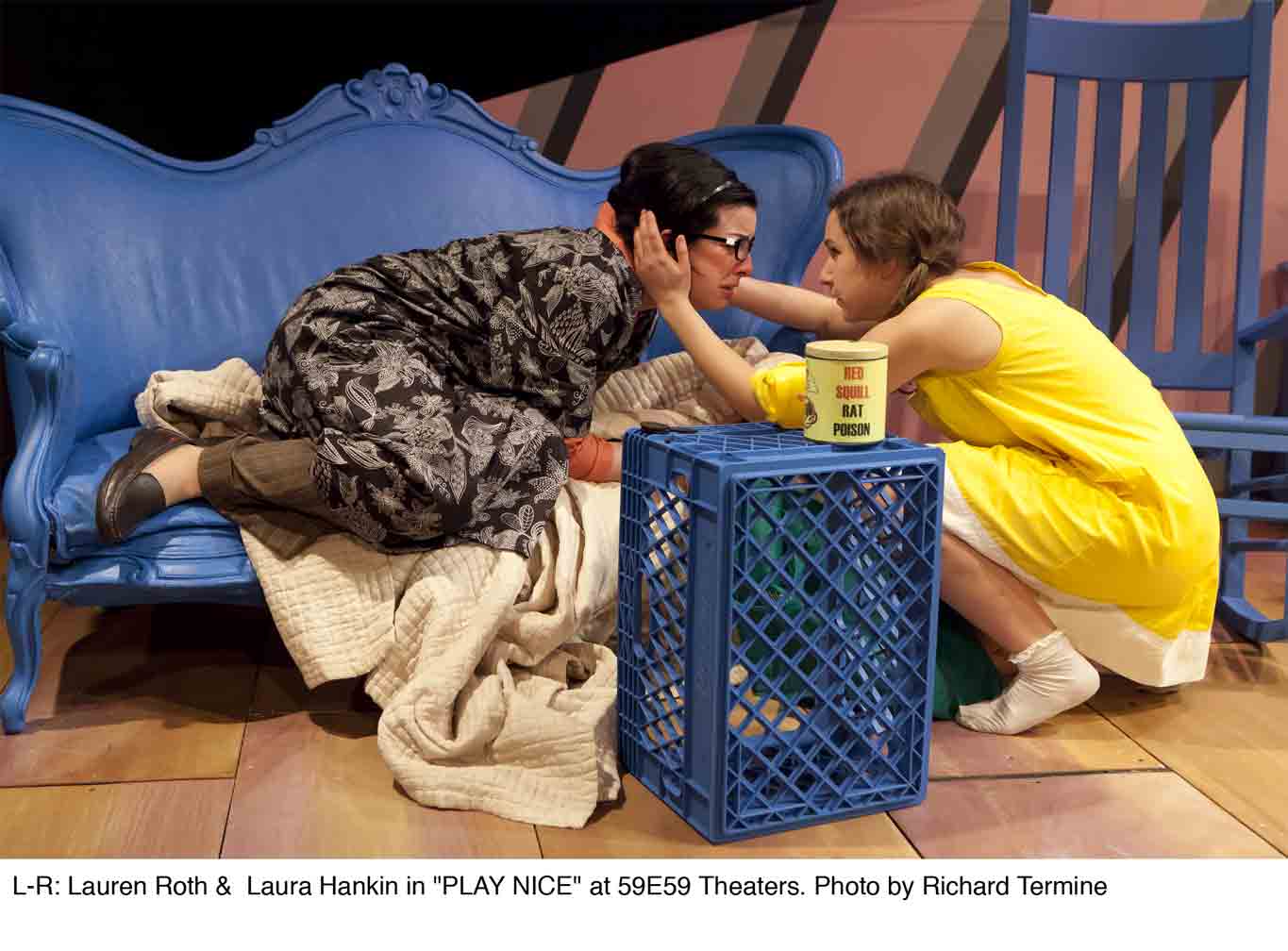
Play Nice! focuses on Isabelle, Luce and Matilda.  On the surface, their lives seem ideal, but behind the doors of their home their reality is quite different. Each of the kids are forced endure their fare share of abuse from their mother, who is an obese alcoholic.  Determined to prove to her neighbors that she deserves to live in this affluent bedroom community 20 miles from New York City, the children’s mother demands perfection in and out of the home, which is only partially furnished to enhance her façade.  The bulk of Luce and Isabelle’s time is spent in the attic escaping into their world of make believe where there mother, the Dragon Queen, cannot reach them.  Matilda is relegated to be the maid and her mother’s verbal whipping girl.  The play’s dark plot primarily takes place in the attic – very V.C. Andrews’ gothic, but that is where the similarity stops.  On Thanksgiving Day the mother is poisoned after having her afternoon tea and the children must utilize their active imaginations to simulate the  events leading up to the poisoning.

Play Nice! is a journey in which pretend can uncover truth and stretches the idea of what a fairytale can be.   It also challenges one’s typical perception to the term gothic.  My issue with this dramatization was the venue in which it took place.  I believe the stage, especially an Off-Broadway one, might not do this story justice.  Ridgewood, New Jersey is a very well-to-do village, but with exception to the mother’s references to this idyllic town, the audience does not get to experience it.  The pretend sequences between Luce and Isabelle once he runs away from his mother are well acted, but the lack of background diminishes the somberness of their reality.  Play Nice! will end its limited run at 59E59 Theaters on March 27.  While it is not necessarily my cup of tea with regards to a play, I firmly believe this story would work well if not better as a film and would happily pay $8.50 to see if my theory is right, as well as to see a few scenes of New Jersey shown in a better light.

Photos:  Richard Termine