April 28, The Crohn’s & Colitis Foundation of America held their 18th Annual Women of Distinction Luncheon, yesterday at the Waldorf Astoria. Jeweler Lorraine Schwartz was presented an award by Tina Knowles. CCFA Board Member Michele Sweetwood and Lizzy Noble were honored as well. This year’s luncheon also featured a fashion show presented by Bergdorf Goodman and featuring the Evening Collections of Alexandra Vidal, Andrew GN, CD Greene, J. Mendel, Kaufman Franco, Naeem Khan, Oscar de la Renta and Zuhair Murad. The affair raised a total of $1.9 million for the foundation.
One thing a recording artist must become used to is talking with the media about themselves. Press junkets are just as important to the process of getting an album to consumers as being in the booth. On April 21, R&B artist Antwon Bailey sat down with members of the media to talk about the upcoming release of his mixtape Mr. Bailey. When Antwon spoke with the press at Selfish Music Group Studios in Brooklyn, this 19-year-old Queens native was realizing a dream. A dream that was conceived when he was boy, entertaining family and participating in school talent shows. That dream began to come to fruition when Bailey was signed to famed Power 105.1 FM radio personality DJ Self’s Selfish Music Group. Now an internet sensation, Antwon’s videos received multiple hits on YouTube and has him being compared to young, sexy R&B crooner Trey Songz.
Antwon Bailey is ready for the world, literally, and got acclimated to speaking with the press by sharing with F.A.M.E NYC his thoughts about the media, being compared to Trey Songz and the new millennium way of breaking new artists into the mainstream.
April 21, 2011 was your media day. What did you enjoy most about talking to the press?
I liked the fact that most of the media/press was really down to earth and knew what my music was about and really express their appreciation for my music.
What is the craziest question you have received?
Someone asked if I would sleep with Lisa Raye.
In your bio it stated that as a child you were called upon to entertain your family. When did you realize that music was something you wanted to pursue as a career?
Once I started doing talent shows at school and performing for the All Stars, that’s when I knew that I wanted to pursue music as a career.
Describe your feelings when you were first signed to Selfish Music Group.
I was excited that I was starting a new venture with all those affiliated with the record label and waiting to see what the next step was. I was happy to be working with one of the hottest DJ’s in NYC.
How would you describe your sound?
I would describe my sound as unique, fun and geared towards the youth, but you can still feel the late 80s, early 90s sound. Overall, it’s definitely for the people. I like to incorporate punch lines that the ladies can relate to.
I have been viewing your videos on YouTube. Some viewers have compared you to Trey Songz. Do you feel that is a fair comparison? Also, how do you feel about artist comparisons in general?
I think it’s an ok comparison. I can see how they would see that being that I’m young and he was young when he started and had braids and I have braids now; I think I just have a little more of an angle geared toward the youth right now. It’s not all grown and sexy.
I don’t really think about being compared to other artists as I’m focusing on my own music currently, but people always compare new artists to known artist so I expect it.
Tell me about the process of recording, “Mr. Bailey.” How have you grown from the experience?
It was a fun experience. I felt like my career is actually growing and I got to see the results of my product, my voice, my music. I must say, that with me being my toughest critic, I was actually satisfied.
“Mr. Bailey” is a mixtape. While the mixtape game is widely known for being a launching pad for hip hop artists, do you think the mixtape game has also benefited the world of R&B?
I feel that the mixtape circuit is just a way to promote your music to those [who] haven’t necessarily heard your music whether it be hip hop or R&B. I think it allows people to see my creative side as I prepare for my album.
The music industry has changed drastically in the way new artists break to the public, do you believe that has served to help or hinder a new artist like yourself? Why or Why not?
I think that it helps new artists like me because the ways artists are brought to the public now are by way of the internet and online media. People from all over the world can see who you are and what you do. It allows artists to communicate with our fans in a way that we wouldn’t have been able to back in the days.
Which track on the mixtape is the most personal for you and why?
“Hotta Hotta” which is number two on the mixtape, is the most personal track on the mixtape for me because it explains my grind in the music industry. It is also a song [about] me explaining to other artists that although they’re hot now, I’m going to come out being even hotter. My quote for “Hotta Hotta” is, “You can stand out, but I’m outstanding.”
As the start of the Tribeca Film Festival approaches, many New Yorkers are unaware that another film festival has already been underway. The African Film Festival is now in the third week of a two-month fete that celebrates and presents African arts and culture in all of its various hues. This year marks the festival’s 18th season, which not only showcases films, but also features a gallery exhibit, fashion show, Q&As with directors and actors and live performances. The festival kicked off on April 2 with a enlightening and inspiring panel discussion with screen legend and human rights activist Harry Belafonte, crochet artist and griot Xenobia Bailey and British-Nigerian filmmaker and former BBC journalist Zina Saro-Wiwa at the Museum of Art and Design, located on 2 Columbus Circle. The festival will travel to different locations throughout New York City before it concludes on May 31.
The United Nations has proclaimed 2011 to be the “International Year for the People of African Descent.” While I think it is wonderful that the achievements of Africans and people of African ancestry are celebrated for a month during the year or recognized by a global institution such as the UN, I would much rather applaud the efforts of African Film Festival, Inc. who have been assiduously pushing to make sure that the filmmakers of post-colonial Africa have a voice and a venue to display their talent as well as educate the public about the multiple faces of Africa. The African Film Festival ensures that continent of Africa remains a relevant topic for dialogue not only in the arts and culture scene, but within the global community as well.
To learn more about the African Film Festival, its mission, the films screening this year, the locations and ticket prices, click http://africanfilmny.org/.
What is the difference between a superhero and a superstar? Both have larger than life personas, are admired by legions of followers and equally despised by multitudes of haters. They posses a distinct sense of fashion and generally posses a divine gift that sets them apart from mere mortals. And like a superhero, superstars generally have an alter ego that allows them to futz around in public.
By day, Aurora Barnes is a music teacher, teaching children the violin in an elementary school in the Bronx. By night, she is a Botticellian tresseled beauty, belting out songs that are a testament to her personal story. A native New Yorker, she has taken the eclecticism of Manhattan, her childhood influences and used it to shine brighter than the top of the Empire State Building. By age 11, she had already performed with violin virtuoso Itzhak Perlman and as a teenager; she attended Fiorello H. LaGuardia High School for Performing Arts (the FAME high school). Aurora’s footprints are all over New York City, performing atthe City Center, Central Park’s SummerStage, Madison Square Garden, Lincoln Center, Carnegie Hall, 92YTribeca, Knitting Factory, Bowery Poetry Club, Nuyorican Poet’s Café and The David Letterman Show. Recently, she has performed at The Bitter End and Bryant Park.
Aurora is also a budding actress, making her film debut in 2009 with bit parts in The Last Film Festival and GetHim To The Greek. After learning more about this young lady – a woman who is passionate about the arts, children and activism – there is one thing I am certain of, it will not be long before Aurora Barnes has Gotham eating out of the palm of her hand. The mayor may not use her insignia to gleam in sky like Batman, but promoters will use her name to headline marquees all over The Big Apple and the world. And just as Batman‘s name is synonymous with heroism, her name will be recognized the world over for her amazing sound.
Recently, F.A.M.E NYC spoke with Aurora after her performance at The Bitter End. She shared with us her influences, experiences and the superstars she would love to join forces with.
You were born in raised in NYC. What neighborhood did you grow up in?
Until I was 14, I lived on the Upper West Side and went to school in East Harlem, so I always say I grew up in those two neighborhoods. During high school, I went to the FAME School (Fiorello H. LaGuardia High School for Performing Arts) and lived in that neighborhood, by Lincoln Center. Since then, I’ve lived in Central Harlem.
How did living in NYC influence your musical style?
NYC is a cultural melting pot. I grew up in El Barrio, in the 80s, and fell in love with hip-hop, R&B and popular Latin music. My mother taught me all about Stephen Sondheim and musical theater (I joined TADA! Youth Theater at the age of 5). Every Sunday morning, I would awaken to my father playing Bob Dylan, The Beatles or The Four Tops on the record player. My grandfather loved jazz and Frank Sinatra. My grandmother loved Shirley Caeser and gospel music. A small part of my family is from Spain and Cuba, so I was even exposed to some Latin Jazz and Afro-Cuban rhythms. I used to say, as most kids did, that I loved every kind of music except Country. Country was never considered “cool.” But as I grew older, I learned that country was rooted in the blues and folk music. It’s shocking to me that music and art programs are always the first to get cut by government funding. There is so much history in art – so much to be educated about!
You have played in many different venues and stages. Tell me about your first experience performing in front of an audience?
Oh, brother. As the story goes, my family took me to see a show at TADA! Youth Theater, when I was about 4-years-old (TADA! is a wonderful theater experience for kids). After the show was over, I am told I walked onto the stage and refused to get off. I suppose that can be considered a first time.
What has been your most memorable performance to date?
I had the honor of performing at SummerStage in Central Park, last summer, June 30th, 2010. It was the most thrilling experience of my life thus far. Being able to convey my thoughts and feelings, through my words and music, in front of thousands of people and have them love it? Nothing beats that. A very close second was when I was 10- years-old, I performed the Bach Double Concerto, on violin, standing on stage between Itzhak Perlman and Isaac Stern, in Carnegie Hall during a benefit performance for the violin program I grew up in called the Opus 118 East Harlem Violin Program. I honestly don’t think my mother will ever be more proud of me than she was at that moment. It was very special.
LaGuardia H.S. is one of the most famous performing arts high schools in the country. How did going to this high school prepare you for a career in entertainment industry?
The best thing about LaGuardia is the kids – so much talent. I learned a great deal about healthy competition; supporting my friends and fellow performers without “hating” on another artist. It is really important for your art, but also for your person, to be able to appreciate someone else’s light. It’s not necessary to be “the best,” whatever that means. We can all vibe off each other and gain tremendously from all the talent, intelligence and love. That’s what going to LaGuardia teaches you.
In college you studied Philosophy, Politics and Law. Has the study of these subjects influenced your writing style?
I love this question. Early on, I wanted to quit college. I thought it was impeding my performance career. My beloved acting coach, Harold Guskin explained to me how important life experience and education is to your art. He told me to read everything, go to museums, listen to all kinds of music. So, I went back to school. I decided to major in Philosophy, Politics and Law because it allowed me to study all sorts of human rights and social justice issues. My family has a deep history in activism so these subjects have always been a major part of my life. Studying these subjects hasn’t directly influenced my writing style, but it has contributed to the content. Exploring, in general, influences my writing style. I used to be afraid of change. Now, I’m thirsty for it.
How does your personal story reflect in your music?
I am unable to write unless I can relate to it, personally. My songs reflect a time, a relationship, an incident that was/is real. I am moved, to write or sing, by emotion. I once read an article, by Roseanne Cash, where she said, “A song can be anything you want it to be.” You can create it from your imagination. This article changed the way I looked at songwriting. Now, I’m interested in painting a picture with words. You can create a brand new experience, still rooted in an honest idea or emotion, but much more layered. I love Seurat’s style of painting because he used so many different colors to create one color, viewed, at first sight, by the naked eye. But if you look closely, you can see the pointillism; you can see all the different colors. It creates an unspeakable depth. It’s so multi-thematic but ultimately makes for a simple, clear, relatable statement. The cool thing about art is I can use pieces of my personal story to create it, and if it connects, the audience, gathers from it, pieces of their personal story.
What prompted you to want to start acting?
I have always wanted to be a singer and an actress. I’ve always wanted to work in theater, film and music. In terms of acting, I fell in love with the work, when I met my coach, Harold Guskin.
How has studying acting help you in performing on stage?
Majorly. When I sing, I sing the words of a song. I convey what the lyrics mean to me. Just like in acting, I take the words off the page and see how the words play on me.
Besides being an artist, you are also an elementary school music teacher. What is do enjoy most about working with children?
I never thought I would love teaching, but I love teaching. I just love my students. I love all the crazy things about them and all the sweet things about them. My favorite thing about teaching violin is when the kids are just beginning to play Twinkle Twinkle Little Star and they recognize the song as they’re playing it. It’s the best moment. It is the first time they are playing an actual song and not just open strings. When they realize what they are doing, they fill with pride –their eyes light up and they smile – it’s so wonderful.
You have worked some very accomplished artists? If you could select three artists to work with this year, who would it be and why?
This is my favorite question. I am giddy just thinking about the possibilities.
A. It has always been a goal of mine, to sing with Bernadette Peters. She has been my favorite performer since I was 6-years-old. And she has been very supportive of me and my career. She gave me my singing coach, Adrienne Angel. Singing with her would be very special, in many ways.
B. I want to sing with Pete Seeger. I grew up listening to him. I watched this wonderful documentary, on PBS, about his life and I realized he is one of the few morally upstanding men who have ever existed. His devotion to human rights is boundless. This is a man who means what he says and says what he means. The honor would be tremendous, just to shake his hand.
C. I want to write with Bruce Springsteen and his team and I want them to produce my album. Bruce is one of the few artists who can sing anything. He does folk, Rock & Roll, gospel, blues, pop… I want to work with him. I believe he will understand my vision, my voice and me.
Sneak a peek of Aurora Barnes – Then Comes You
Want more of Aurora…check out, www.IAMAURORA.com. Photos courtesy of Aurora Barnes
Discovery Times Square is more like a time portal than an exhibition space. With its knack for presenting shows that flawlessly harmonize history, culture and spectacle, Discovery Times Square allows New Yorkers to walk through ancient worlds and alternate universes without ever having to step into an airport. On April 5 the world of muggles and wizards invaded the Big Apple as Harry Potter: The Exhibition opened at Discovery Times Square, marking its final North American Stop before the train to Hogwarts goes international.
In June 1997, Harry Potter and the Philosopher’s Stone, the first in a series of seven novels written by British author J.K. Rowling, was released. Its tremendous popularity spurred the ultimate 20th century homage – a film adaptation. In 2001, Daniel Radcliffe, Emma Watson, Rupert Grint and the rest of the cast brought the characters to life onscreen and muggle-mania erupted. In the last decade, fans of the series have watched these child actors grow into young adults and contributed to a franchise that is worth billions. July 2011 signifies an end of an era as the last Harry Potter film will be released and the fates of the characters that have enraptured millions of devoted followers will be revealed. Harry Potter: The Exhibition is an homage in its own right – a walk down memory lane, literally.
The exhibition is brought to fruition through the partnership of Global Experience Specialists (GES) and Warner Bros. Consumer Products. GES is a leading provider of event, exhibition and retail marketing services. Warner Bros. Consumer Products is a subsidiary of Warner Bros. Entertainment Company and is one of the foremost global merchandising and licensing organizations. In 2009, the exhibition made its world premiere in Chicago; following its debut, it travelled to Boston, Toronto and Seattle. The timing could not be more felicitous for Harry Potter: The Exhibition to be arriving in New York City; Daniel Radcliffe is blocks away at the Al Hirschfeld Theatre playing the lead character in the 50th anniversary revival of How To Succeed In Business Without Trying. Like the other exhibits that have passed through Discovery Times Square, Harry Potter: The Exhibition scoops the visitors up and drops them off in the magical world created by the producers, set decorators, costume, graphic, prosthetics, make-up and props designers of the Harry Potter films. Presented in nine connecting sections, the exhibit is an intricate, multifaceted exploration into the creative nuances of moviemaking.
The show begins with the Sorting Hat, the famed headpiece that proclaims which house the new arrivals at Hogwarts will be placed into. Volunteers come forth, and like the movie the hat is placed on their heads, comes alive, assesses the individuals’ personality and assigns them to either Gryffindor, Hufflepuff, Ravenclaw or Slytherin. But the Sorting Hat does have a bit of assistance, before the dormant hat is placed on the volunteer’s head; the volunteer expresses which house they prefer. Cute and witty, it is an appropriate introduction into the universe of Harry Potter and Hogwarts. Next the group enters The Pre-Show, an eight screen montage of the Harry Potter films. The video mosaic culminates with the whistle to the Hogwarts Express being heard and the wall of the Pre-Show rising to reveal a replica of the train that takes the students to Hogwarts. A colossal vision to behold, the replica along with the mist that accompanies it gives the audience the sense that they are about to embark on a journey of sight, sound and emotions.
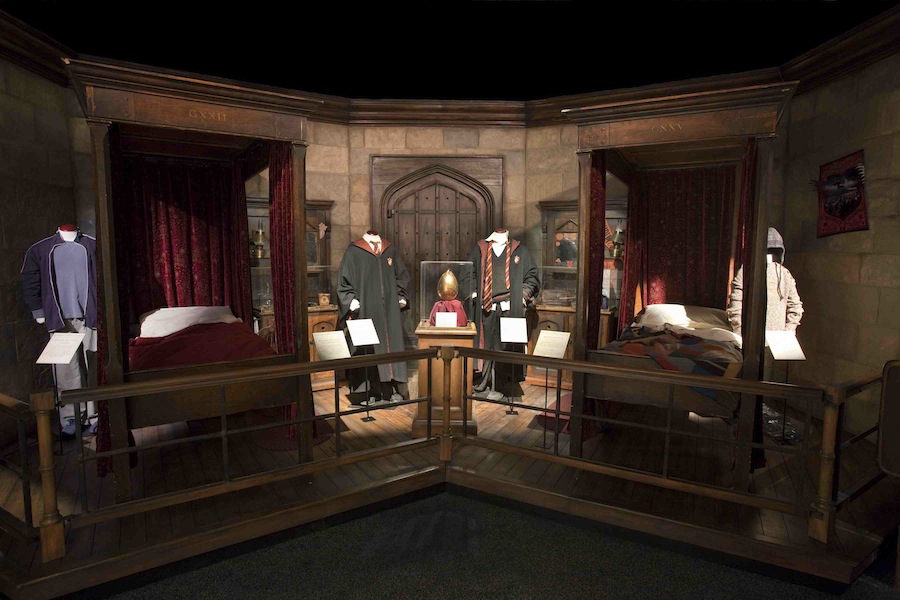
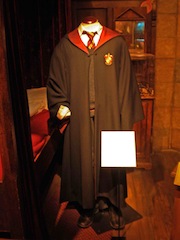
After the Pre-Show, the exhibition truly begins. Guests are led past a gallery of portraits and the Fat Lady, the guardian of the Gryffindor area of the castle/school, into the third installment of the exhibition, the Gryffindor Common Room. Gryffindor is the house that Harry Potter, Hermione Granger and Ron Weasley, the series principle characters, belong to. In this area the audience views the house colors (scarlet and gold), Harry’s glasses and wand, Ron’s monogrammed sweater and the Marauder’s Map. Past the Gryffindor Common Room are the dormitories where the visitors can view more of the wardrobe and garner an understanding of the actors’ journey growing from children to young adults as the clothing shows their physical growth from the first film to the last. The fourth set are the classrooms – displays of the props and costumes of the Potions, Divinations, Defense Against the Dark Arts as well as a recreation of the Herbology greenhouse. This is one of three areas in which the touching of props is encouraged – visitors can pull a squealing Mandrake from its potted roots.
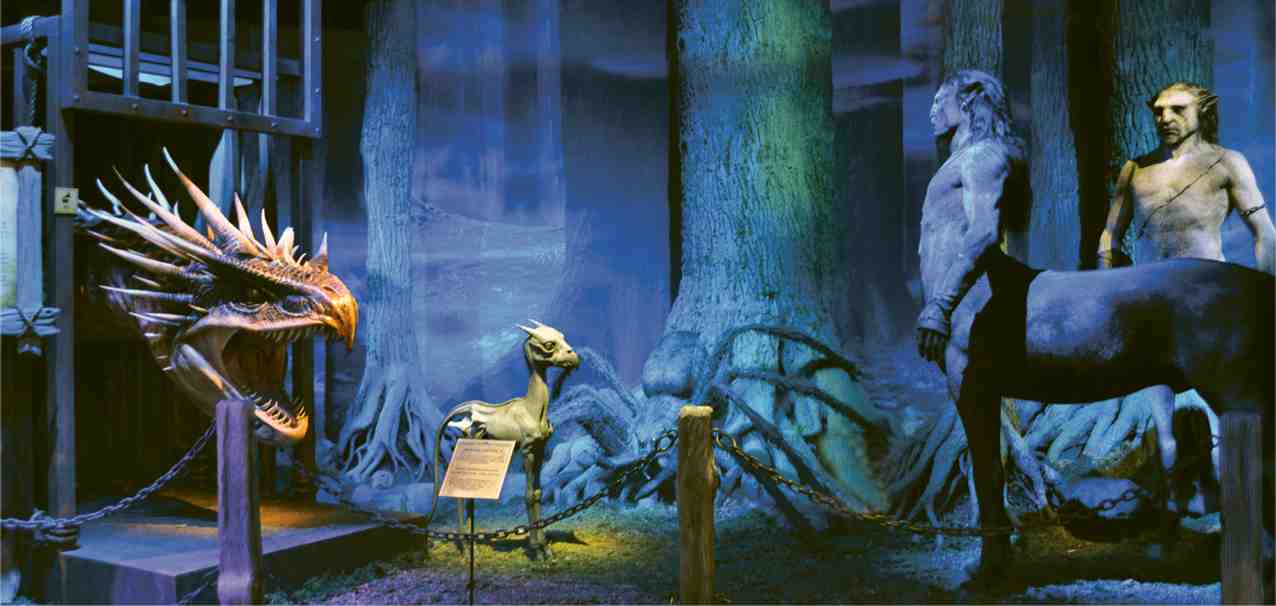
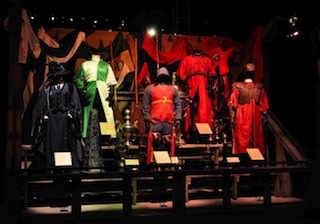
Once out of the classroom area, the tour goes outside the grounds of Hogwarts into the Forbidden Forest – the audience can get up close and personal with the Hungarian Horntail Dragon, a Centaur and a Thestral. Also displayed are Buckbeak the Hippogriff and additional costuming from the film. The Forbidden Forest leads to Hagrid’s Hut, which is actually located on the outskirts of the forest in the book and film series. This oversize room contains Hagrid’s clothing, the Monster Book of Monsters as well as a mammoth chair that visitors can sit in. Quidditch is the sport of choice for wizards and is the next section of the exhibit complete with Quidditch equipment, a Nimbus 2000 broom, the Golden Snitch used in all the movies and uniforms from the different houses. If a guest is feeling athletic, they are invited to toss a Quaffle around and try to score a point or two. The exhibit takes a dark turn as the next segment is dedicated to the darker elements of the films. On display are the Angel of Death Statue, robes, costumes and masks of Lord Voldemort and his Death Eaters. The tour of the enchanting world of Hogwarts and its inhabitants ends in grand fashion with the Great Hall. The Great Hall is a setting that plays a major role in the film, visitors will view props and costumes from the Yule Ball, Professors McGonagall and Dumbledore’s costumes and wands as well as Dobby, the house elf, and Fawkes, Professor Dumbledore’s phoenix.
The exhibitions build in excitement and education with each setting seemingly more fascinating and fabulous than the previous one. The price for admission for Harry Potter: The Exhibition is$25.00 for adults and $19.50 for children ages 4-12; an audio tour is available for $7.00. The items of the exhibit are labeled with numbers and information about the artifact, with the audio tour the visitor can learn more information about the prop by the people that actually manufactured it. Both the price for admission and the audio tour are worth every penny. This exhibit is a must see for anyone that is a fan of the Harry Potter series or anyone that is a true movie buff. I have never read J.K. Rowling’s books and I have not watched the Harry Potter film series in its entirety, but I found Harry Potter: The Exhibition to be a very enriching experience. The concern to make these fictional characters and settings believable and the attention to the minutest detail is amazing. When I arrived at Discovery Times Square, I was a muggle novice; I left feeling as if I had known and grown with the cast (human and non-human) as well as any Harry Potter fan and will be eagerly anticipating seeing how it all ends when the last film is released in July. Harry Potter: The Exhibition, leaves New York City September5, go and indulge the wizard in you.
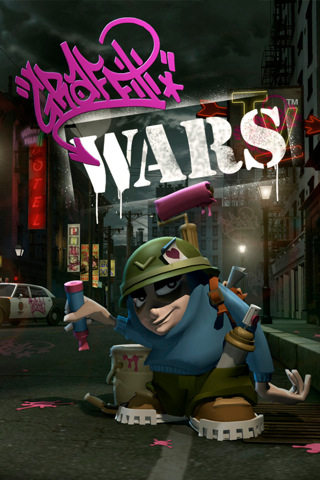
Have you ever been inspired to unleash your creative vision on the streets of NYC but were scared to do so because of fear of the NYPD? Well, now there is an app for that. Graffiti Wars, by Stink and Muse, version 1.0.2 is now available for the iPhone 4 and iPhone 3GS. This GPS based game allows you to create graffiti with your own personal aesthetic. The player earns extra points by tagging over rival graffiti spots; the points can be used to protect your graffiti. Although there has been a previous version of this app available, this version boasts an improved performance, bug fixes and other game play tweaks.
I am not sure about you FAMERS, but this app sounds like it is quite addicting and supplies another reason for people to walk with their heads down, not watching where they are going. This game gives new meaning to the saying, “Tag, you’re it.” Sign me up!
The Day After Tomorrow, Twister and Volcano are Hollywood’s idea of what a cataclysmic natural disaster would be like. But in August 72 A.D., Mother Nature played out its own story when the cities of Pompeii and Herculaneum were buried alive under ash and pumice from a colossal eruption from Mount Vesuvius. Very few natural catastrophes have ever rivaled the destruction of Pompeii and Herculaneum as an entire existence was obliterated in a 48-hour span.
Pompeii and Herculaneum was inadvertently unearthed in 1599 and was once again forgotten about until 1738 when Herculaneum was rediscovered by workers digging for the King of Naples’ summer palace. Pompeii was found 10 years later. In 1860, archeologist Giuseppe Fiorelli took charge of the excavations and had the spaces left by the victims of the eruption filled with plaster to create perfect casts of the citizens that were unable to escape. Pompeii and Herculaneum also marked the first major find in the budding discipline of archaeology.
What made the cities of Pompeii and Herculaneum such an ideal discovery was the cause of its demise. The pumice and ash created a tomb for the municipalities and its occupants. Everything about the Roman towns remained the same as it did when eruption began – lying undisturbed and waiting for human civilization to resurrect it from its petrified state. More than any other find, Pompeii and Herculaneum gave people the opportunity to witness what daily life in the ancient world was like. Now New Yorkers can incorporate this once thriving city and its surrounding town into their daily routine by visiting Pompeii the Exhibit: Life and Death in the Shadow of Vesuvius at Discovery Times Square.
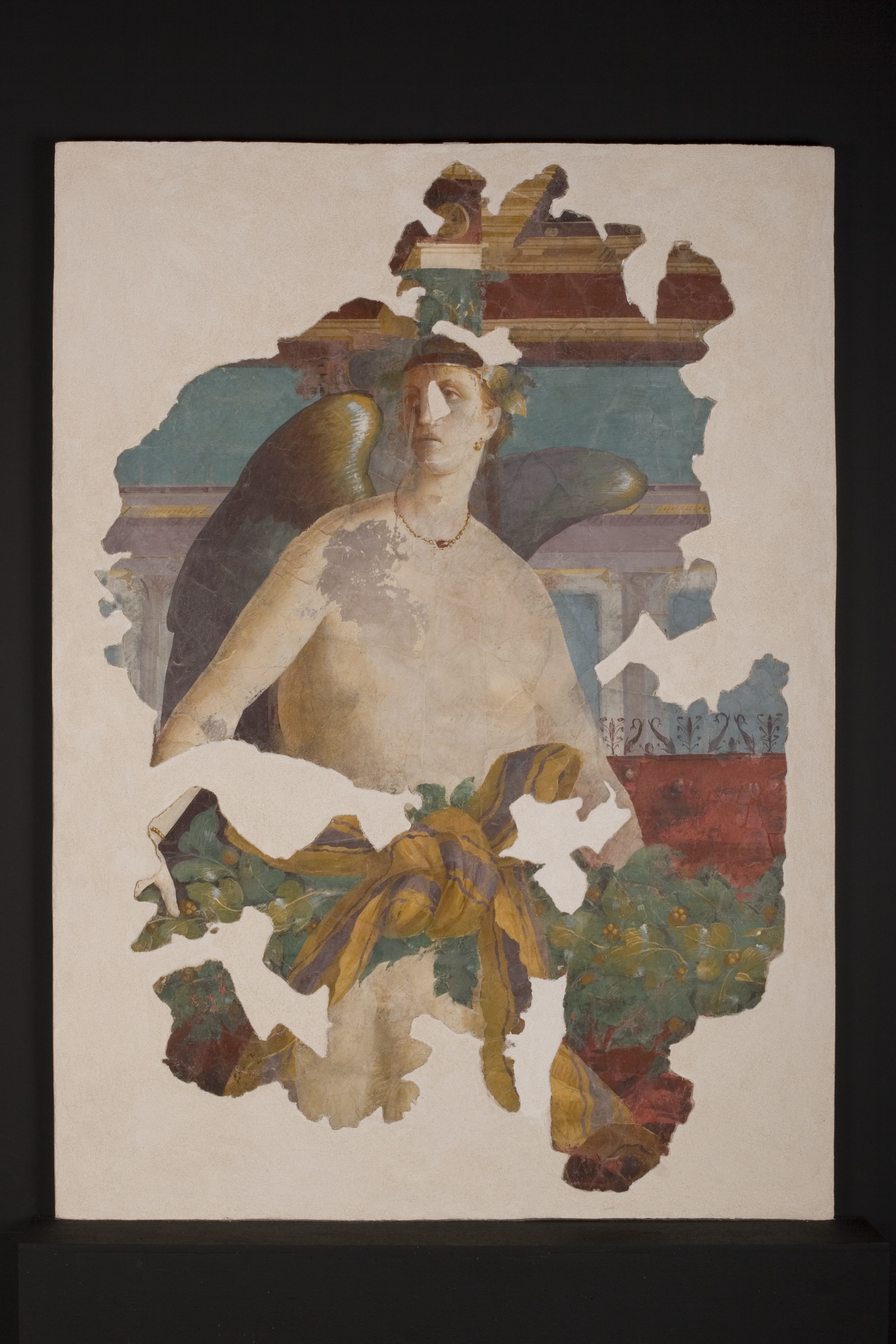
Pompeii the Exhibit is a comprehensive exploration into the commonalities of the human existence – a visual display that reminds of the audience that the song “Everything Old Is New Again” rings undeniably true. Over 250 artifacts are exhibited; we learn about Pompeii’s principle gods and goddesses, which were adopted from Rome, Greece and Egypt as well as view their money system, weights for measurement, a wall of graffiti, jewelry and a recreation of a room in a brothel. Also included were utensils, beans, a loaf of bread and partially restored frescos.
Perhaps the most creepy and bone-chilling aspect of the exhibit was the six-minute video that recreated the extermination of Pompeii and Herculaneum and the body casts and skeletal remains of those who perished. Patrons enter a dark room with a screen. Minute-by-minute the details of the eruption are witnessed as crashing, fiery effects are projected from the speakers and with a cold blast of air, the doors open to reveal the replicas of the citizens that endured the worst horror one’s mind could ever conceive. But what is equally fascinating and daunting was that unlike the rest of the exhibit, reality had been exhumed and presented right before our eyes. In other rooms of Pompeii the Exhibit: viewers could imagine a man entering the brothel room with his chosen lover or the gladiator that wore the helmet and shin guards that protected him in a glorious win. But there was no need to imagine the pain that was wracked in the face of a chained dog as he twisted on his back or the man that covered his face with his tunic to avoid inevitable suffocation. The room was filled with ghosts telling their story.
Pompeii the Exhibit: Life and Death in the Shadow of Vesuvius will run at Discovery Times Square, located at 226 West 44th Street, until September 5. Like the King Tut exhibit, a portion of the proceeds of the exhibit will go toward the preservation of the Pompeii site. Ticket prices range from $19.50 to $25.00 and the last tickets are sold 90 minutes prior to closing.
Many mourned the departure of Fat Beats when they closed the doors to their Manhattan and LA stores last year. But as a wise man once told me, nothing is ever really gone. The legendary record store is back and in Brooklyn, at least for day. That’s right, those who crave the crackle only vinyl can supply will be ecstatic to know that Fat Beats will begin a monthly pop-up shop in their warehouse, located in the DUMBO section of the borough at 110 Bridge Street, starting on March 5. On hand to bless Fat Beats’ reopening will be some of Brooklyn’s heavy hitters on the ones and twos, DJs Spinna, Evil Dee and Rich Medina. Doors will reopen at noon. If you consider yourself to be a true hip-hop head, mark your calendar for Saturday and pop-up at the pop-up shop.
Actually, this documentary is an oldie but goodie – a cult classic. Re-released after 25 years on DVD, 80 Blocks from Tiffany’s resurrects the apocalyptic conditions of life in the South Bronx in the late 70s and early 80s that later gave birth to hip hop and its culture. Released in 1979, 80 Blocks from Tiffany’s focused on two street gangs, the Savage Nomads and Savage Skulls. The idea for the documentary came to director Gary Weis after reading “Savage Skulls,” an article by Jon Bradshaw published by Esquire Magazine which centered on both gangs. After convincing SNL producer Lorne Michaels to help him produce the film, Weis and a camera crew went into one of the deadliest areas in New York City – a combat zone where various gangs ruled the streets serving their own brand of justice and terrorism. Weis, Bradshaw and crew spent two weeks in the South Bronx speaking with and recording gang members, police officers, community activists and civilians.
The title, 80 Blocks from Tiffany’s, referred to the distance between the much glamorized jewelry store on 5th Avenue and the South Bronx. A viable walking distance for anyone that has the moxie, but too far the young men and women living a virtual Mad Max existence who had never been out of the Bronx. The dilapidated, burned-out buildings, plots of barren land, and abject poverty displayed in the film were light years away from the famed store turned iconic by a Truman Capote novel and Blake Edwards film in which the heroine claimed that nothing could go wrong in Tiffany’s. These young adults had no fabulous shelter to run to, so they created their own shelter, families, laws and opportunities in hellish conditions.
Stark…inexorable…undeniably real, 80 Blocks from Tiffany’s has received a following that far outreached the expectations Gary Weis ever had for the film. Part of the reason for its cult status is because of the participants in the film. These young men were angels with tattered wings and filthy faces who admitted to beatings, rapes, robbery and other crimes, yet their compelling presence demanded viewers to see past their deeds and peer into their souls. As mundane and clichéd as it sounds, they were the fruit of their environment, how could any viewer really judge having never experienced their life. These men and women were the displaced members of the civil rights movement that did not come up like George and Weezie, but instead got left behind. And as the dust settled from riots, arson, the flooding of drugs into their community and the economic climate of the day (which was just as dismal as our present condition) they were forced to fend for themselves by any means necessary.
The other component that draws people to the film is the portrait it casts on New York City, which serves as a microcosm for all inner-cities in the 70s. After watching this 67-minute narrative of barrio life, you will completely appreciate how granular this metropolis really was. Also, you will understand the correlation between the gang culture of NYC and its influence on the genesis of hip hop. These gang members were the catalyst and founding fathers of hip hop culture, patriarchs like Afrika Bambaataa, a founding member of the Black Spades who used hip hop to thwart kids away from gang life and the violence that accompanies it.
Mesmerizing from beginning to end, 80 Blocks from Tiffany’s is a collector’s item for anyone that loves New York or hip hop history, it is an essential slice of Americana that worth revisiting and should never fall back into obscurity again.
First released at the Sundance Film Festival in January 2010, then released nationwide in June, Jean Michel Basquiat: The Radiant Child is Tamara Davis’ visual love letter profiling one the most enigmatic, creative entities that ever passed through the streets of Gotham.
When Basquiat died at age 27 in 1988 of a heroin overdose, he had already been recognized as a prodigy who was equally known for being infamous. Since his untimely death, he has ascended beyond the classifications that hindered him in life to become one of the most famous artists of his generation. Being the first black fine artist to not only break in America, but internationally, he reached a pantheon of that few black artists attain – a trailblazer burdened with the responsibility of being the first, a star that ultimately becomes an anomaly that neither well-meaning liberals nor conservatives know what to do with.
Brilliant and tragic…beautiful and scarred…extremely personal and striking, this documentary presents an introspective portrait of Basquiat’s life through rare footage and interviews with Basquiat, as well as remarks from friends, colleagues and ex-girlfriends. The film begins with Langston Hughes’ poem Genius Child. It chronicles his move from Brooklyn to NYC in the late 70s, which was laden with crime and economic hardship, the forming of the band Gray (comprised of himself, Shannon Dawson, Michael Holman, Wayne Clifford, Nicholas Taylor, and Vincent Gallo and named after Gray’s Anatomy by Henry Gray) and his rise as a star in the downtown art scene from the SAMO graffiti to his first shows. It also provides a comprehensive review of Basquiat’s work, paying homage to other artists, and chronicling the black experience in America, as well as details his isolation, becoming a prisoner of the fame he sought, his descent into heroin addiction, his friendship and collaboration with Andy Warhol and his grieving and further spiral into drugs upon Warhol’s death.
The 90-minute film ends with observations about his last show in April 1988 (a bleak prophecy or a massive cry for help), a pictorial retrospective of his work and the man himself and Fab 5 Freddy reciting Langston Hughes’ Genius Child, changing the last line to “Free him – and let his soul run wild.”
When he died, Basquiat left over 1,000 drawing and paintings. What I realized after watching this documentary is that the true last line of the poem is more accurate, “Kill him – and let his soul run wild.” Was it really the heroin that killed Jean-Michel Basquiat, or was the katzenjammer of loneliness that often shadows success? Maybe Jean-Michel Basquiat was murdered long ago by the press, the art elitists that control the New York and international art scene and straphangers that latched on to his coattails for a ride. Maybe the heroin overdose really did free him to allow his soul to run unbridled and unburdened.
Artists, especially great ones, always offer profound commentary about the history of our world and reflect the current circumstances of our society, sometimes even predicting it in their work. Basquiat was known for using the expression “Boom for real.” Perhaps he knew he was not meant to wither and age, but instead, he was more like a comet illuminating the sky, fleeting, wondrous to behold and leaving fiery fragments behind – evidence that signifies that what was witnessed truly existed.















 F.A.M.E NYC Magazine