
Once upon a time in there was an island, surrounded by the Hudson and Harlem Rivers. It was a place where the underworld, “Regular Joes” and elite flowed past each other creating a unique aura that produced the energy for a city that never slept. Those seeking fame and fortune came to the island to stake their claim and be seen. Manhattan was a melting pot brimming to the top with a million and one stories that now haunt the streets like ghosts over resurrected apartment complexes and 21st-century skyscrapers.
 One such story about that emerged out of this glorious period was the story of David Hampton. A handsome grifter from Buffalo N.Y., Hampton used his good looks, manners and ability to manipulate others to intersect with the upper-crust of New York City society and glitterati. By pretending to be the son of Sidney Poitier, Hampton dined for free at the best restaurants, received A-list treatment at New York City hot spots and flimflammed his way into the homes of the Upper East Side.
 Playwright John Guare became aware of Hampton’s infamous con when married friends of his became one of Hampton’s many marks. Their intersection became the foundation for his play Six Degrees of Separation. Six Degrees of Separation made its Broadway debut in 1990 at the Vivian Beaumont Theater and was nominated for the Pulitzer Prize and a Tony. It was adapted into a movie in a film in 1993. Now it’s back on Broadway for a limited 15-week engagement.
 On the surface, Six Degrees of Separation explores the theory that everyone is connected by six other people. The play primarily takes place at the apartment of Flan and Louisa “Ouisa” Kittredge, which overlooks Central Park. Flan is an art dealer and one evening when he and his wife are entertaining (and ass-kissing) a super-rich friend, Paul, a young, charming black man, appears on their doorstep wounded and bleeding. He claims he had been robbed and stabbed. He claims he knew their children. He says he is the son of Sidney Poitier.
 Paul cooks them dinner and beguiles them, especially Ouisa who had been seeking a deeper connection with her own children. Paul tells the Kittredge’s that he is expected to check into a hotel with his famous father in the morning. Flan and Ouisa insist that Paul spends the night with them. In the morning, Ouisa goes to wake Paul and finds him mid-coitus with a hustler he picked up after they had gone to bed. After that encounter, Ouisa and Flan’s lives continue to intersect with Paul. Finally, after one scam too many, the police get involved. Sensing the police are closing in, Paul makes a final, desperate call to Ouisa to beg her to accompany him when he turns himself in. She agrees to take him, but the police pounce before she can get there. Ouisa is left to ponder the future of Paul, the experience as a whole and her future after this experience.
 If one is only looking at the surface, it would appear that Six Degrees of Separation looks at how lives collide into each other and impact those collisions make, but the play takes us deep into the rabbit hole providing critiques on myriad topics. Six Degrees of Separation tackles issues of race, class and homosexuality. The beauty of Guare’s storytelling is the method in which these topics are brought to the forefront. The dialogue is luscious, full of wry wit and flows with a hustle and bustle of New Yorkers beating their feet to the pavement during rush hour. Guare doesn’t bop you over the head or smack you in the face with social commentary, instead, he guides you to a mirror, and when you are laughing at some snarky line, you suddenly realized you are looking at yourself and how you have perceived others. New Yorkers are so quick to believe the hype of the liberalism simply because there are no monuments erected to Confederate generals in the middle of Times Square; however, when faced with our own Guess Who’s Coming to Dinner scenario, we suddenly realize we aren’t as free-thinking as we thought we were. Through Flan, Ouisa and Paul, the audience is able to confront their own prejudices, fears and desires to belong.
 The selection of the cast is a stroke of genius. Allison Janney is hysterical as Ouisa; her comedic timing is impeccable. When Ouisa is most introspective, Janney breathes tenderness into these moments. Her performance reveals just how much Paul has changed the trajectory of Ouisa’s life. John Benjamin Hickey provides a multi-faceted performance of Flan. He is pretentious, yet sensitive. He has the soul of a tortured artist, but reeks of capitalist greed. He is a hypocrite, yet still totally likable. The crown jewel in this cast is Corey Hawkins, who plays Paul. From the moment he rushes onto the stage in a state of panic, he captivates the audience. Without knowing, Hawkins wraps you around his finger and compels you to believe even the most fantastic lie. Every face Hawkins presents as Paul is equally as believable as the next. When he says to Ouisa,” I like being looked at,” I thought to myself who would want to look away? Hawkins goes deeper than just bringing the character of Paul to life for a new generation of theatergoers. He honors the soul of the man whose infamous life was the catalyst for this splendid play. He is a writer’s dream, a master actor in the making.
 Six Degrees of Separation is a masterpiece. The only problem with this production is the fact that it’ll only be at the Ethel Barrymore Theatre until July 16. This play is too brilliant to run the risk of not being seen by every New Yorker and those who come to visit this metropolis. The themes of this play are as relevant now as they were in 1990 because they are intrinsic components in the state of the human condition. More importantly, this play is a time capsule of an era in New York City that will never come around again. Only in Manhattan could a con artist pretend to be the child of an icon and hobnob with the crème de la crème of New York society. Six Degrees of Separation is vivid, sexy and seedy; just like Paul. It’s one Broadway experience that shouldn’t be missed.
Photos: Joan Marcus


 MAHOGANY REYNOLDS
 ARTHUR G. PUGH
 BRYANT L. LEWIS
 LAMAR RICHARDSON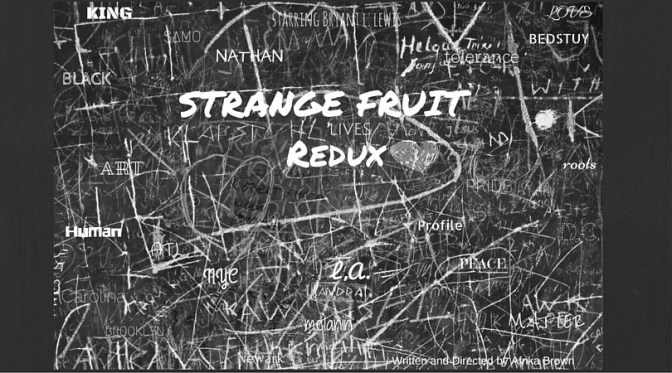
 HERE Arts Center is located at 145 Avenue of the Americas; show time is at 7 p.m. Written by Afrika Brown and starring Bryant L. Lewis, STRANGE FRUIT REDUX centers on a pivotal day in the life of Nathan Strange, a 25-year-old artist from Brooklyn, as he is poised to ascend to the top of the NYC art scene; it’s a series of poem monologues mixed with music and sio-political, pop culture sound bites geared to show the fears and frustrations of the modern day black man. Tickets for the 29th are still available and can be purchased at
 First, I’m a former ballet dancer. I didn’t dance for “the frickin’ Bolshoi”, but I have a long history with NYC and the dance community spanning from coast to coast, and I taught ballet for seven years. I’ve interviewed famous principal dancers, collaborated with artistic directors, danced beside guest professionals, had my toenails fall off from dancing on pointe, lived in many studios, stages, audiences, and in the wings. I know a thing or two. I’ve even seen a few of the show’s stars, Sascha Radetzky and Irina Dvorevenko, perform live. Second, I’m pushing 30, I’m married, I had a friend die from heroin, I struggled with an eating disorder in high school, I had a friend who stripped in her early twenties, I’m fully aware incest and other sexual abuse exists, and I’ve seen slit wrists up and close. Not only do I have experience in the ballet world, (which most of the trolls on the message boards don’t), I don’t live in La La Land either. Life can be rough. “Flesh and Bone”, however, in its attempt to combine all these taboos with tutus, is just all kindsa’ wrong.
 If I’m going to play Devil’s advocate, I can see its appeal from a couple of angles: one, non-dancers are genuinely curious about ballet dancers’ lives because the ballet world is largely mysterious. If it weren’t for YouTube and other social media, the everyday operations of a ballet company would be buried along with Balanchine—exclusive and inaccessible. After all, most people don’t wear leotards to work. They want to know if the urban legends of bleeding toes and sleeping with the director are true. I get that. (For the record, dancers toes do bleed, and the casting couch is not an impossibility.)
 On the other hand, sex sells. And that’s unfortunately—depending how you feel about it—the problem. Yes, dancers have sex lives and walk around naked in dressing rooms. Nothing inaccurate about that. But when phallic slang, midday romps with boy toys, and pissy naked roommates leave more of an imprint in your brain than the subject itself—ballet—it means the producers are lazy. Seriously, when you spotlight a prima ballerina snorting coke before each class, the masses will automatically be wondering the next time they take their daughter to see the Nutcracker if the Sugar Plum Fairy has a deviated septum. Even if these scenes and story lines reflect some of the realities of the ballet world, the show isn’t an artfully crafted, thoughtful vehicle for educating the outside world about the profession. Rather, it’s one giant, gratuitous cheap shot that plays on the ignorance of the general population. I made it through the first episode only because I had access to a fast-forward button. After half-watching the lead character’s brother tame the dragon to her beloved childhood heirloom, I won’t try to stomach another one.
 I’m over my generation’s fascination with the Natalie Portman-ballerina. The tortured ballerina is so passé. If this makes me anti-progressive or un-hip, so be it. I’ll be joining the old folks down at Lincoln Center for some true artistry.
 Bethany Leger taught ballet for 7 years in Dallas, TX. She is the founder of Ballet For Adults, a site dedicated to educating adults about ballet at

 F.A.M.E NYC Magazine