Flex and Tension with The Ailey Extension

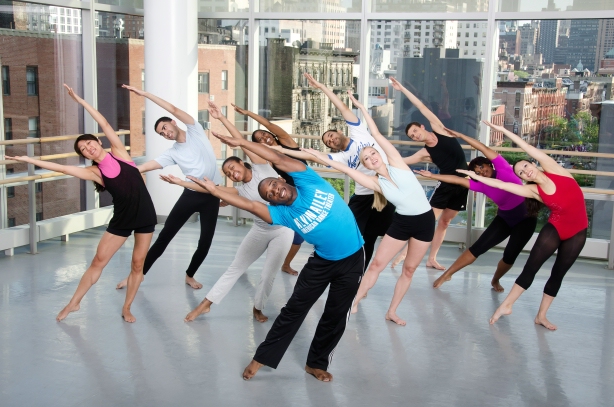
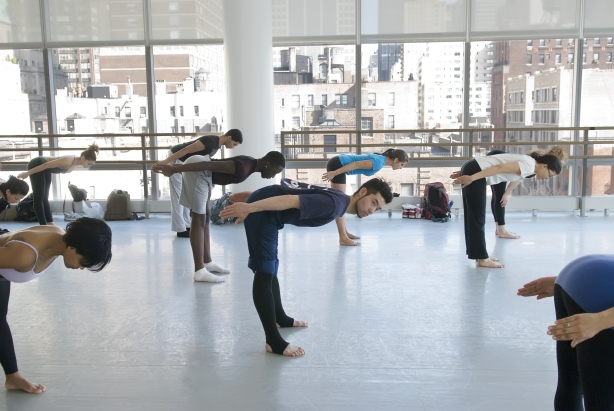
During the spring, most of us work like Rocky Balboa training for a prize fight in order to look desirable during New York City’s annual humidity festival, also known as the summer.   But as sure as The Empire State Building lights up in the evening, the temperature cools, making way for fall.   Bikinis, mini-skirts, sandals and halter tops are replaced with jackets, sweaters, corduroys and knee-high boots.  The quest to maintain that summer figure may become more difficult as fall gives way to winter.  New York City is filled with gyms, but spinning on a bicycle going nowhere, posing in yoga positions or doing repetitions on a weight machine are not the only methods to staying fit and agile.  Dancing provides all the sweat and none of the routine of regular workout and The Ailey Extension offers both.
Alvin Ailey American Dance Theatre is best known as being the “Cultural Ambassador to the World,” but in New York City AAADT is an institution.  Founded in Manhattan in 1958, Alvin Ailey American Dance Theatre and its creator changed the landscape of American modern dance.  One of Ailey’s signature ballet, Revelations, is considered to be the most often seen modern dance performance.  Each time I watch this extraordinary work, I sit in awe and sometimes believe that I can perform the choreography.  After my brief moment of delusion, I realize I can never move and accentuate my body like someone who has devoted their life to dancing and performing, but I can learn.   

“Mr. Ailey understood that people need to be engaged and connected in a way that they understand,” states Iquail Johnson, one of the instructors at The Ailey Extension.  And through The Ailey Extension everyone is able to partake in a piece of Alvin Ailey’s legacy, experiencing the opportunity to comprehend dance the way he understood it.  Created in 2005, The Ailey Extension offers over 80 dance and fitness classes each week in a variety of different styles and skill levels.  The teachers are all specialists in their field.  Iquail Johnson is a Philadelphia native that began his career in dance at 13 after being accepted to the Philadelphia High School for the Creative and Performing Arts.  He continued his studies with PHILADANCO, Philadelphia Dance Company, and earned scholarships to attend The Julliard School, The Ailey School and The Paul Taylor School among others.  After receiving a Bachelor of Fine Arts in Ballet from the University of the Arts and a Master of Fine Arts from SUNY Purchase, , Iquail has worked with dance companies including Ronald K Brown/Evidence, The Fred Benjamin Dance Company, and Subtle Changes.  He has also appeared on Broadway in Hot Feet, The Lion King, and Purlie and is the Founding Artistic Director of Dance IQUAIL!

Iquail began teaching Horton, the dance style Alvin Ailey used as the foundation of his choreography, at The Ailey Extension in 2006.   One might think that a dancer of his caliber would be climbing the walls trying to teach a roomful of nonprofessionals how to properly execute Locomotions, “Accented Runs,” “Hip Pushes” and “Leg Slices,” but Iquail enjoys working with the variety of students that pass through his class on a weekly basis.  “The most interesting thing is to see the development,” he says.  “You can see when they come in if they have no experience.  But no matter where [the students] come in, at what level, you can always see the growth that happens, you can see the ‘a-ha’ moment, when finally after taking classes for three months, six months or even a year they start to get it and their body starts to understand it. And that is the beauty of it.  When the body holds on to it, it is something that is undeniable,” 

As a trained dancer, Iquail physique is the embodiment of perfection, but he also believes that dance is a great alternative to traditional exercise regiments.  “Dance is a fabulous way to introduce people to movement.  No matter what kind of culture you are from, movement is a part of our everyday life, even if it’s a pedestrian walking down the street, he says.  “And the physical aspect is so integrated in dance,” he continues, “that its fun. You’re not thinking ‘Oh I have to do twelve more or I have thirty minutes.’  Also you are building cognitive skills, you’re developing comprehension skills, you’re coordinating your body, so at the end of the day you’ve developed your physicality, your mental state and your awareness of other people, and you packaged it with grace and elegance.  You can’t get that working out.”   When asked what technique he prefers and which technique should a new student learn first, Iquail jokingly replies, “Horton of course.”  “It is a fabulous technique for a lot of different reasons,” he says, “One, it wasn’t created with one person in mind. A lot of modern dance was developed for one person, the creator of that particular style.  Lester Horton decided not to let himself be the vehicle to express his technique, he used all the dancers around him, so that way he could make the technique work for no matter what body type you have.”  But if a student comes into The Ailey Extension taking Horton, they do not have to stick with it.  The staff and teachers at The Ailey Extension want you to feel connected to whatever classes you decide to take.  With that concept in mind, The Ailey Extension has an open door policy where students can go from one class to the next, trying them out until they find a class and teacher that works for them.

After my brief conversation with Iquail, it was time for me to see him in action as he taught his Wednesday evening class.  As I walked through the halls to the classroom the richness of spirits that have passed through this hallowed dance institution was almost tangible and completely entrancing.  In fact, as soon as you step through the doors it is as if the weight of day drops at your feet.  The more you walk, the more negativity is removed until you feel as clean as a newly christened baby.  I like to think of myself as a spirit dancer, also known as a free-stylist.  I hear the beat, and whatever comes out, comes out.  I thought I could pull the journalist card and sit back and watch the class, but Iquail would have none of that.  Of course having no formal training, I initially got tripped up by the terminology and stiffened up with the knowledge that was not dancing in a dimly lit room with strobe lights bouncing off the walls, but Iquail’s patience allowed my muscles to relax so that I could receive the dance.  Iquail is no Debbie Allen banging the floor with her dance stick, but he is not Mr. Softee either.  He pulls every inch out of you, making sure that you are extending and giving all you can to the movements.  By the time my hour was over, I realized I had sweated just as hard and felt just as sore as if had ran a few miles or had danced for five hours.  I left the class with a soul as rejuvenated as any time I danced a 10 -hour marathon at Club Shelter.  As I walked out, I thought about something Iquail said about the legacy of Alvin Ailey, whose presence could still be felt in the building.  “I think it has to do with taking dance away from dance.  It has to do with the fact that [Mr. Ailey] touched people.  And that everything he did was as a result of selflessness and generosity, and people gravitate to that, unbeknownst to them.  His generosity was so strong that people can’t explain why when they go see Revelations, that it is something they have to return to see over and over again for the last fifty-two years.  Now when you go see something fifty-two times, you’re like ‘Ok, now I’m tired,’ but to see something over and over again for fifty-two years, it becomes something that is transcendent. And I think that is why [AAADT] is such a global brand, because it is not about the dance.  Dance is just a vehicle to tell people we are all connected. The dances are the same steps; it has something to do with the spirit.”  What I learned is The Alvin Ailey Extension is more than just a place to learn dance steps or lose weight; it is a sanctuary to refresh your soul.  The perspiration is just a bonus.  

To learn more about The Ailey Extension, click

http://www.aileyextension.com/

Photos: Gabriel Bienczycki and Kyle Froman

New Ailey Season Comes This Way

Under the leadership of Robert Battle, Alvin Ailey American Dance Theater is poised to add new treasures to their already voluminous, lionized legacy.  The world’s most dynamic and soulful dance company will be in the Big Apple at New York City Center from November 30 to January 1.  The “Cultural Ambassador to the World” is back home to dazzle New Yorkers with new ballets as well as with classics like “Revelations.”  But you do not have to believe me, take a look for yourself.


To order tickets, please click

http://www.alvinailey.org/citycenter

Photo:  Paul Kolnik

Video courtesy of Alvin Ailey American Dance Theater

Get Ready for Shoot Your Close Up

On September 19th, The Tribeca Film Festival has opened submissions for next year’s festival, which will be held April 18 to April 29.  Currently they are accepting submissions for narrative and documentary features as well as short film entries.

Below are the submission deadlines:

October 28, 2011 (6pm EST, postmark)
Early entry deadline for Features and Shorts

December 2, 2011
(6pm EST, postmark)

Official deadline for then-complete Features and for ALL Shorts

January 6, 2012
(6pm EST, arrive by)

Late deadline for Features completed after the Official Entry deadline

The Tribeca Film Festival is looking for the next Woody Allen, Scorsese, Spike Lee or Kenneth Branagh to showcase their talent at NYC’s premiere film event.  The next great Big Apple film may be resting in the annals of your mind, so get that camera out and submit your movie.

To learn more about The Tribeca Film Festival and its submission details, click

http://www.tribecafilm.com/news-features/2012_Tribeca_Film_Festival_Submissions_Now_Open.html

Mary Poppins 2.0, Practically Perfect

Besides the cavalcade of characters that sprang from the world of Disney, Walt Disney was a virtuoso at adapting popular children’s stories into theatrical extravaganzas that were amalgamations of color, sound and joy.  Mary Poppins was no exception.  Based on the book series created by P.L. Travers, the 1964 film was written by Bill Walsh and Don DaGradi, with songs courtesy of the Sherman Brothers.  Shot on a set in California, Disney’s Mary Poppins was based primarily on the first book, starred Julie Andrews and Dick Van Dyke, combined animation and live action, churned out some of Disney’s most popular tunes and won five Oscars.  Although under the strict supervision of Travers, Disney also managed to transform the character of Mary Poppins from a no-nonsense, frigid au pair into a beautiful, cheery governess, as well as delete two of the four Banks children, change the setting from the 30s to the Edwardian era and cajole suggestions that Bert and Mary could have been more than friends. 

Along with creating indelible imprints on American and pop culture, Disney has also found tremendous success adapting their films into stage productions.  Once again, Mary Poppins was no exception and like its box office predecessor, the musical also received an overhaul.  Although Disney wanted to procure the stage rights, they were unsuccessful.  In 1993, theater producer Cameron Macintosh acquired the stage rights and in 2001, he and Thomas Schumacher, the head of Walt Disney Theatrical, began talks on a possible collaboration, which ensured songs from the Disney film could be used. With both sides in accord, a preliminary outline of the show was written in 2002. The stage production of Mary Poppins included aspects of the film and the book series with the book written by Julian Fellowes.   The music and lyrics of the Sherman Brothers received an additional boost from composer George Stiles and lyricist Anthony Drewe, giving the musical a more modern feel with the music helping to move the narrative along.  Also the lively, magical caregiver was brought back to her London roots.  The West End production premiered in December 2004 and garnered two Olivier Awards before floating overseas, opening at the New Amsterdam Theatre on Broadway in November 2006.  Almost five years later, and the carpetbag totting supernanny and the music she inspired are still enchanting men, women and children on Broadway and all over the world with various tours.

I had not seen the film version of Mary Poppins since I was a teenager, but as with most Disney movies, the Supercalifragilisticexpialidocious classic left a huge impression, becoming part of my adolescent experience as well as turning me into a life-long fan of Julie Andrews and Dick Van Dyke.  Although it had been decades since I saw the film, I remembered it enough to realize that the stage version of Mary Poppins had received an upgrade.  It was not a complete skin-pulling facelift; instead the musical had more like a treatment of Botox – a few subtle injections that change the aesthetic of the musical for the better.  By integrating additional books from the series, the plot had a plenteous storyline making it more engaging than its film predecessor.  Staple numbers like “Jolly Holiday,” “Chim Chim Cher-ee,” “A Spoonful of Sugar,” Let’s Go Fly a Kite,” “Feed the Birds,” “Step in Time” and “Supercalifragilisticexpialidocious” are performed in the musical and are cleverly interwoven throughout the course of the upgraded production.  For instance, “Spoonful of Sugar” is performed after the children create a disaster in the kitchen right before their mother is to receive guests for a luncheon, and “Supercalifragilisticexpialidocious” integrates a lesson about the importance of words.  Songs like “Brimstone and Treacle,” “Playing the Game” and “Anything Can Happen” were wonderful complements to the existing Sherman Brothers tunes, even better suited than the original compositions of the film that were removed.

But of course the ultimate test of whether or not Mary Poppins could stand up to the film was the casting of Bert and Mary.  One of the roles Julie Andrews is most famous for is the role of Mary Poppins and Dick Van Dyke made being a lowly chimneysweep seem as cool as a barrister.  The actors attempting to fill these roles on stage had a tremendous shadow following them knowing their faces would replace the image set by these two iconic television, film and stage legends.  Laura Michelle Kelly and Gavin Lee originated the roles of Mary and Bert on the West End, and subsequently played the roles on Broadway, both leaving and returning back to the show.  Mary and Bert are the heart and soul of the show; I believe the show’s long running success, surpassing Pippin to become the 30th longest running show in Broadway history, is a testament to the awesome performances of these actors.  They carry the heaviest burden and they do so with the ease of Atlas.  Gavin Lee is marvelous as Bert.  He almost made we want to say, “Dick Van Who?”  Actress Catherine Walker played the role of Mary during the evening in which I attended.  Walker’s voice is utterly ravishing.  Indeed the entire cast is a pleasure to watch.  Similar to the film, the choreography is traditional with touches of technology fused in allowing Bert to walk on the ceiling and Mary to glide above the audience.  Although not as dare-devilish or as splashy as some of the choreography on Broadway, Poppins is done with air of class, which is always en vogue and can be enjoyed by young and old alike.   Numbers like “Step in Time” and “Supercalifragilisticexpialidocious” are awesome crowd pleasers that would have anyone rise to their feet to give a standing ovation, and “Feed the Birds” is still my favorite song, bringing water to my eyes each time I hear it.  While I would not recommend any parent bring a little one under the age of six to see this musical (there are a few scenes in the show that may be too scary for them) Mary Poppins and the lessons she shares through song would bring the kid out of anyone.  Cameron Macintosh and Walt Disney Theatrical have most definitely succeeded in adding another winning chapter in the story of Pamela Travers most famous character; even a hard taskmaster like Travers would be pleased. The stage version of Mary Poppins surpasses the film and still draws a full house on Broadway.  It is a heaping tablespoonful of fun – deliciously delightful in everyway.

Photos:  Broadway.com

(Posted photos are of Laura Michelle Kelly in the role of Mary Poppins.)

O’Neil Play Goes Back Down Memory Lane

When reading the manuscript of a play, the reader can discover a world that does not necessarily appear on stage.  Dialogue and most importantly stage directions reveal more about the playwright’s true purpose for writing the play other than applause and a stint on Broadway.  Similar to a poem cleverly hidden within a poem, stage directions add texture and inject supplementary life to the work.

No playwright was as detailed with their stage direction as Eugene O’Neil.  The legendary dramatist made his first mark on Broadway with Beyond the Horizon, but before O’Neil became a Nobel and Pulitzer Prize winning playwright, he was an experimental writer in the downtown theatre district. 

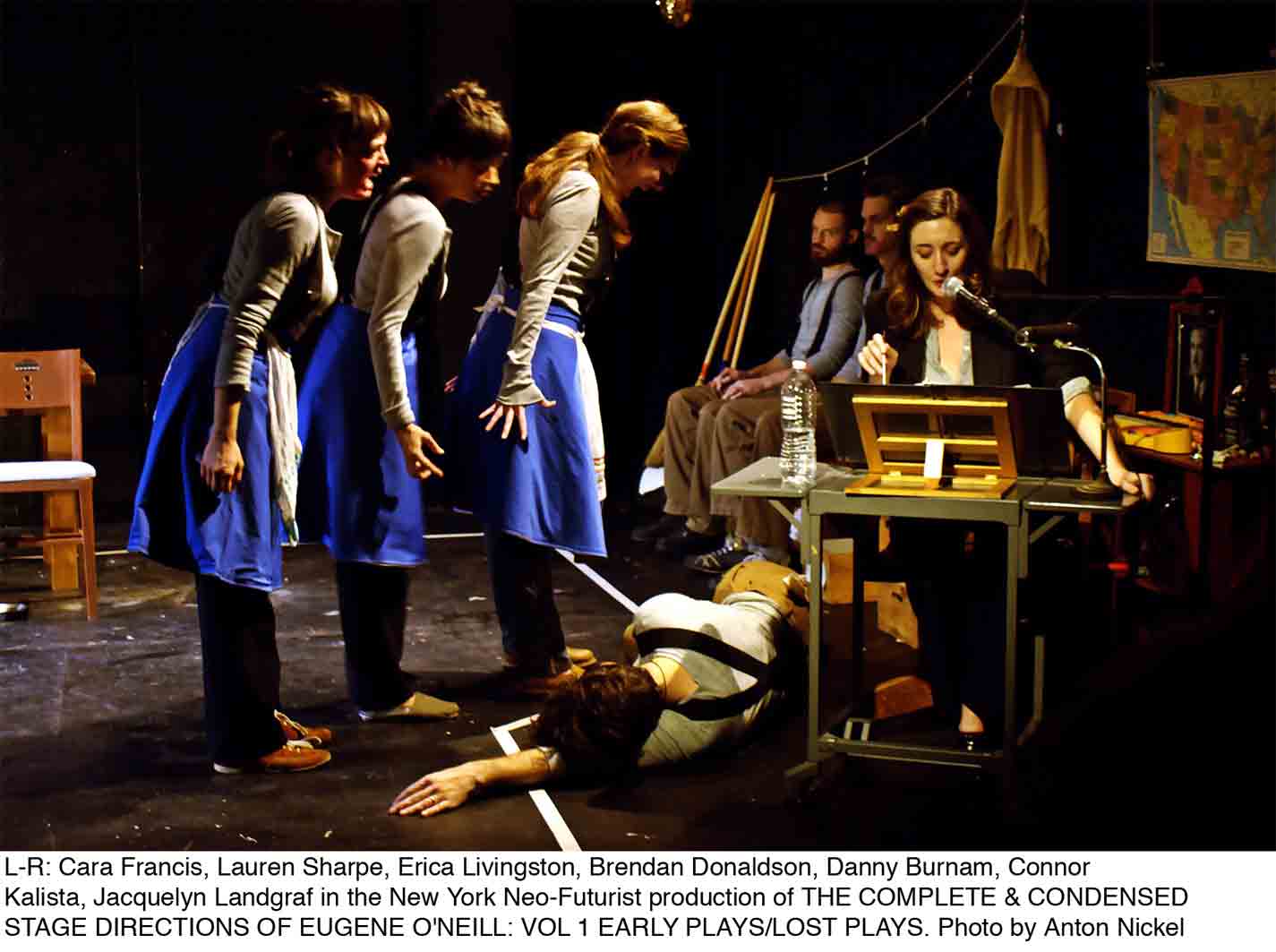
Christopher Loar describes O’Neil as “a failed poet who became a Nobel Prize winning playwright.”  Loar is an ensemble member for New York Neo-Futurists  Known for Too Much Light Makes the Baby Go Blind, a production billed as “an ever-changing attempt to perform 30 Plays in 60 Minutes,” New York Neo-Futurists interject vivacious physicality into live theatre – they are not a theatre group, they are a revolution.  As the director of The Complete and Condensed Stage Directions of Eugene O’Neil: Vol. 1, Early/Lost Plays, Christopher Loar accepted the mission of adapting O’Neil’s punctilious stage directions into a production that could stand on its own, separate from the dialogue, scenery and transformation of the actors into the characters.  The result is an uproarious free-for-all.

Loar and the ensemble of New Neo-York Futurists deconstruct the instructions of an obsessive control freak and create comedic art.  Following the model of Too Much Light, the troupe stages a physical reenactment of seven of O’Neil’s lesser known works.   As a narrator, played by Jacquelyn Landgraf describes the action, the ensembles mimic O’Neil’s stage directions with gestures that are over-dramatized and abundant with laughs.  There is no way anyone can watch this production and not walk away without having one moment in which they are doubled over in their seats from laughter.  Each of these plays deals with intense emotion and somber subject matter, however after New York Neo-Futurists get done with it, it became a vaudeville skit for the new millennium.  A red pail doubles for a fire in the Arizona desert; actors with shark fins on their heads imitate circling predators, an ensemble member places a puppet dinosaur over her hand and pretends to coo and cry like a baby, actors smear rouge on their face to display changes in emotion, a pig nose masquerades for an oddly shaped feature– all of it absurd and every bit of it comedic gold.

Overall, The Complete and Condensed Stage Directions of Eugene O’Neil is a 60-minute bacchanalia.  It is a brilliant, unique theatre going experience that elevates O’Neil’s work into a new realm all while bringing  America’s greatest playwright back to his beginnings.  If Benny Hill and Monty Python adopted a group of kids, New York Neo-Futurists would be their rainbow tribe.  Hats off to this kooky troupe for developing a new take on a theatre legend.

Photos:  Anton Nickel

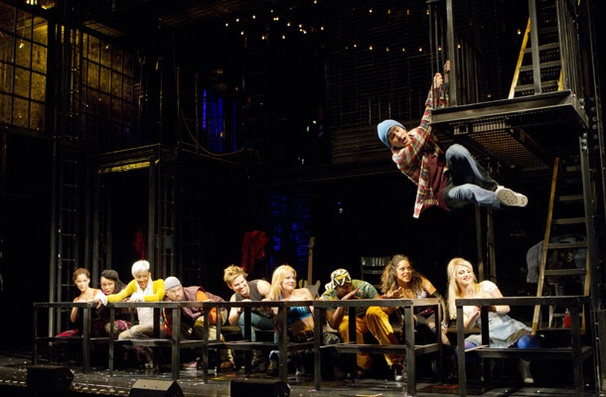
A Testimony for RENT

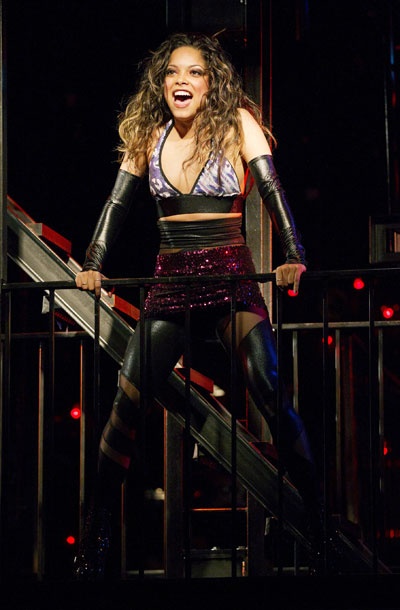
Every Sunday those who are filled with the spirit, regardless of their denomination, attend church.  In the Baptist faith, there is a part of the service called devotion.  During this time, parishioners and visitors stand before the congregation and give their testimony, which generally consists of a narration that details the trials and tribulations that they have gone through and how they have overcome them (usually with  the assistance of god).  I spent season after season of my childhood in church listening to people’s testimonial; none of them were as dynamic as the affirmation I received after watching RENT.

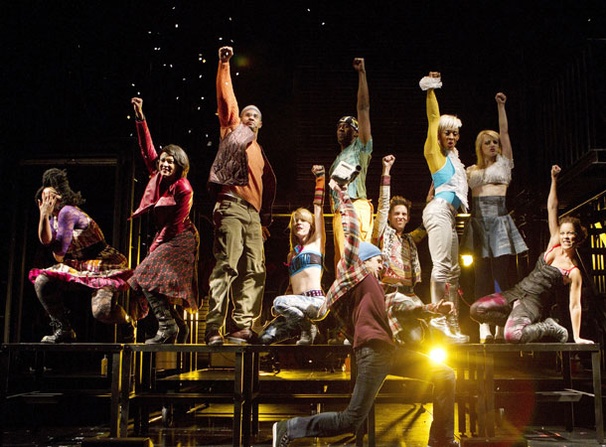
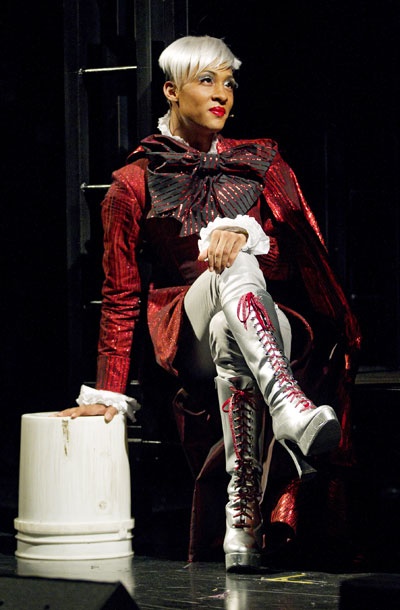
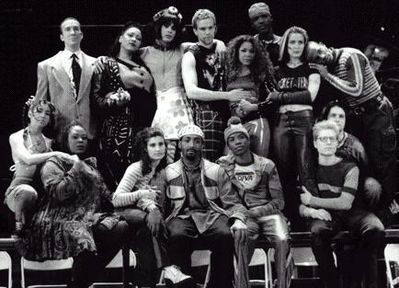
There is no doubt in my mind that Jonathan Larson’s most seminal piece of work was and still is the ultimate testimony of a life lived.  The story behind RENT is beyond legendary.  The fact that Larson died at 35 of an aortic aneurysm the night before its off-Broadway premiere in 1996 is a detail that epitomized the phrase “life imitating art.”  Like the character Angel, who looked after his friends after his death, it seemed as if his spirit departed this earthly plane so that he could be a guide, lifting this production on his shoulders, as he did in life, and ensuring that his labor of love lived on.  A labor, and a testimony in itself, Larson wrote RENT as a tribute to the friends he lost from AIDS.  And how his tribute has grown, becoming an entity of its own, when the rock opera completed its final Broadway performance on September 7, 2008, it had become the ninth longest-running Broadway.  Subsequently, it developed legions of zealous RENTheads, created several incarnations with American and European tours.  It even spawned a school edition (which toned down the language and other elements of the show) and a 2005 movie which featured the majority of the original Broadway cast. 

Now RENT has returned back to its Off-Broadway roots – full circle for a production that had been touted as the musical that spoke to Generation X the way Hair spoke to those who grew up in the 60s.  I have always believed there is a time and season for everything.   When RENT made its Broadway debut on April 29, 1996 at Nederlander Theatre, I had no desire to see it, despite the ravings of my colleagues.   I never listened to the soundtrack, nor had I watched one scene from its film adaptation.  Perhaps it was because I was too much of a rebel back in the 90s to believe anyone had my generation pegged.  Perhaps it was because I lost one brother to AIDS in 1988 and another in 1997 and had no desire to return to feelings of despair, hysteria, anger and grief of the AIDS epidemic of the late 80s and early 90s.  Perhaps it just was not my time to see it.  Suffice to say when I took my seat at New World Stages, I was a true RENT-virgin and what a cherry popping!  I sat behind a row of RENTheads who were already singing the songs before the performance started.  But once it did, they were right on queue, from the first “Voicemail” to the last.  Putting the production within the context of when it originally premiered, I understood how RENT was ahead of its time and definitely ushered in a new age of American musicals, laying out a blueprint that productions like American Idiot and Fela used.  What I was not prepared for was the flooding of tears that erupted from my eyes as I stood to give the cast the standing ovation it most definitely deserved.

There is no doubt that RENT is a masterpiece in any incarnation.  After I pulled myself together, I went home and immediately scoured the internet to view the movie and whatever videos I could find of the original cast.  Despite being overtaken with emotion by this powerful theatrical force of nature, the reviewer in me still needed to make comparisons.  Without question the shoes the current cast had to fill were larger than the Grand Canyon.  And they do so in an impressive scale, I did not feel as if I had been cheated by not seeing RENT on Broadway or in the movies.  The spirit of Jonathan Larson is still present and when they lifted there voices to sing every note, they did so with the sincerest passion to live up to the promise of the music and still make the character their own.  They delivered a dose of fabulosity that I will soon not forget.

To wax on about how wonderful RENT is would seem futile and unworthy of what I experienced.  Everyone knows it is phenomenal – a tour de force of the digital age.  Perhaps the best attempt to sum up RENT’s continual relevance on our culture is to give my testimony.  RENT hit me with a direct blow to the heart and as I cried I knew why I never saw this rock opera before.  I am a member of the bohemian class.  The group I belong to is the underground house community of New York City.  Some of us have belonged to this community for decades, others for a few months. Like the protagonists of Larson’s greatest musical production, our struggle has been to find the freedom to be ourselves without judgment from the outside world. Whether it has been The Paradise Garage, Sound Factory Bar, Body & Soul, Shelter or Soulgasm we have given our sweat, blood and spirit to the dance floor, finding our true selves in the bass and treble of the speakers, making connections with people who could only understand us because they were like us.  Now my beloved community seems to remain in an in a state of disrepair.  I have watched fellow members become ill and die.  I have viewed members dismantle precious relationships through petty actions.  I have witnessed New York City attack my culture, deeming it unworthy because we do not want to spend hundreds of dollars for bottle service or pose behind a velvet rope. As I watch cast sing “no day but today,” in the final scene, I realized RENT was created during the height of the New York clubbing experience.  I began to understand how the mistakes of our past are shaping the consequences of today and if Mimi got a second chance, maybe we would get a second chance too. 

RENT is to me what Marvin Gaye’s What’s Going On is to my mom and like that great musical work, will always be relevant.  Sure, some who go to see it may be in their twenties and can fully comprehend the idea of not selling out.  Others may be older and view it with through the reflection of hindsight, recognizing past mistakes and knowing they may have abandoned some principles to pay a mortgage or a child’s school tuition.  While the rest, will just hear the wonderful music and lyrics of Jonathan Larson and just be satisfied with that.  Because in the end, after you strip away all the back stories the greatest testimony of this rock opera is the music and because of it, RENT will never be evicted from the hearts and minds of anyone who sees it. 

Photos:  Joan Marcus

Nick Jonas Succeeds Harry Potter

Nick Jonas is no stranger to the bright lights of Broadway.  He has appeared in productions such as Annie Get Your Gun, Beauty and the Beast and Les Miserables.  Next year the Jonas brother will make his fifth appearance on Broadway as he replaces Daniel Radcliffe in How to Succeed in Business without Really Trying.

Jonas will assume the role of J. Pierrepont Finch, beginning January 24 and will play the role until July 1.  Radcliffe’s final performance is set for January 1.  Darren Criss, best known for the role of Blaine Anderson on the hit Fox show Glee, will make his Broadway debut on January 3, taking on the role of Finch for three weeks until Jonas begins his latest stint in the theatre.

Broadway Sheds Its Prices for Fall

The sun-filled days, the crisp in the air at night, the Caribbean Day parade on Labor Day, the makeover of Lincoln Center for Fashion Week – all signs that fall is fast approaching.  With the impeding10th anniversary of 9/11 reminding New Yorkers of how resilient we are and how much we have overcome since that tragic day, Broadway brings discounts center stage. 

After the events of September 11, 2001, Broadway as well as other businesses in the theatre district suffered huge losses in sales.  In response, Seasons of Savings was created in January 2002 to entice theatergoers to go back to The Great White Way.  The special edition Playbill is published twice a year, and is called the unofficial “New York Theatergoer’s Guide to Times Square.”  

Seasons of Savings features discount coupons with savings codes for various Broadway and Off-Broadway shows as well as restaurants, hotels and other Big Apple attractions.  On August 29, Serino Coyne, Broadway’s largest advertising agency, hosted an event at Tony’s Dinapoli, located at 147 West 43rd Street, to introduce this year’s coupon booklet.  Tony’s Dinapoli is a family style restaurant located in the heart of the theatre district.  It is famous for its scrumptious Italian cuisine and great relationship with Broadway.  This year’s booklet offers discounts to Memphis, Mary Poppins, Godspell, Chinglish, The Adams Family, Catch Me If You Can, Circle Line and more.  Seasons of Savings makes Broadway more affordable and provides an opportunity for more people to fall in love with the theatre.  Tis the season to save, I encourage all FAMERS to take advantage. 

To learn more about Seasons of Savings and its discounts, click http://seasonofsavings.com/, and join their mailing list.


Judy Garland Comes To Broadway

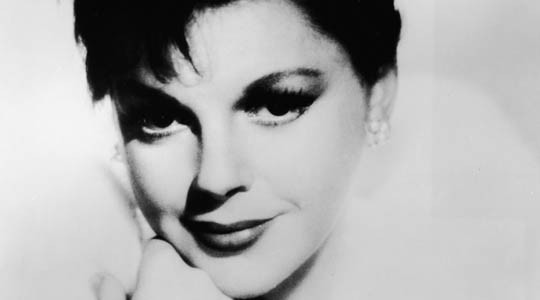
As the fall 2011 season begins on Broadway, there is buzz about a new musical coming in spring 2012.  Peter Quilter’s End of the Rainbow, a production about the last months of Judy Garland’s life, is poised to begin performances March 19 at a theater to be announced.  The show is set in London in 1968 and chronicles her problematic life on and offstage as Garland finishes her final performances in The Smoke. Two-time Oliver Award winner Tracie Bennett will reprise the role of Garland, which she originated in London, on Broadway.   End of the Rainbow features several of Garland’s signature songs including “Over the Rainbow” and will make its US debut in January in Minneapolis as it gears up for its Broadway run.

Born Frances Ethel Gumm in Grand Rapids, Minnesota, Judy Garland was the youngest child of Vaudevillian parents.   She started in show business at the tender age of two joining her older sisters on stage as The Gumm Sisters.   In 1935, she signed a contract with MGM and in 1937 appeared in the first of a string of successful “backyard musicals” co-starring Mickey Rooney.  In 1938, she began filming The Wizard of Oz playing the role of Dorothy, the character she is most known for.  Her years at MGM and following her departure from the studio were tumultuous at best.  Throughout her life she suffered mental and physical illnesses and battled alcohol and drug addiction.  She was married five times and had three children, Liza Minnelli, Lorna Luft and Joey Luft.  Judy Garland died at age 47 in London.  Her legacy remains as a performer, one of the greatest female stars of all time and a gay icon.

“External resource for help with drug addiction in Minnesota: http://www.detox.net/clinics/detox/minnesota/

Spiderman 2.0 The Future of American Musical Theatre Personified

If I was presented with the task of summing up Spider-Man: Turn Off the Dark in two words, I would adamantly choose creative and ambitious.  If given a bonus word, I would throw in persistent.  Indeed it was persistence (perhaps plain stubbornness) creativity and ambition that has powered the engine of this production as it steamrolled its way onto Broadway.  More often than not, Peter Parker’s journey to the stage has been the equivalent of a run away train with several derailments.  In 2002, Marvel announced that film and theatre producer Toney Adams would produce a Spiderman musical.  Three years later he would suffer a stroke and die while the creative team, which included U2’s Bono and Edge and Julie Taymor, gathered to sign contracts.  An omen perhaps, but the production found a new lead producer in Adams’s partner David Garfinkle and carried on.  During its push to opening night, the musical has obtained a ballooned budget of over $70 million, received the honor of having the most previews of any Broadway production in history and endured cast injuries, multiple tongue-lashings by the critics as well as creative and cast changes.

Despite the rollercoaster ride during its prolonged preview period, Spider-Man: Turn Off the Dark has prevailed (at least over its former obstacles) and officially opened at The Foxwoods Theatre, located at 213 West 42nd Street, on June 14. The story of Peter Parker aka Spiderman is well-known. He is Marvel’s lead character and one of the most commercial superheroes.  His sagas have been depicted in comic books, newspaper comics, cartoons, televisions and on film with Tobey Maguire in the lead role.   Although the producers and creative team behind this production overcame epic hindrances that would have frozen most shows quicker than a gaze from Medusa, the real encumbrance was creating a musical about a character whose story is so popular.

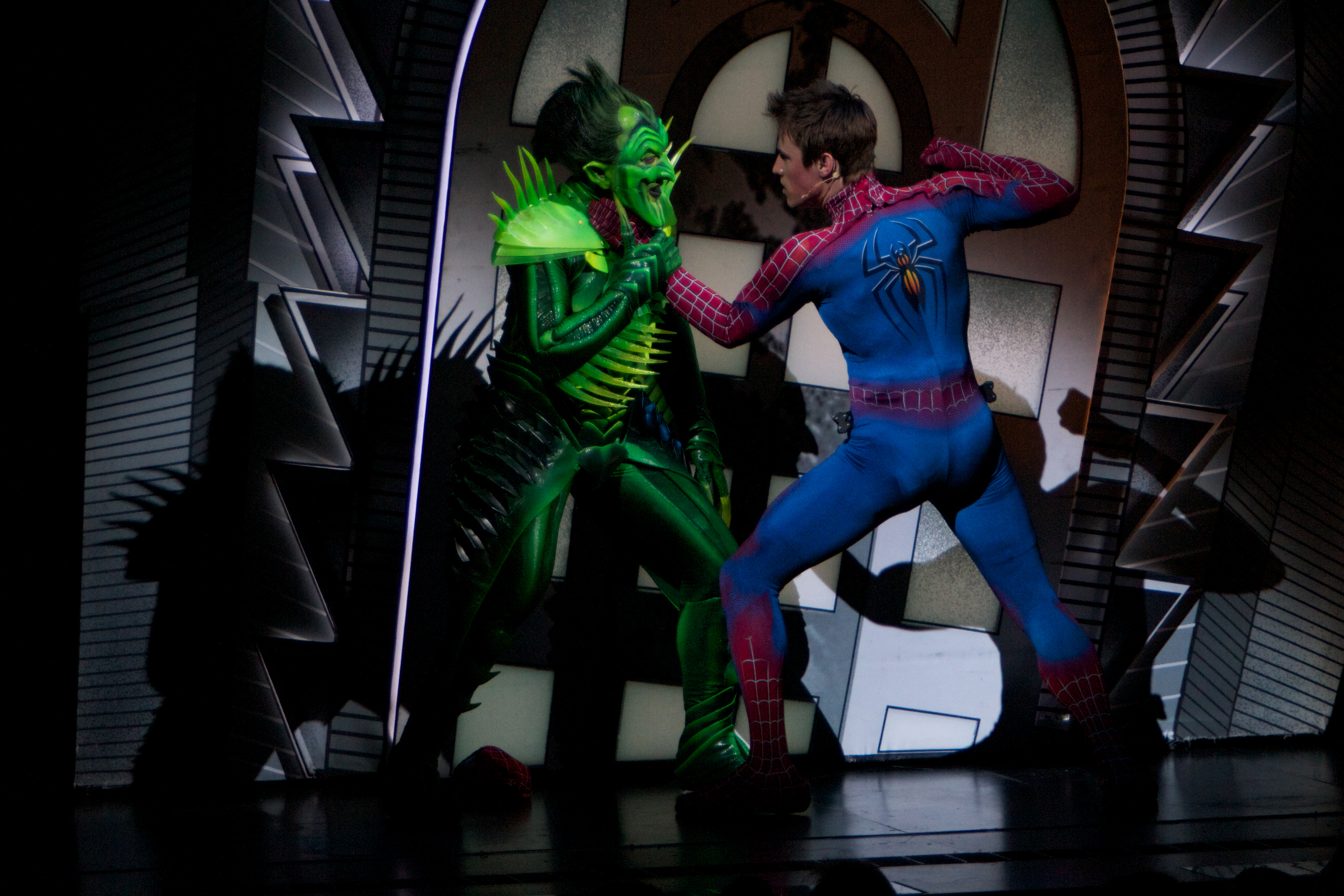
Spiderman 2.0 begins in school with the Peter Parker reciting his oral book report, the story of Arachne the world’s first with spider, to the class.  Suddenly, Arachne descends from the ceiling ala Cirque du Soleil complete a Greek chorus visually bringing the myth to life. It was then that I realized this adaptation of the Spiderman story was going to be different than any I had viewed or read before.  The introduction of the Arachne myth was a refreshing and integral component.  In the first incarnation of the stage production Arachne was Spiderman’s villain, but in Spiderman 2.0 she is transformed into an ethereal guiding force, appearing when Peter is most in doubt about his gifts and his purpose.  I found the intertwining of Greek mythology to the Spiderman legend to be a marvelous addition to the story.  

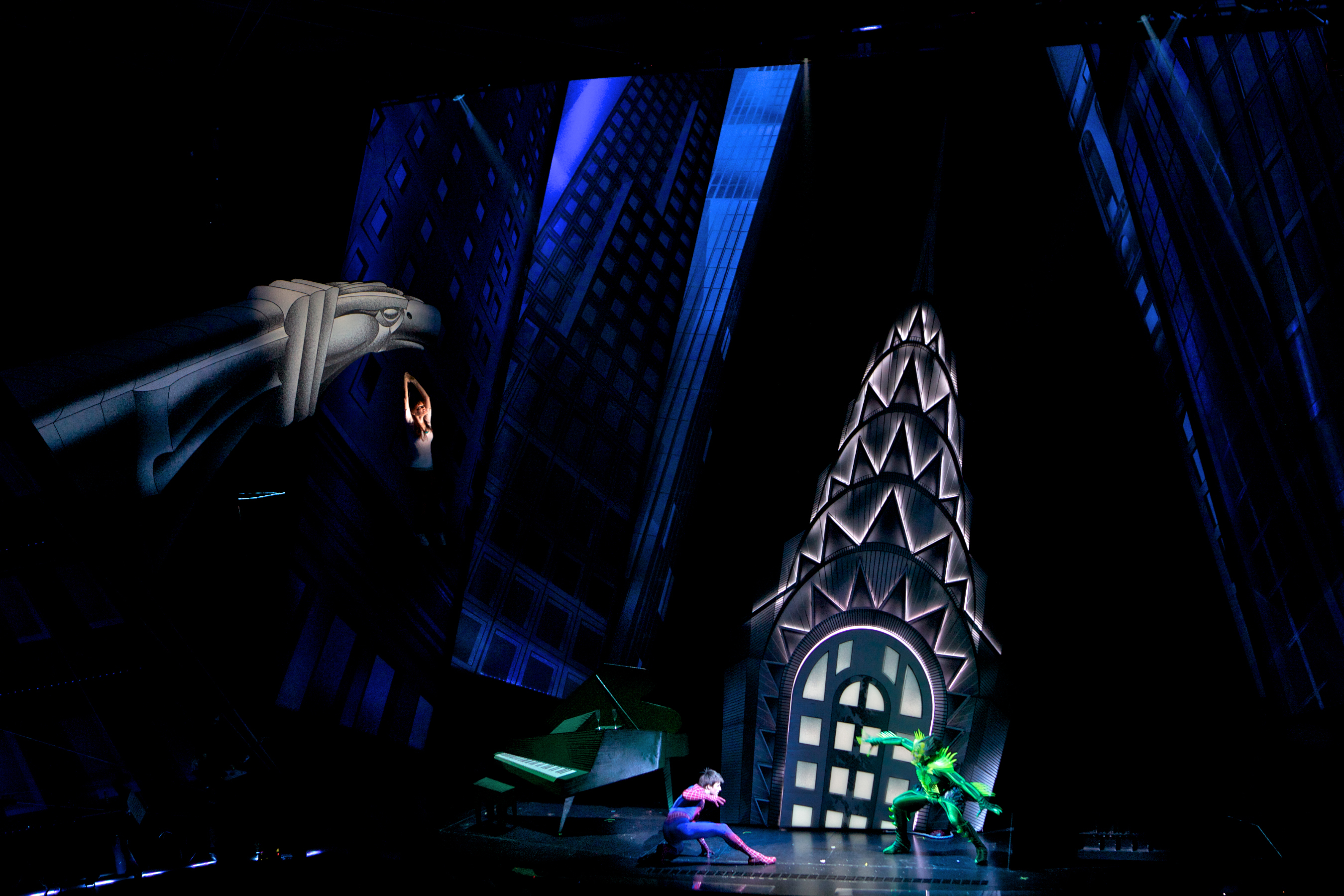
The book is a mélange of the comic and film series; besides the insertion of Arachne (characterized by T.V. Carpio), the book brings no surprises to Spiderman’s character, which should be a relief to die-hard Spiderman fans.  Peter Parker (played by Reeve Carney) is a highly intelligent student, with a keen interest in science.  He is tormented at school by Flash Thompson (portrayed by Matt Caplan) and his band of hooligans.  He is secretly in love with Mary Jane Watson (played by Jennifer Damiano) who harbors a desire to be an actress and get away from her home life.   Peter is an orphan and lives with his Aunt May and Uncle Ben (portrayed Isabel Keating and Ken Marks).  During a field trip to Norman Osborne’s genetics lab Peter is bitten by a genetically altered spider.  From the bite he develops a muscular frame, 20/20 vision and other spider-like abilities including releasing webs from his wrists.  At first, Peter seeks to capitalize from his new powers, but after his uncle is murdered by a thief he is persuaded by Arachne to use his powers to fight evil.  Donning a costume, he becomes his masked doppelganger Spiderman and begins taking down Manhattan’s criminals.  He also gets a job at The Daily Bugle as a freelance photographer catching exclusive photos of Spiderman for EIC J. Jonah Jameson (played by Michael Mulheren) who adamantly believes that the masked crusader is actually a criminal.   Meanwhile, Mary Jane pursues a career in the theatre as a romance with Peter heats up and Norman Osborne (played by Patrick Page) convinced that Spiderman pilfered his research decides to experiment on himself, kills his wife Emily (portrayed by Laura Beth Wells) in the process, goes insane and mutates into the Green Goblin.  As a Green Goblin Osborne manufactures a troupe of similar mutants that he labels the Sinister Six, together they unleash a terror-spree, the likes of which have never been seen, on Manhattan.  Spiderman, who contemplated retirement to protect his loved ones, must now live up to the phrase, “With great power comes great responsibility,” and has a showdown with the Sinister Six and the Green Goblin, who kidnap Mary Jane with purpose of drawing Spiderman out of hiding.  Spiderman defeats the Green Goblin, rescues Mary Jane and all is right in New York City for now.

After viewing Spiderman 2.0 I took some time to brood over what I saw.  I did not see Spiderman during its episodic ramp up period, so I researched articles from critics that had seen both versions.  Most critics did upgrade their marks from an F to a C+, but at best most of them saw the production as a boilerplate musical.  I must admit that I was ambivalent to the musical when first leaving Foxwoods Theatre.  My immediate thoughts summoned another musical that the critics impugned during its run, Taboo, the musical based on the life of Boy George.  It was edgy and ahead of its time.  There were components that worked extremely well and if not for the internal issues and the critic’s harsh reviews, it might have had a longer run.   Although there are parallels in Taboo’s Broadway story with that of Spider-Man: Turn Off the Dark, I firmly believe that a premature closure will not be its fate.  The diligence of everyone involved in this project will not let that happen.  Also, Spiderman is a character loved globally.  If New Yorkers do not want to pay the price of admission, there are plenty of tourists that will.  I propose that as long as our friendly neighborhood superhero is starring on Broadway, this musical will be a stop on any vacationer’s list, ranking just below The Statue of Liberty, Empire State Building and Times Square.

Like the weaver Arachne, Spiderman 2.0 weaves an intricate, innovative web; bottom line: Spider-Man: Turn Off the Dark turned Broadway out! Critics, including myself, are so used to the status quo musical paradigms, that it became laborious rating the production using the standard criteria.  There is a tendency to reject something that is new, but there is no doubt that a shift has happened in the theatre, a changing of the musical guard literally and figuratively.   It is trailblazing, pushing the envelope of musical theatre into the 21st century.  But like any pioneer there still bumps along this unforged path.  As a new production, Spider-Man: Turn Off the Dark is greater than the sum of its parts, but there is no denying that certain elements function effectively better than others.  Although the book sticks close to the Spiderman comic, it is mediocre. I am a huge fan of U2 and could not wait to see what Bono and Edge would do, needless to say, it is no Tommy.  Bono and Edge’s imprint is present throughout the music and lyrics, Edge’s guitar licks and Bono’s writing style are beyond reproach.  However, there are numbers that worked to perfection while others were just average.  “Behold and Wonder,” “Bouncing Off the Walls,” “Rise Above,” “If the World Should End,” “Turn Off the Dark” and “I Just Can’t Walk Away” were pleasers with myself and the audience.  When it comes to crafting a musical Bono and Edge are not as great as Andrew Lloyd Webber just yet, but give them time and they will be.  The choreography infused urban movements like krunking during “Bullying By Numbers” as well as hip-hop/African heel-toe dance steps.  The urban choreography was not executed as strongly as other musicals that I have seen that have used these dance styles. 

Overall, the cast triumphantly works with the material they are given, and are the real success story.  It is their execution of the material that is the raison d’être why the elements that do work operate brilliantly. The sets use screens and are stimulating and visually engaging  as a 3D pop-up comic book. But it is my sincere belief that the most outstanding part of the show is Spiderman, or should I say Spidermen and the death defying aerial stunts that he and Green Goblin engage in.  Although Carney plays Peter Parker and Spiderman, there are other stuntmen and dancers that portray Spiderman throughout the show.  The martial arts inspired choreography the dancers perform is enlivening.  As much as your eyes are on stage, your pupils will be fixed on the ceiling, the balcony and all over the theatre as Spiderman uses the entire theatre to fight crime and combat the Green Goblin.     

Spider-Man: Turn Off the Dark is a boundless ride that rivals any rollercoaster at Six Flags Great Adventure – a spectacle P.T. Barnum would be proud of.  At best, Spiderman 2.-0 is an exhibition of what American musicals could be – a shining glimmer of the future.  At worst, it is a science experiment that works but still needs some fine tuning.  Personally, I reside comfortably on the fence neither loving it nor hating it completely.  Spider-Man: Turn Off the Dark is unlike any musical that has come before it, in my opinion it is not a musical at all, it is art on a Broadway stage –pure inspiration and that is the most paramount reason to go and see it.

Photos courtesy of O&M Co.