Pompeii Rises from the Ashes

The Day After Tomorrow, Twister and Volcano are Hollywood’s idea of what a cataclysmic natural disaster would be like.  But in August 72 A.D., Mother Nature played out its own story when the cities of Pompeii and Herculaneum were buried alive under ash and pumice from a colossal eruption from Mount Vesuvius.  Very few natural catastrophes have ever rivaled the destruction of Pompeii and Herculaneum as an entire existence was obliterated in a 48-hour span.
Pompeii and Herculaneum was inadvertently unearthed in 1599 and was once again forgotten about until 1738 when Herculaneum was rediscovered by workers digging for the King of Naples’ summer palace.  Pompeii was found 10 years later.  In 1860, archeologist Giuseppe Fiorelli took charge of the excavations and had the spaces left by the victims of the eruption filled with plaster to create perfect casts of the citizens that were unable to escape.    Pompeii and Herculaneum also marked the first major find in the budding discipline of archaeology.


What made the cities of Pompeii and Herculaneum such an ideal discovery was the cause of its demise.  The pumice and ash created a tomb for the municipalities and its occupants.  Everything about the Roman towns remained the same as it did when eruption began – lying undisturbed and waiting for human civilization to resurrect it from its petrified state.    More than any other find, Pompeii and Herculaneum gave people the opportunity to witness what daily life in the ancient world was like.   Now New Yorkers can incorporate this once thriving city and its surrounding town into their daily routine by visiting Pompeii the Exhibit: Life and Death in the Shadow of Vesuvius at Discovery Times Square.
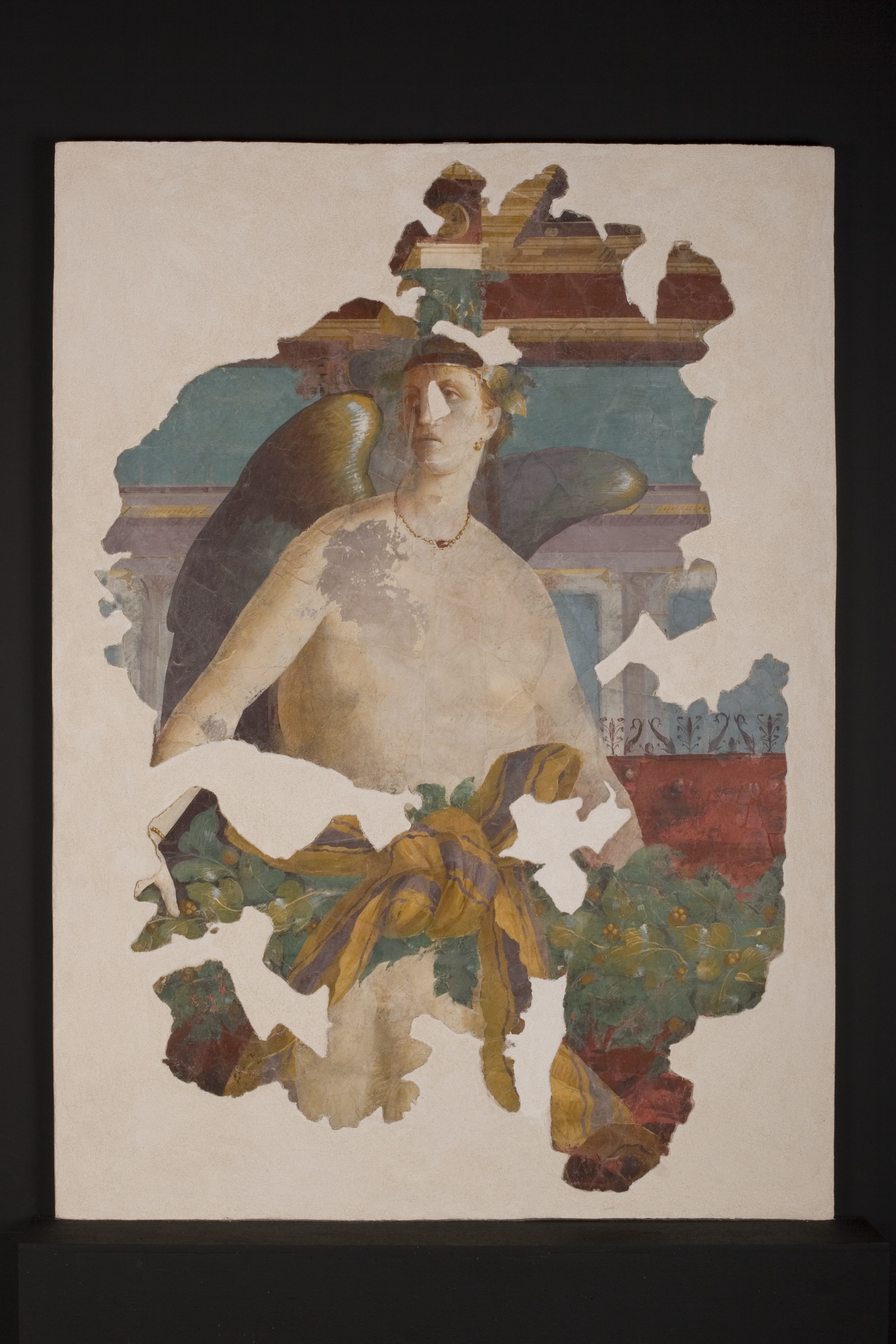
Pompeii the Exhibit is a comprehensive exploration into the commonalities of the human existence – a visual display that reminds of the audience that the song “Everything Old Is New Again” rings undeniably true.  Over 250 artifacts are exhibited; we learn about Pompeii’s principle gods and goddesses, which were adopted from Rome, Greece and Egypt as well as view their money system, weights for measurement, a wall of graffiti, jewelry and a recreation of a room in a brothel.  Also included were utensils, beans, a loaf of bread and partially restored frescos. 
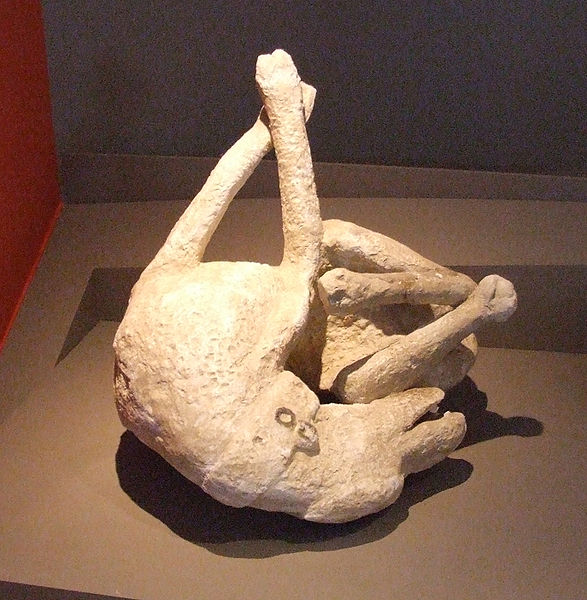
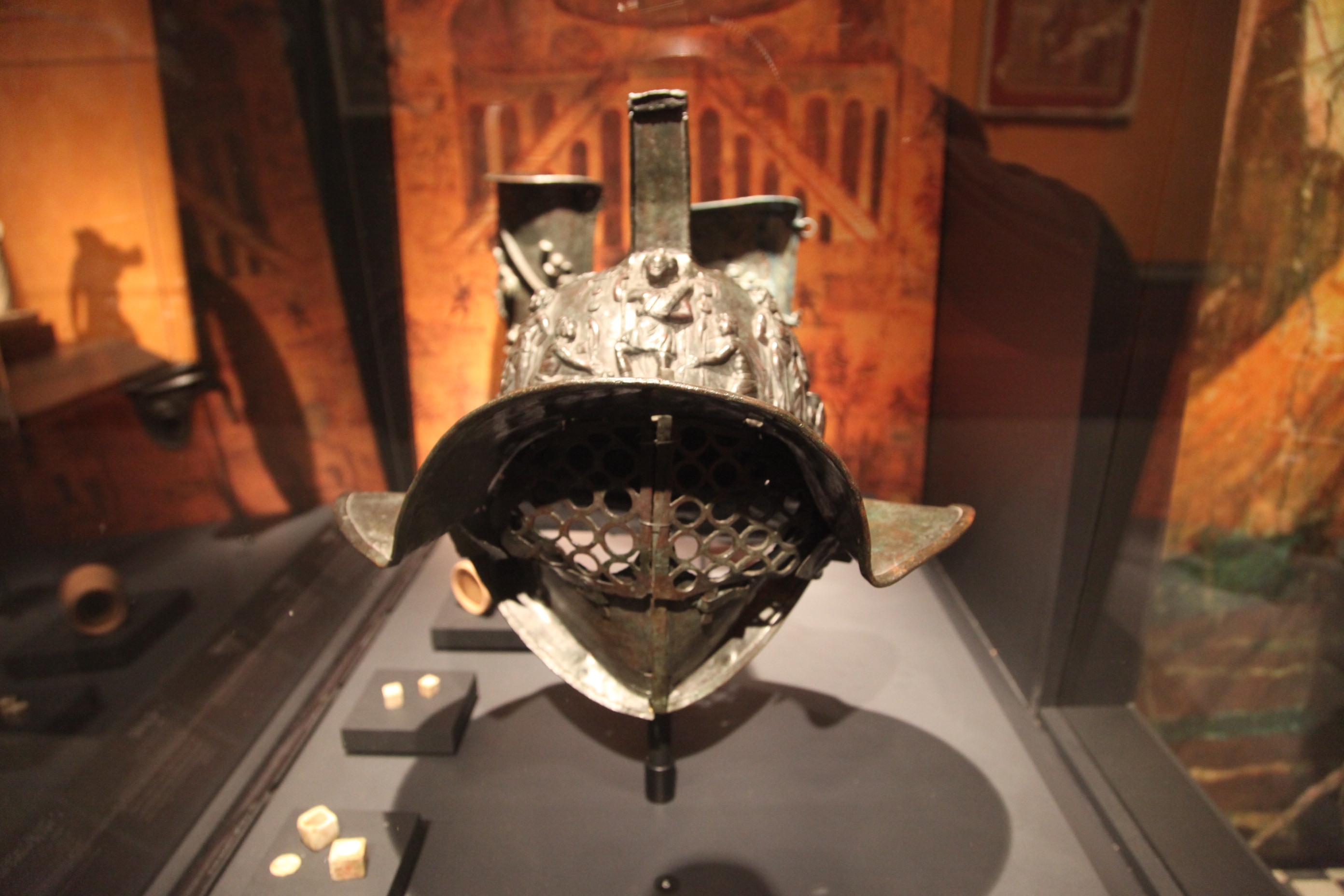
Perhaps the most creepy and bone-chilling aspect of the exhibit was the six-minute video that recreated the extermination of Pompeii and Herculaneum and the body casts and skeletal remains of those who perished.  Patrons enter a dark room with a screen.  Minute-by-minute the details of the eruption are witnessed as crashing, fiery effects are projected from the speakers and with a cold blast of air, the doors open to reveal the replicas of the citizens that endured the worst horror one’s mind could ever conceive.  But what is equally fascinating and daunting was that unlike the rest of the exhibit, reality had been exhumed and presented right before our eyes.  In other rooms of Pompeii the Exhibit: viewers could imagine a man entering the brothel room with his chosen lover or the gladiator that wore the helmet and shin guards that protected him in a glorious win.  But there was no need to imagine the pain that was wracked in the face of a chained dog as he twisted on his back or the man that covered his face with his tunic to avoid inevitable suffocation.    The room was filled with ghosts telling their story.

Pompeii the Exhibit: Life and Death in the Shadow of Vesuvius will run at Discovery Times Square, located at 226 West 44th Street, until September 5.  Like the King Tut exhibit, a portion of the proceeds of the exhibit will go toward the preservation of the Pompeii site.   Ticket prices range from $19.50 to $25.00 and the last tickets are sold 90 minutes prior to closing. 

Photos:  F.A.M.E NYC Editor, MWW Group

Video Shot the Photographer

Photographer D. Austin has made it his mission to pursue art through his camera lens.  In an effort to evolve his craft, he has decided to say goodbye to still photography and is now producing HD videos set to music to showcase his love of imagery.  D. Austin is an artisan that is consistently pushing the envelope of art.  So without further ado, D.  Austin presents Ghost Dance.

Video courtesy of D. Austin Photography

Oscar-Nominated Actor Geoffrey Rush Reprises Madman One Last Time

To write a paragraph, or two, or three about the brilliance of Geoffrey Rush would not be waxing poetic, it would be waxing reality.  If this Sunday’s Academy Awards ceremony was the Belmont Stakes, then Rush would be a shoo-in.  After all, he has already won an actor’s Triple Crown (an Academy Award, a Tony Award and an Emmy Award) as well as two Golden Globes and three Screen Actors Guild Awards.  I first saw the Australian actor and film producer in Shakespeare in Love, but it was not until I saw him playing the Marquis de Sade in Quills that I truly began to appreciate his ability be consumed by a role as well as his talent to portray a crackpot convincingly.

 Although much of the media attention surrounding Rush at this time is dedicated to whether or not he will win the Oscar for Best Supporting Actor for The King’s Speech, this award season has been a very demanding one considering he is also starring in BAM’s US premiere of the Belvoir St Theatre’s The Diary of a Madman, directed by Neil Armfield.  This is not Rush or Armfield’s first descent into lunacy, both men know Poprischin (the protagonist) quite well.   The Belvoir St Theatre is one of the most acclaimed companies in Austrailia.  Company co-founder Neil Armfield directed Rush in the initial run of The Diary of a Madman 22 years ago, it seems felicitous that they would echo this classic as Armfield’s swansong as the company’s artistic director.  But for me, It seems appropriate that a story concerning quills would once again allow me the opportunity to acknowledge Rush’s genius.

The Diary of a Madman is based on the 1835 short story by Russian novelist Nikolai Gogol.  The story, written in first person format, focuses on Aksentii Poprischin, a low-ranking civil servant and chronicles his digression into delirium.  Poprischin loathes his common status and despises the bureaucracy of St. Petersburg and his supervisor Mikhailov in particular.  Despite his feelings for his boss, he is completely enamored with Mikhailov’s daughter Sophia.  His yearning for her sends his imagination into the stratosphere as he believes he has overheard a conversation between Sophia’s dog Medji and another dog name Fifi.  He spies on the two pooches in effort to learn more about Sophia.  Eventually he convinces himself that he is to assume the throne of Spain and prepares for his coronation and move to Madrid, which is actually an asylum.  Once inside the sanitarium, he believes the torture he receives to be some crude coronation ceremony, then part of the Inquisition.  The heart of this tale is about a man who craves to rise above his proletariat status so desperately that his quest to shine drives him loco, a need that anyone who has ever swiped an employee badge can comprehend.  David Holman, Neil Armfield and Geoffrey Rush’s adaptation of this story is a satirical masterpiece – dark comedy at its zenith.

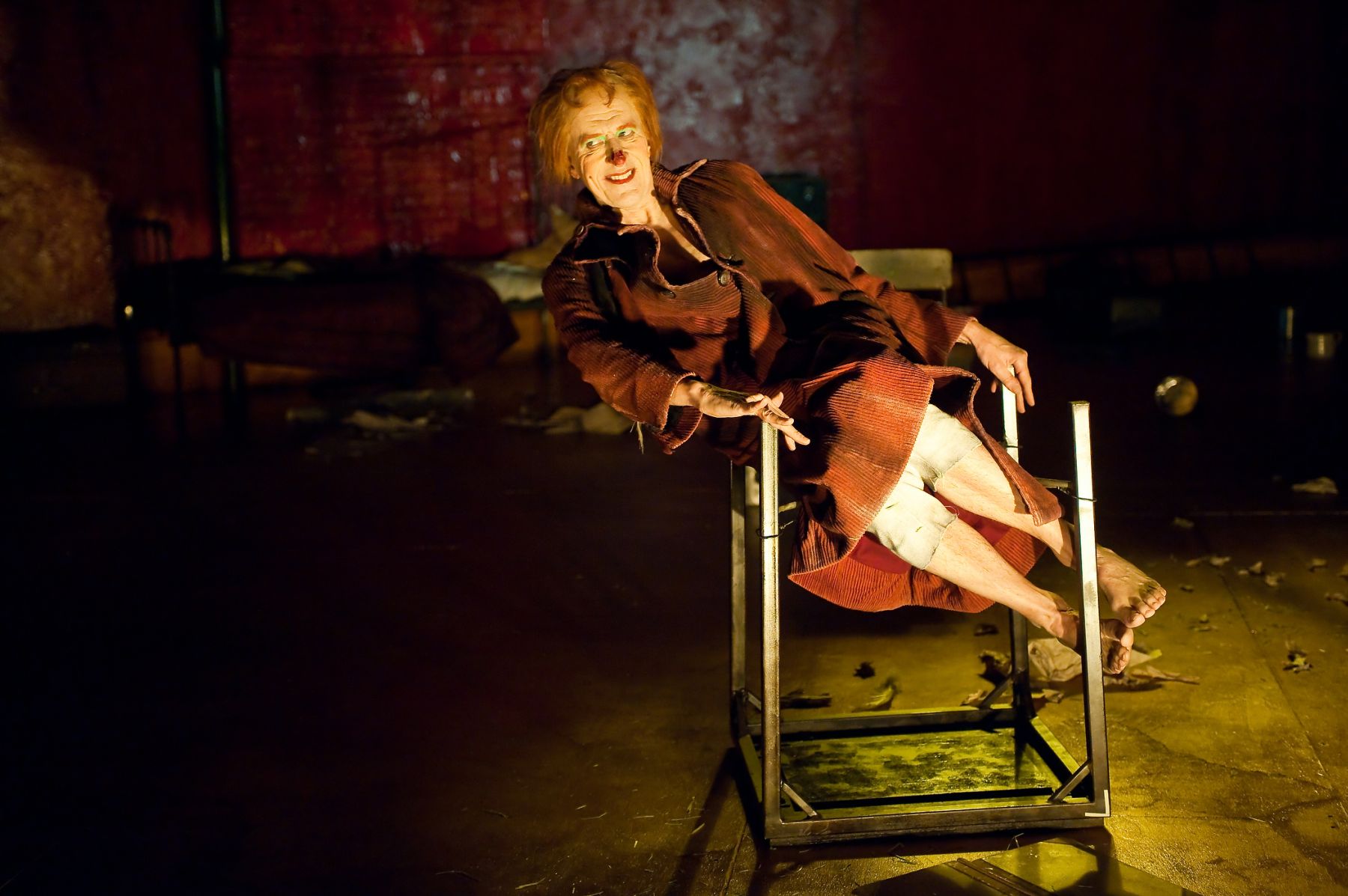
Geoffrey Rush breathes an eccentric life into Poprischin that is nothing short of fabulous.  As the Marquis de Sade, Rush was frantic to procure quills so he could author his erotic stories and express himself freely.  As a lowly clerk of the 9th grade, Rush is hired to mend quills as part of his “spoke in the wheel” position.  But after work, he is at liberty to dip his feather in the inkhorn and allow his lucubrations to manufacture a world where dogs conversed like humans, and his true disdain for the bourgeoisie could flow unbridled, scenes full of romance and royalty where he could prove that he was more than his position in society allowed him to be.  Along with a two-piece band that provided whimsical and stark sound effects, Rush entwines comedy and tragedy exquisitely.   As he blathers on about his aversion to Mikhailov, being ignored by his landlady and the ignorance of Tuovi, the landlady’s Finnish maid, the audience cannot help but to break out in side-splitting laughter.  Another aborning truth that becomes clear is that as Poprischin Rush is the poster boy for “going postal.”  Rush brings out the calamity of this character so well that as his shift into madness increases, it becomes harder to make light of his situation.  Every chuckle at his delusions is accompanied with uncomfortableness as you acknowledge he is losing his mind.  In the final scene, where Poprischin is confined and mistreated in the asylum, the audience receives the literal understanding of laughter through tears.  As Rush fails to understand why he, the king, is being treated so harshly the heartstrings of everyone in the theater are pulled to capacity, but in that most dramatic moment, he makes an absurd comment that is meet with sheer amusement.  Yael Stone is sensational as Tuovi, the Finnish maid, the apparition of Sophia and Tatiana, the shrieking cell mate of Poprischin after he is committed.  She adds another wonderful comedic layer to this play.

My suggestion is that every New Yorker takes a queue from this incredible actor’s name and rush to go see The Diary of a Madman before it leaves BAM’s Harvey Theater on March 12.  It is the Triple Crown of theatre going – engaging story, great acting and lots of emotion.  Oscar or no Oscar for The Kings Speech, this production is an oration that you would be crazy to miss.

Photos:  Stephanie Berger

Oz Comes This Way Soon

March is the season for gusty winds, sort of like the tornado winds that blew Dorothy from Kansas to the mythical Land of Oz.  Fortunately for New Yorkers, Oz has come to us.  French Street Artist Ugly-Kid GUMO will be exhibiting THIS IS OZ-NOTHING MAKES SENSE at the Fountain Art Fair, located on Pier 66, from March 3-6. 

F.A.M.E NYC first introduced this artist to you back in November.  Take a look at the video below to catch a sneak peek of GUMO and the Oz he lives in.

Video courtesy of Marianne Nems, Marianne Nems Gallery New York

The Dragon Speaks

Low Blow, Oil on canves

“Have a nice Day,” Sh*t Happens,” T-shirts allow us to literally wear our heart and emotions on our sleeves (or should I say across our chest).  Icons of history and pop culture have become iconography in fashion as their faces are plastered across cotton blend canvases.  James Rieck explores non-verbal communication on multiple levels with Enter the Dragon, on display at Lyons Wier Gallery until February 26.

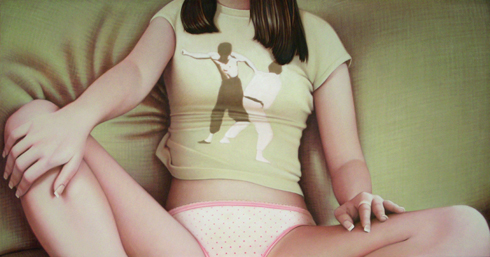
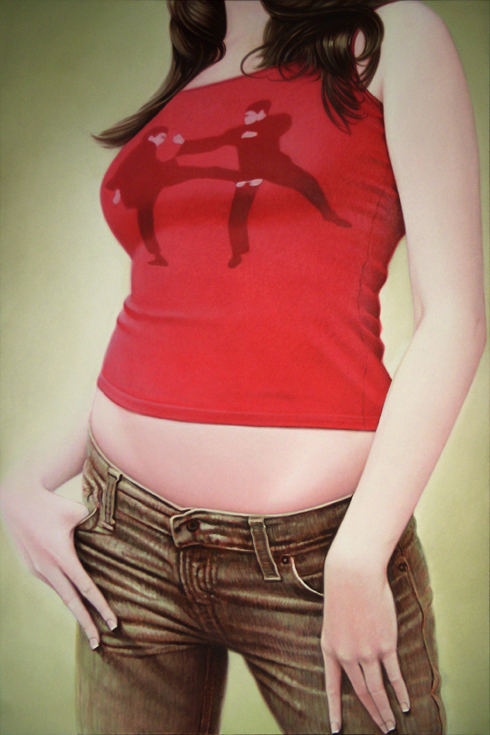
Using Bruce Lee as a muse, Rieck presents five lifelike oil portraits of women with T-shirts that depict fight scenes from Bruce Lee movies.  Martial arts is a dialogue between two opponents, and no one did it better than Bruce Lee.  The vivid depiction of the shirts serves as an unconventional and colorful reminder of his stunning form and technique. 


The portraits’ names, “Cockblock,” “Body Shot,” “Low Blow,” “Black Belt” and “Gang Bang,”  provided a sexual innuendo that corresponds to not only the positioning of the models, but the action in the T-shirt.  Enter the Dragon is short and to the point just like a T-shirt, and the dynamic illustrations definitely did not come from a comic book.

To learn more about Lyons Wier Gallery or James Rieck, click http://lyonswiergallery.com/.

Photos courtesy of Lyons Wier Gallery

The Bitch in Me

As a small girl I kept my face in books (perhaps that is why I am writer today). Reading to my mother while she made dinner was one of my favorite pastimes.  The XX chromosome dictated my reading selection and I always seemed to fancy tales that were epic in scale, took place in a land far away and had at least one damsel in distress. Not only did the words enrapture me, but the illustrations kept me fascinated as well.  In the myths and fairytales I read as a child, the wolf always played an essential role.  In Little Red Riding Hood the wolf was a cross dresser that had such an obsession with the girl in the crimson cloak that he slaughtered her grandmother and pretended to be her in an effort to get close to his target.  In ancient mythology, a she-wolf suckled twins Romulus and Remus.  Her milk-filled tits fed the starving babies that were abandoned and left to die.  She was their first foster mother, and as men the twins would become known as the founding fathers of Rome.

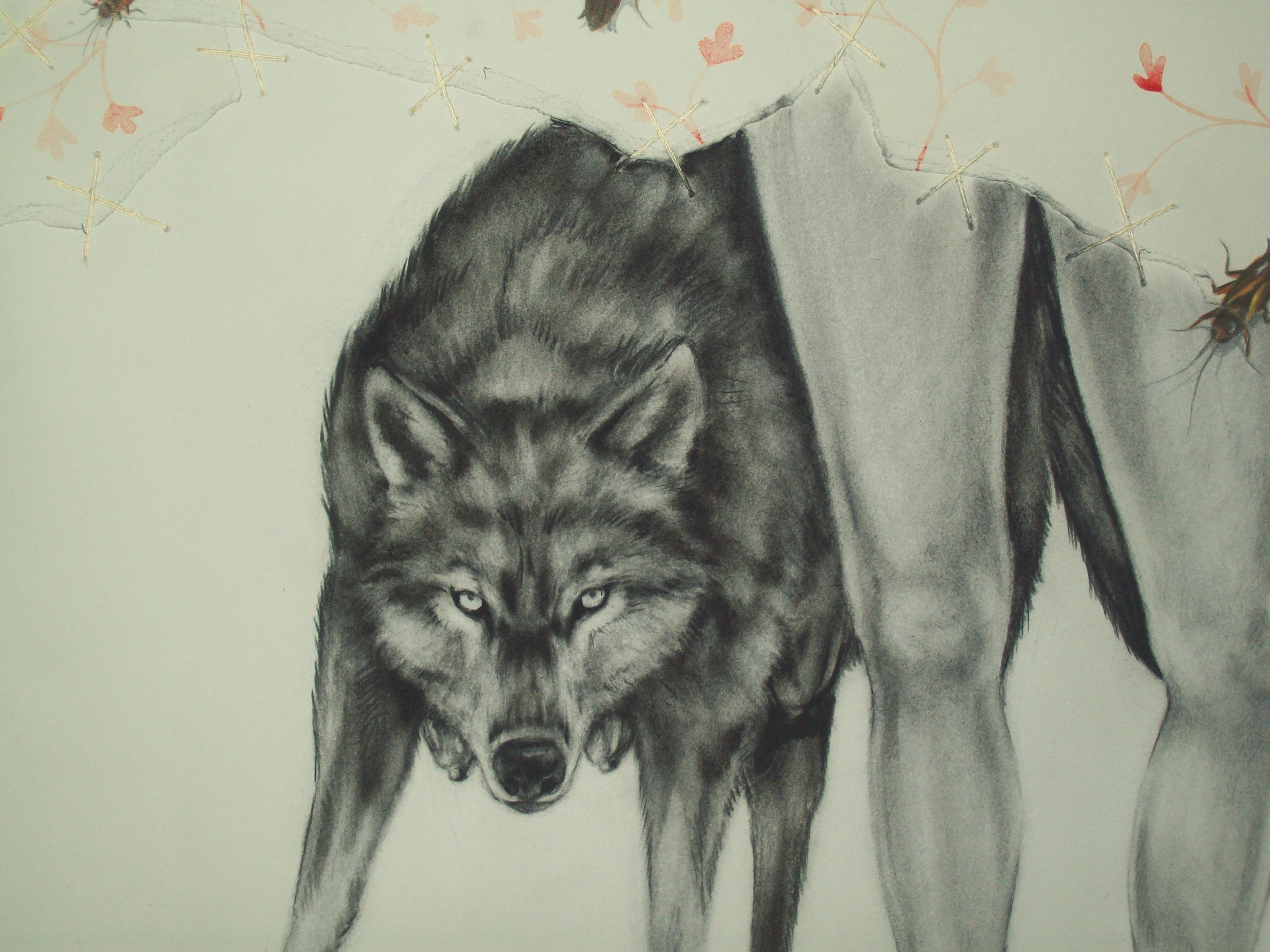
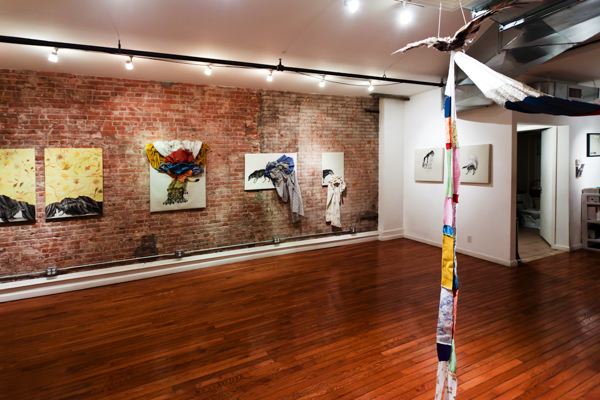
Jennifer Murray has her own story with the she-wolf.  As we stood in front of one her creations last Thursday, she revealed to me the catalyst that manifested into the furry siren.  While in college, Jennifer was experiencing circumstances that required a Waiting to Exhale moment.  When she finally had the opportunity to release, a wolf was delivered.  Further developing the seed that had been planted long ago, Jennifer brings the mysticism and allure of the she-wolf and cougar that has been skulking in our social conscious to the surface in Displaced Fables/Damaged Dreams, her first solo exhibition.   Displaced Fables/Damaged Dreams is an imaginative exploration of the female mystique and its multiple perceptions.  Using charcoal sketches on stretched paper, mixed media canvases and hanging installations, Jennifer balances the fierceness, femininity and fragility of these creatures with great detail and perfect symmetry.   With baroque fabrics, flowery patterns, wallpaper with foliage and yarn she literally weaves a tapestry of visual anecdotes that create a new vocabulary for women.

With “The Queen/Bitch Diptych” Jennifer presents the face of two she-wolves, their necks surrounded with fabric like a Medici collar.  The canine lassies hang side by side one looking stoic and magnanimous, the other is tempestuous with snarling fangs.  “White Drawing I” displays a she-wolf haphazardly suspended in white sheets, perhaps the colorless cloth is preventing her from moving or could be removing her from a perilous encounter, thereby becoming her saving grace.  “Decoy Triptych” depicts a wolf straddling a sheep and a sheep mounting a wolf cleverly exposing the facades we flaunt when hiding our true selves. What I found particularly interesting about this piece were the beleaguered expressions of the mounted animals, they reflect the burden of constantly having to carry a disguise.

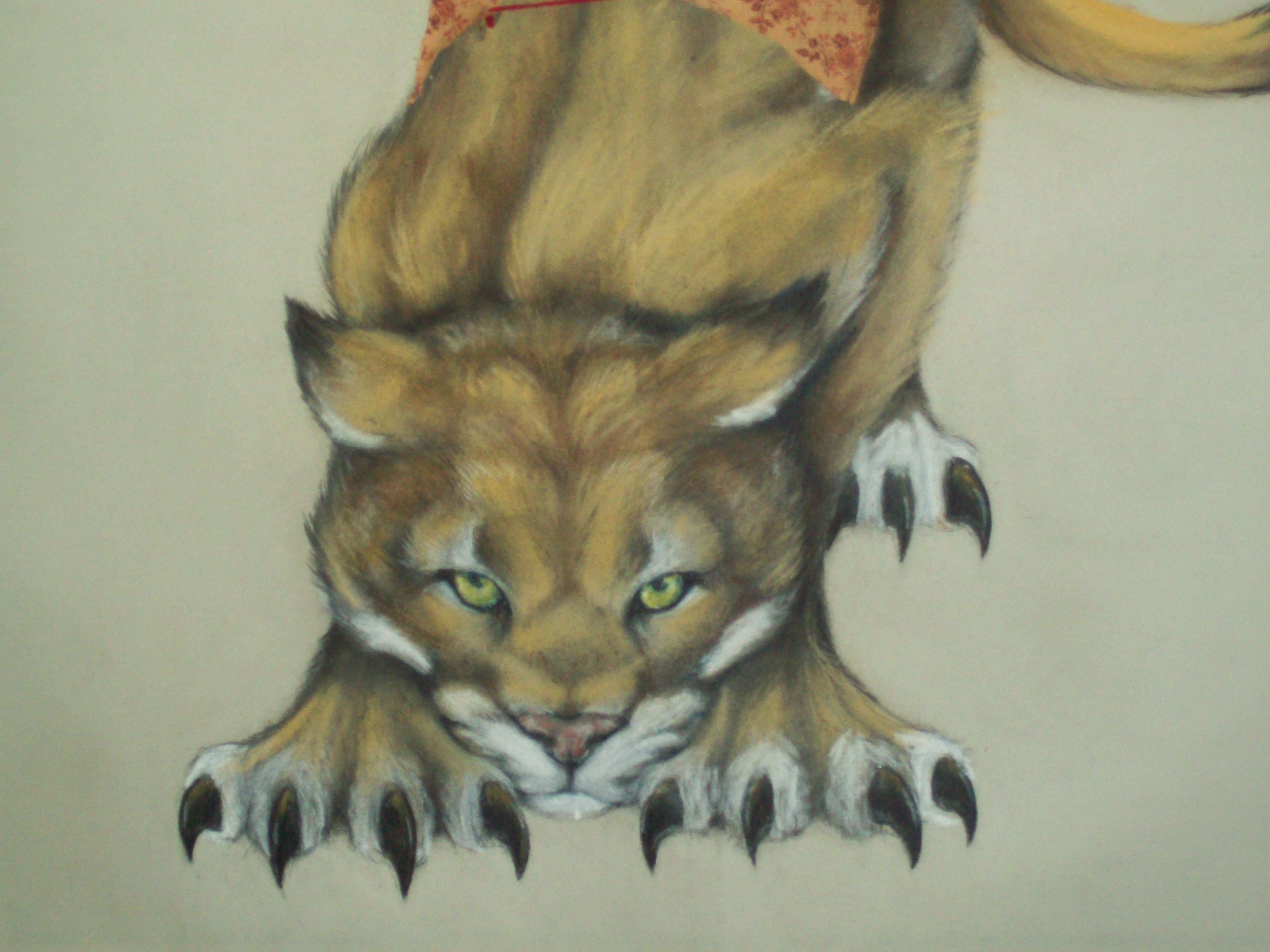
I first became acquainted with Jennifer Murray and her work at the last year’s Affordable Art Fair.  Upon first glance I knew I would like to see more of her creations.  In total, I was extremely impressed with Jennifer’s initial introduction to the New York City art scene.  Displaced Fables/Damaged Dreams achieved its goals in positioning the viewer in fragmented narratives and dreamlike visions allowing us to decipher how textile flying machines, birds, wolves and cougars related to our human experience.   As I toured the exhibit, I kept returning to Spiker,” a drawing of a cougar with bold material covering her back.  She was crouched, her front paws resembling a pouncing stance.  Her eyes were sexy, determined and primal.  Looking at this totemic symbol of womanhood I was reminded that within me and every woman there is a little girl playing dress up, a battle-axe ready to strike, a wolf ready to howl at the moon and an empress ready rule.  The trick is harmonizing these characters in the story of our lives as effortlessly as Jennifer composed the scenes of this exhibit.

Displaced Fables/Damaged Dreams will be on display at Raandesk Gallery, located on 16 W. 23rd Street until March 5.

Photos:  MyNameIsPhoto.com and F.A.M.E NYC Editor

Slideshow:  F.A.M.E NYC Editor

A Freestyle Thing

In the 90’s freestyling, an improvisational form of rapping in which lyrics are produced off-the-top-of-the-head, was the test to prove a rapper’s true MCing prowess.   With an accompaniment of a beat box, track or simply acapella, rappers proved why this burgeoning form of music was truly an art.  In the theatre, the art of improvisation is nothing new; improvised performing can be traced back as far back as the 16th centuries across Europe.  Modern improv is generally accredited to Viola Spolin, widely considered to be the grandmother of improvisational theatre and falls into two groupings, shortform and longform.

Fusing the best of shortform (short scenes initiated by an audience suggestion) and longform (a production in which short scenes are connected by the story and characters), Baby Wants Candy is an autoschediastical klatsch of epic proportions.  A cast of rotating players breaks the fourth wall (generally a standard in live theatre) and asks the audience for a title to a production that has never been seen.  Once one is shouted out, the actors and a live band construct a side-splitting musical that is guaranteed to be one of the blithest 60-minutes one will ever spend in a theatre.  Baby Wants Candy offers an once-in-a-lifetime theatre experience; the scenes, dialogue and musical numbers are only displayed for that performance.  If you missed it, then you missed it.  But the silver lining is there is always an innovative, clever, inspiring musical on the horizon just waiting for the audience to name it.  Baby Wants Candy is an unforgettable display of the human imagination.

Like hip hop, jazz is another musical genre that welcomes improvisation.  A group of players on stage make an offer, inviting us to come on an aural journey of pop-up riffs and harmonious ad-libs. It is an offer most times the audience can not refuse.  In improvisational theatre, an offer, which refers to an actor defining a scene, is also made.  Once an offer is accepted, another actor will initiate a new offer and so on creating a spontaneous house of cards.  Improvisers call this “Yes, And…”  While watching artisans on stage, I also have a sort of “Yes, And…” experience.  Generally it happens when something is lacking in the performance, but with this troupe of zany entertainers, I did not say, “Yes, and…,” I screamed, “Woohoo!”  On the way home I had to convince myself that the audience member that provided the title was not a mole, which I believe is the greatest testimony to the cast’s mastery of their art.  Baby Wants Candy makes me crave improv. 

Baby Wants Candy will be performing Saturday evenings at the SoHo Playhouse, located on 15 Vandam Street, until February 26.  To learn more about Baby Wants Candy, click www.babywantscandy.com.

Cast photo and logo courtesy of Noreen Heron & Associates, Inc.

Top NYC Documentary for 2010

80 Blocks from Tiffany’s

Actually, this documentary is an oldie but goodie – a cult classic.  Re-released after 25 years on DVD, 80 Blocks from Tiffany’s resurrects the apocalyptic conditions of life in the South Bronx in the late 70s and early 80s that later gave birth to hip hop and its culture.  Released in 1979, 80 Blocks from Tiffany’s focused on two street gangs, the Savage Nomads and Savage Skulls.  The idea for the documentary came to director Gary Weis after reading “Savage Skulls,” an article by Jon Bradshaw published by Esquire Magazine which centered on both gangs.  After convincing SNL producer Lorne Michaels to help him produce the film, Weis and a camera crew went into one of the deadliest areas in New York City – a combat zone where various gangs ruled the streets serving their own brand of justice and terrorism.  Weis, Bradshaw and crew spent two weeks in the South Bronx speaking with and recording gang members, police officers, community activists and civilians. 

The title, 80 Blocks from Tiffany’s, referred to the distance between the much glamorized jewelry store on 5th Avenue and the South Bronx.   A viable walking distance for anyone that has the moxie, but too far the young men and women living a virtual Mad Max existence who had never been out of the Bronx.  The dilapidated, burned-out buildings, plots of barren land, and abject poverty displayed in the film were light years away from the famed store turned iconic by a Truman Capote novel and Blake Edwards film in which the heroine claimed that nothing could go wrong in Tiffany’s.  These young adults had no fabulous shelter to run to, so they created their own shelter, families, laws and opportunities in hellish conditions. 

Stark…inexorable…undeniably real, 80 Blocks from Tiffany’s has received a following that far outreached the expectations Gary Weis ever had for the film.  Part of the reason for its cult status is because of the participants in the film.  These young men were angels with tattered wings and filthy faces who admitted to beatings, rapes, robbery and other crimes, yet their compelling presence demanded viewers to see past their deeds and peer into their souls.  As mundane and clichéd as it sounds, they were the fruit of their environment, how could any viewer really judge having never experienced their life. These men and women were the displaced members of the civil rights movement that did not come up like George and Weezie, but instead got left behind.   And as the dust settled from riots, arson, the flooding of drugs into their community and the economic climate of the day (which was just as dismal as our present condition) they were forced to fend for themselves by any means necessary. 

The other component that draws people to the film is the portrait it casts on New York City, which serves as a microcosm for all inner-cities in the 70s.  After watching this 67-minute narrative of barrio life, you will completely appreciate how granular this metropolis really was.  Also, you will understand the correlation between the gang culture of NYC and its influence on the genesis of hip hop.  These gang members were the catalyst and founding fathers of hip hop culture, patriarchs like Afrika Bambaataa, a founding member of the Black Spades who used hip hop to thwart kids away from gang life and the violence that accompanies it.  

Mesmerizing from beginning to end, 80 Blocks from Tiffany’s is a collector’s item for anyone that loves New York or hip hop history, it is an essential slice of Americana that worth revisiting and should never fall back into obscurity again.


Photo and trailer courtesy of Audible Treats

Top Documentary about a New Yorker for 2010

Jean-Michel Basquiat: The Radiant Child


First released at the Sundance Film Festival in January 2010, then released nationwide in June, Jean Michel Basquiat: The Radiant Child is Tamara Davis’ visual love letter profiling one the most enigmatic, creative entities that ever passed through the streets of Gotham. 

When Basquiat died at age 27 in 1988 of a heroin overdose, he had already been recognized as a prodigy who was equally known for being infamous.  Since his untimely death, he has ascended beyond the classifications that hindered him in life to become one of the most famous artists of his generation.  Being the first black fine artist to not only break in America, but internationally, he reached a pantheon of that few black artists attain – a trailblazer burdened with the responsibility of being the first, a star that ultimately becomes an anomaly that neither well-meaning liberals nor conservatives know what to do with.

Brilliant and tragic…beautiful and scarred…extremely personal and striking, this documentary presents an introspective portrait of Basquiat’s life through rare footage and interviews with Basquiat, as well as remarks from friends, colleagues and ex-girlfriends.  The film begins with Langston Hughes’ poem Genius Child.  It chronicles his move from Brooklyn to NYC in the late 70s, which was laden with crime and economic hardship, the forming of the band Gray (comprised of himself, Shannon Dawson, Michael Holman, Wayne Clifford, Nicholas Taylor, and Vincent Gallo and named after Gray’s Anatomy by Henry Gray) and his rise as a star in the downtown art scene from the SAMO graffiti to his first shows.  It also provides a comprehensive review of Basquiat’s work, paying homage to other artists, and chronicling the black experience in America, as well as details his isolation, becoming a prisoner of the fame he sought, his descent into heroin addiction, his friendship and collaboration with Andy Warhol and his grieving and further spiral into drugs upon Warhol’s death.

The 90-minute film ends with observations about his last show in April 1988 (a bleak prophecy or a massive cry for help), a pictorial retrospective of his work and the man himself and Fab 5 Freddy reciting Langston Hughes’ Genius Child, changing the last line to “Free him – and let his soul run wild.” 

When he died, Basquiat left over 1,000 drawing and paintings.  What I realized after watching this documentary is that the true last line of the poem is more accurate, “Kill him – and let his soul run wild.”  Was it really the heroin that killed Jean-Michel Basquiat, or was the katzenjammer of loneliness that often shadows success?  Maybe Jean-Michel Basquiat was murdered long ago by the press, the art elitists that control the New York and international art scene and straphangers that latched on to his coattails for a ride.  Maybe the heroin overdose really did free him to allow his soul to run unbridled and unburdened. 

Artists, especially great ones, always offer profound commentary about the history of our world and reflect the current circumstances of our society, sometimes even predicting it in their work. Basquiat was known for using the expression “Boom for real.”  Perhaps he knew he was not meant to wither and age, but instead, he was more like a comet illuminating the sky, fleeting, wondrous to behold and leaving fiery fragments behind – evidence that signifies that what was witnessed truly existed.

To learn more or order Jean Michel Basquiat: The Radiant Child, click http://www.jean-michelbasquiattheradiantchild.com/.

Top Play for 2010

Time Stands Still

In 2010, the best that Broadway had to offer was at the Cort Theatre.  First theatre-goers were dazzled with the revival of Fences and in the fall they were awed by the debut of Time Stands Still on Broadway.  Like The Scottsboro Boys the buzz created by Time Stands Still during its Off-Broadway run demanded that this production come to Broadway.  This is a grown-ass play dealing with grown up, modern relationship issues.  Time waits for no man, but sometimes it pauses briefly for a display of greatness.  To read F.A.M.E NYC’s full review of Time Stands Still, click https://famenycmagazine.com/2010/10/17/time-is-on-their-side/.

Photos:  Joan Marcus