
Four Years Strong….F.A.M.E NYC Anniversary Ticket Giveaway
It’s F.A.M.E NYC Magazine’s Anniversary!!! And as a thank you to all my FAMERS, I would like to extend the opportunity to win two tickets to see BECOMING DR. RUTH!
To enter, all you have to do is leave this comment: “I LOVE F.A.M.E NYC!”
Each comment increases your chances of winning, so comment a lot. This is quickie ticket giveaway and the winner will be announced November 20, 2013.
So what are you waiting for….comment and tell us how much you love F.A.M.E NYC and win some tickets!
Tickets courtesy of Serino Coyne

Several Incarnations …One Life- Becoming Dr. Ruth
Holocaust survivor, sniper, sex therapist, author, mother of two, widow, grandmother of four all packed in 5-foot-4-inch frame, can anyone say #WOW? While some sit and contemplate how to get one life going, Dr. Ruth has had several and at 87 this force of fierceness is still out and about every night. Listen up Millennials, before there was a Carrie Bradshaw there was Dr. Ruth. When she launched her radio show, “Sexually Speaking”, in 1980, the idea of a woman speaking so candidly about sex was still taboo. Dr. Ruth is a trailblazer, but what led her to become America’s favorite sex therapist? That journey is poignantly explored in Becoming Dr. Ruth.
 The one-woman production takes place in 1997 at Dr. Ruth’s apartment in Washington Heights. Recently widowed, she is preparing to move and talking on the phone when she realizes she has company (the audience). Dr. Ruth, colorfully played by Debra Jo Rupp, then breaks the fourth wall to lead the audience through a narrative of the events of her life before we came to know her. Born Karola Ruth Siegel in Wiesenfeld, Germany, Dr. Ruth was forever separated from her family when her mother and grandmother decided to send her to Switzerland as part of the Kindertransport. She details the harsh reality of living in that environment while still dealing with the issues of childhood. At 17, she was a member of the Haganah in Jerusalem serving as a scout and sniper. In 1950, Dr. Ruth moved to France studying and teaching psychology at the University of Paris. In 1956, she immigrated to New York City, moving into the same apartment she inhabits today. And if that wasn’t enough, she divorced two husbands, gave birth to a daughter, married her beloved Fred Westheimer, became a mother for the second time, earned a master’s degree in sociology and completed her-post doctoral work in human sexuality before the name Dr. Ruth became synonymous with sex. The play also chronicles what life was like after she became the most famous sex therapist of the 20th century.
Four-stars usually signify that a creative endeavor has achieved an A+ grade. Well in my opinion, four stars don’t adequately display how wonderful this production is. Becoming Dr. Ruth is triumphant – a soul-hooking display of the resiliency of the human spirit. From the time Debra Jo Rupp acknowledges the audience until the lights dim, spectators are swept-up in a tale so epic Homer would be envious that he hadn’t written it. The narrative is so engrossing that no other characters are necessary. Dr. Ruth’s story makes for the quintessential one-woman show.
 Playwright Mark St. Germain wrote my favorite play in 2010, Freud’s Last Session, and I believe he has done it again with Becoming Dr. Ruth. To create a character in your head, infuse him/her with a dose of humanity and make him/her relatable to an audience isn’t an easy commission, but the best writers can make the transformation seem effortless. What is even more difficult is converting a real person into a character. This is St. Germain’s genius. He can translate a story, real or fiction, of historical figures that preserves their human quality without making them caricatures. When St. Germain wrote the play, he knew he wanted Debra Jo Rupp to portray Dr. Ruth and he was so right. Rupp’s performance is magnificent – she nails the amalgamation of Dr. Ruth’s German, Hebrew, French and English accent with the accuracy of a sharp shooter (pun intended). To say she is a delight to watch is a gross understatement; her presence is its own spotlight. She fills the stage warmth.
Becoming Dr. Ruth encompasses everything you want in a play – it tells a powerful story with candor, humor and sophistication. It’s a brilliant artistic representation that mirrors a life that is equally as brilliant. Many of us have followed Dr. Ruth’s advice, now take my advice…go to the Westside Theatre and see this play!
Photos: Carol Rosegg, Lanny Nagler

Carlos Scarpa Glasswork on Display at The Met
On Nov. 5, The Metropolitan Museum of Art unveiled Venetian Glass by Carlo Scarpa The Venini Company, 1932–1947. Born in 1906 in Venice Italy, Carlos Scarpa studied architecture at the Accademia di Belle Arti in Venice and graduated in 1926 with the qualification of being “professor of architectural drawing.” Between 1926 and 1932, he worked at M.V.M. Cappellin glassworks. During Scarpa’s next position at Venini Glassworks (1932 and 1947) his talents redefined the art glass-blowing. The medium of glass-blowing is a tradition that spans centuries on the Venetian island of Murano. Scarpa and the Venini factory became the leaders of innovation experimenting with surface texture, silhouettes and color.

Truncated cone-shaped glass vase of murrine romane
The exhibition features close to 300 selected pieces, which are organized chronologically and divided into groups according to technique. Two of the techniques showcased are bollicine, named for the bubbles of air trapped inside, and mezza filigrana, the art of blowing glass as thinly as possible into objects weighing just a few ounces each. Venetian Glass by Carlo Scarpa The Venini Company, 1932–1947 will run until March 2, 2014 and was made possible in part by the Jane and Robert Carroll Fund.
Photos courtesy of The Metropolitan Museum of Art
Lady Day Illuminates The Little Shubert Theatre
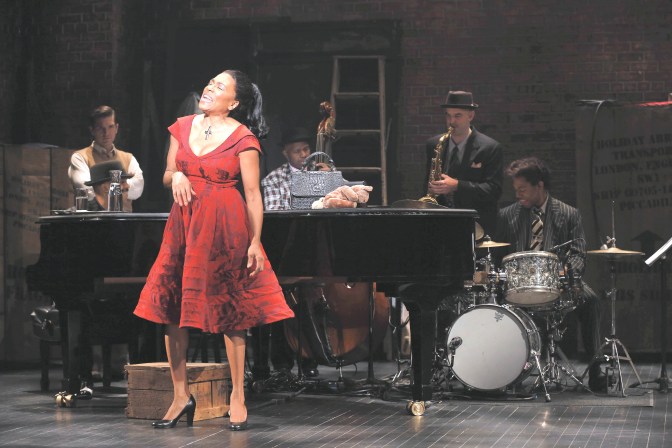
I always knew that Broadway was haunted. Apparitions of playwrights, producers, actors and famous characters skulk around theaters and are as eternal as the neon lights that electrify the Great White Way. Each season we are revisited with the ghosts of productions past, but this fall two New York City theaters are being visited by the spirits of iconic vocalists past. On Broadway, Janis Joplin and her musical influences rock The Lyceum Theatre from floor to roof, and Off-Broadway the music of one of her influences is receiving its day. Lady Day, the musical about Billie Holiday, provides its audience with a stunning visual and aural lesson in tragedy and triumph.
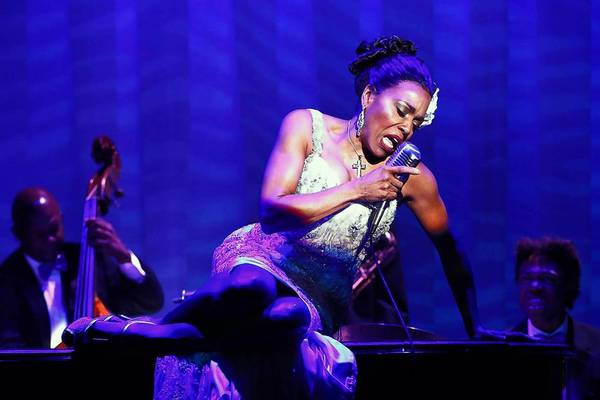 Anyone who has seen or read Lady Sings the Blues knows the calamitous story of Billie Holiday’s life. Overflowing with agonizing memories, abusive men and addiction, the pain Holiday experienced habitually showed in various aspects of her life – most often in her music. Her sound carried listeners through the valleys of the blues transforming agony into musical ecstasy. You don’t just hear Billie Holliday…you feel Billie Holiday, and that essence is fabulously represented in this production.
Lady Day is an overwhelming emotional tribute to the legacy of Billie Holiday. The musical takes place at a theater in London. Billie Holiday and her band are playing the final leg of her European tour. The first act consists of the rehearsal and the second act is the show. Woven between 25 of Holliday’s most famous songs is the recounting of her troubled life. Through music Billie tries to fight the demons haunting her in rehearsal, but winds up still fighting them during the show – something I suspect that happened repeatedly during her brief life. As Billie exposes her scars, the audience bears witness to an unflinching portrait of pain, but it is how her hurt is translated into song that makes this production shine – each song helps to build the story. Like Billie Holiday’s music, this production burrows underneath the skin and lingers in the pit of your gut.
 The success of this musical is largely due to the performance of Grammy-winner Dee Dee Bridgewater. She plays the role of Billie Holiday as if she is possessed and her voice is spot-on. I have never heard anyone capture the timbre of Lady Day as she has. Bridgewater is simply amazing; you won’t be able take your eyes off of her. And you won’t soon forget Lady Day the musical. All artists are tasked with the frightening aspect of revealing their souls to the scrutiny of the masses, but there is something in the way a jazz musician does it that is undeniably raw and palpable. Billie Holiday’s voice was an instrument that could rival the bent notes and artistry of any of the jazz greats. She was the voice of her time. Her influence can still be heard in singers today.
A good story and good music will always yield promising results. It is as simple as saying one plus one equals two. At The Little Shubert Theatre, the life of Billie Holiday (which includes her music) and the brilliant showcasing of Holliday’s work (courtesy of Dee Bridgewater) make for compelling theater and two good reasons to see this show.
Photos: Carol Rosegg
William Kentridge’s The Refusal of Time On Display At The Met
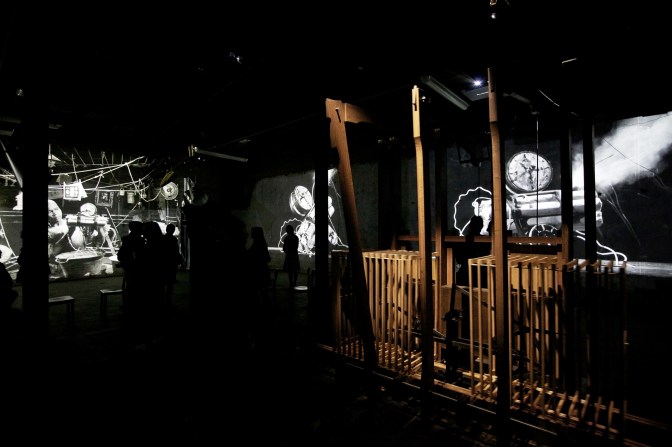
In a joint acquisition with the San Francisco Museum of Art, The Metropolitan Museum of Art premiered William Kentridge’s The Refusal of Time (2012) on October 22; the exhibit will run through May 11, 2014. A five-channel installation is billed as “a thirty-minute meditation on time and space, the complex legacies of colonialism and industry, and the artist’s own intellectual life.” Kentridge was born in 1955 in Johannesburg, South Africa where he still lives and works.
The Met will host three Gallery Talk events in conjunction with this exhibit. The dates are as follows:
Saturday, January 4, 2014, 11:00 a.m.–12:00 p.m.
Sunday, January 5, 2014, 11:00 a.m.–12:00 p.m.
Saturday, February 22, 2014, 11:00 a.m.–12:00 p.m.
Gallery Talk is free with Museum admission
Photo: Henrik Stromberg
Video: Antonio Limonciello
F.A.M.E NYC Remembers Lou Reed
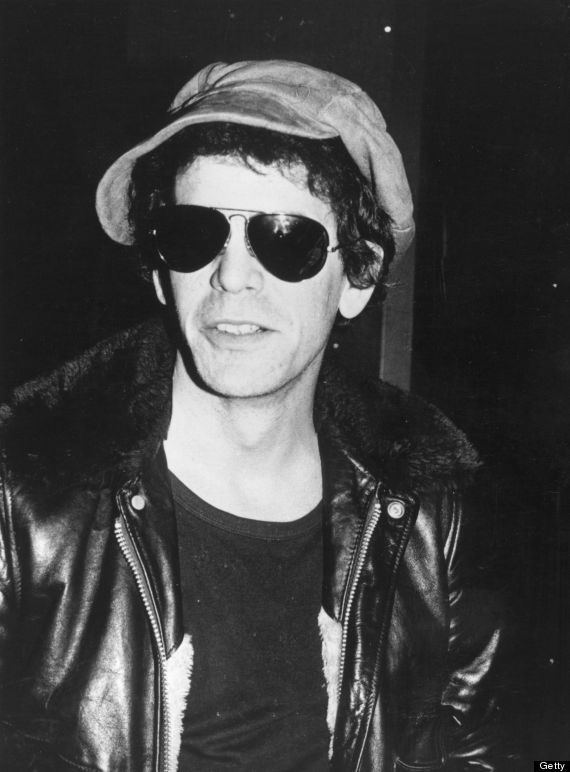
My earliest memory of Lou Reed was hearing his music and saying, “I wanna write like that.” His voice…his poetry – it’s artistic perfection. When I heard of Lou Reed’s passing, I was devastated. We want our artistic heroes to be immortal but our flesh doesn’t work that way. It wrinkles, it ages, it fades and dies. Thankfully we have his music, brimming with energy and moments accompanied by sound. I would like to share some of my favorite Lou Reed songs. After all his music tells his story better than I ever could. RIP Lou Reed!
Photo: Getty

Hurricane Sandy One Year Later
Last year this time I had no electricity. I was disconnected from family, friends and the entire world. I was on the road maneuvering around downed trees and power lines, searching for non-perishable food to feed my parents and myself as well as gas to feed my vehicle. Anxiety was starting to settle in; my gas gauge was at a quarter of a tank and I had no idea when the gas trucks would arrive. Darkness was descending and my Blackberry’s battery life was dwindling. It had been a long time since I had been frightened on Halloween. I felt as if I was starring in my own post-apocalyptic drama.
When Sandy hit the NYC-Metro area I, like many others, was ill-prepared. I heard the warnings but I didn’t take them seriously. I didn’t run out and stock up on canned goods, candles and water. This is NYC and New Jersey I thought, we’ll be fine. Around 8:30 that evening my home went dark. From my windows I watched the transformers blow one by one, sparking electric flashes of blue light. One by one I watched as the surrounding blocks and homes in my neighborhood lost the life source of the 21st century. As I stared into the candlelight illuminating my bedroom, wondering what time it was, I was suddenly humbled by the tremendous power of Mother Nature. Two days after Halloween, the lights in my house came back on and I was able to view the full devastation of what Sandy had left in her wake. I was thankful that Sandy only cost me a few days of inconvenience, but horrified and saddened to see and hear the stories of those who had lost everything.
As the anniversary of Hurricane Sandy approached a feeling invaded the air, it was almost palpable. A year later and many of us have had the opportunity to go back to normal. For some the ghost of Sandy still lingers, still possessing a stranglehold on their lives. Recovery is slow going but I stand firm in the belief that those who were severely affected by the storm will receive the resources necessary to rebuild. One thing I know about this area is we may get knocked down, but we get back up better than before.
Photo: Getty
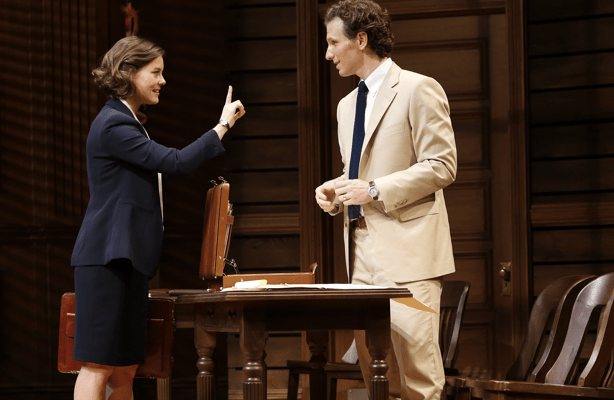
John Grisham’s A Time to Kill Is Broadway Ready
A Time to Kill has been captivating audiences for over 20 years. The novel, which eventually became a best-seller, was first published in 1989. In 1996, Matthew McConaughey, Sandra Bullock, Samuel L. Jackson and Kevin Spacey starred in the film version. Adapted for the stage by Tony award-winning playwright Rupert Holmes, A Time to Kill explores the undercurrent of race in our justice system. A 10-year-old black girl is savagely raped, beaten, almost lynched and left for dead. The two perpetrators are shot and killed at the courthouse by the girl’s father, Carl Lee Hailey. Hailey is arrested and charged with first degree murder sparking tensions that had bubbled underneath the surface of a Mississippi town and subsequently gained nationwide attention. Hailey hires Jake Brigance, a white attorney, as his defense lawyer. Receiving advice from his disbarred mentor and much needed assistance from a pushy Bostonian intern, Jake begins to build an insanity defense for Carl Lee, while receiving death threats from Ku Klux Klan. In court he tangles with Rufus R. Buckley, a superstar district attorney on his way to the governor’s office. And while explosions erupt in and out of the courtroom, Jake uses an impassioned plea to get the jury to acquit Carl Lee.
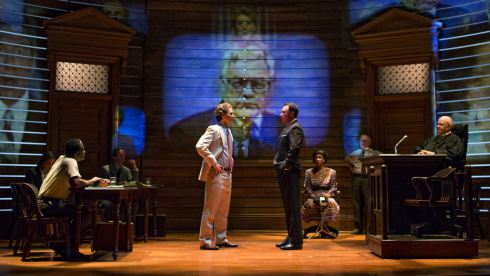 The plot of A Time to Kill is well-known, it’s robust and meaty. I liken Rupert Holmes’ A Time to Kill to a fillet – some parts are stripped away but there is still enough meat for the audience to sink its teeth in. The actors of this production had some pretty large shoes to fill considering some of the biggest names in Hollywood performed these characters on screen; the comparisons to the actors of the film are inevitable. Led by Sebastian Arcelus, who plays Jake Brigance, each member of this cast turn in a fair performance. Veterans Tom Skerritt and Fred Dalton Thompson offer great portrayals of Lucien Wilbanks and Judge Omar Noose. Skerritt was as charming as ever as Lucien and Thompson’s feisty Judge Noose was a pleasure to watch, however it’s still the relationship between Jake Brigance and Carl Lee Hailey that drives this story. Sebastian Arcelus and John Douglas Thompson showed promise as Jake and Carl Lee.
A Time to Kill received negative reviews when it played in D.C. in 2011, but the creative team appears to have worked out some of the kinks and the Broadway version is more solid. Whether you have read the novel or saw the movie, this adaptation of A Time to Kill ultimately provides its audience with a thought-provoking experience and is a good addition to the legacy of one of John Grisham’s most recognized stories.
VIVA JANIS!
Holy revival Batman! There is a nightly resurrection going on every night at The Lyceum Theatre. In an era when rock titans such as Jimi Hendrix and Jim Morrison walked the earth and groups like The Who asked to die before they got old, a little lady from Texas with extraordinary chops offered up pieces of her heart and become just as legendary as the boys –her name was Janis Joplin.
 Janis Joplin was born in Port Arthur, Texas in 1943. She was raised in a cocoon of various musical influences courtesy of her mother and father. When she finally did spread her wings, she flew to San Francisco in 1963. She briefly returned to Texas only to go back to California in 1966 to join Big Brother and the Holding Company as their lead singer. By the time of Joplin’s untimely death in October 1970, she had ensured her legacy as a rock goddess and with her unique interpretation of songs, one of the most recognizable voices ever.
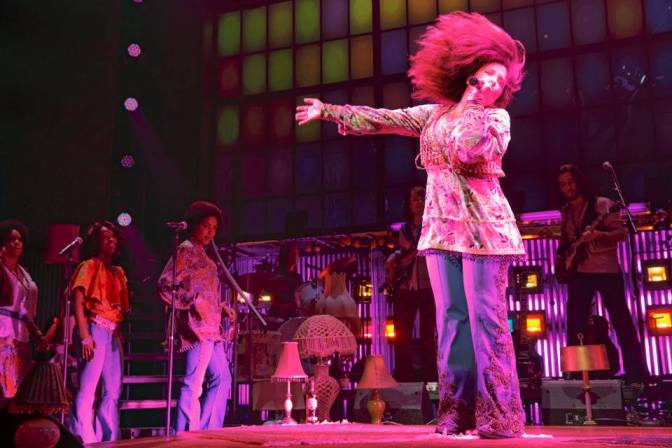
I don’t think the world needed any reminders about the raw power and beauty of Janis Joplin’s voice, but in case it did A Night with Janis Joplin served a stunning aide-mémoire. This production is a hot rocking time capsule. Once it starts the audience is shuttled back to the Age of Aquarius with one of its most colorful figures as mistress of ceremonies.
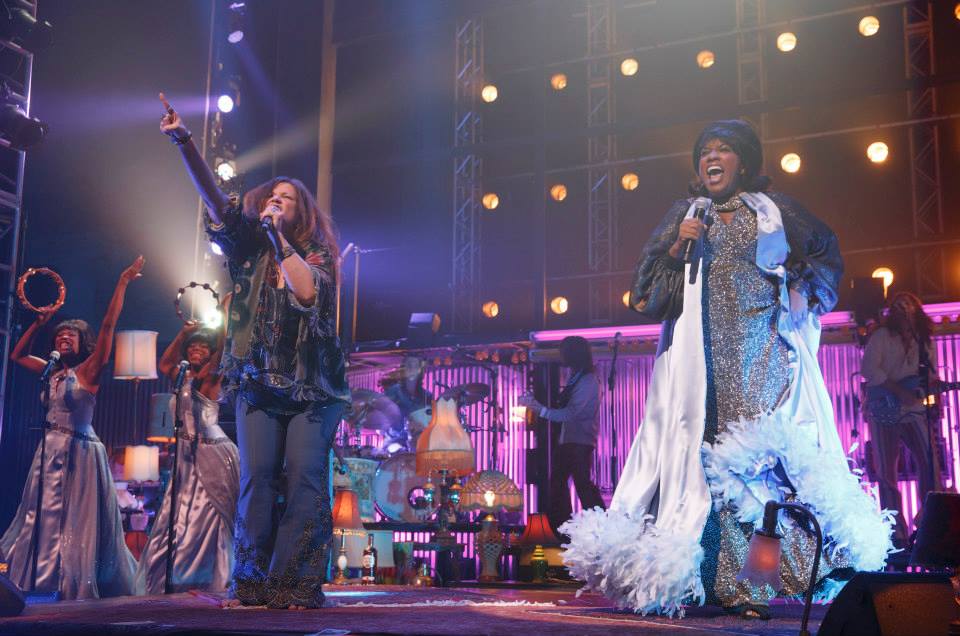 I expected A Night with Janis Joplin to typical a jukebox musical chronicling the highs and lows of Joplin’s life with the musical numbers accentuating the book. I was pleasantly surprised. A Night with Janis Joplin is more like a concert and is all about the music, mainly the singers that influenced Joplin’s sound – singers like Nina Simone, Bessie Smith and Etta James. Even the Queen of Soul was present to do a number with Janis that injected everyone in the audience with the spirit. Mary Bridget Davies is nothing short of phenomenal as Janis Joplin, it’s like she comes from another plane. For an individual who didn’t get the opportunity to experience Janis Joplin when she was alive, Davies’ performance is awe inspiring. Taprena Michelle Augustine, De’Adre Aziza, Allison Blackwell and Nikki Kimbrough round out the cast of ladies on stage playing The Joplinaires as well as The Chantels, Bessie Smith, Nina Simone and Aretha Franklin –their voices soar to right out of the theater and up to heaven.
A Night with Janis Joplin is a loving tribute to music of the Pearl and the strong, mainly unsung women that inspired her. There was never a point in the show where I wanted to be contained in my seat, my feet never stopped tapping. I wanted to sway, shake and move in the aisle and enjoyed watching the audience becoming part of the show and singing along. Hearing “Me and Bobby McGee”, “Ball and Chain” and “Stay with Me” performed live brought me to tears. Mary Bridget Davies doesn’t just sing she performs a séance. A Night with Janis Joplin is a prime example of how music can transport and uplift the soul. It’s a must see.
Photos: Joan Marcus

Rare Torah on Display at The Met
Beginning October 1, The Met debuts a rare 15-century handwritten copy of the Mishneh Torah by the renowned medieval scholar Moses Maimonides. The work will be showcased in The Lawrence A. and Barbara Fleischman Gallery of Late Medieval Secular Art among other 15th-century works from Europe and will remain at The Met through January 5, 2014.
Created in Northern Italy around 1457 by Marco Barbo, Bishop of Treviso, the Hebrew text includes the eight final books of the Mishneh Torah, or “Repetition of the Law,” the first systematic collection of Jewish law. Amassed between 1170 and 1180 by rabbi, physician, and philosopher Moses Maimonides, the Mishneh Torah is organized by subject matter and contains six large painted panels decorated in exquisite pigments and gold leaf and 41 smaller illustrations with gold lettering decorating the opening words of each chapter.
The beautifully adorned text was acquired jointly by The Metropolitan Museum and The Israel Museum in Jerusalem in April. Prior to its presentation at the Metropolitan, the manuscript underwent restoration at the Israel Museum, where it has been on long-term loan since 2007 and on view to the public since 2010. The Mishneh Torah was purchased for The Israel Museum by René and Susanne Braginsky, Zurich; Renée and Lester Crown, Schusterman Foundation and Judy and Michael Steinhardt. It was purchased for The Metropolitan Museum of Art with Director’s funds and Judy and Michael Steinhardt Gift.
Videos
Galleries

This gallery contains 20 photos.

